
Montrose, Angus
On 26 February 1913, the Royal Flying Corps opened its first operational military aerodrome in the United Kingdom, and the place they chose was Montrose. The town sits on the Angus coast between two river mouths, a former royal burgh that had spent the previous eight centuries trading hides and cured salmon out of its natural harbour. Now it traded altitude. By the Second World War, pilots from Poland, Czechoslovakia, France, America, Russia and across the Commonwealth were training in its skies, flying Hurricanes and Spitfires on sorties over Norway and home defence runs above Edinburgh. The Germans noticed and bombed the town more than once. None of that is what most people remember Montrose for now. Most people remember the dog.
The Sea Enriches, The Rose Adorns
David I founded Montrose around 1140 as Sallorch, a charter scribbled into existence on the strength of a good natural harbour at the mouth of the South Esk. The name evolved into Munross by 1178, then settled into Montrose. Folk etymology turned it into the Mount of Roses, and the town's motto leans into the legend: Mare ditat, rosa decorat, the sea enriches, the rose adorns. The reality was less floral. Danes plundered the place repeatedly. Edward I of England turned up during the Wars of Independence with thirty thousand men and, by some accounts, stripped King John de Balliol of his royal insignia inside Montrose Castle, an act of public humiliation that other sources locate at Brechin. The castle was destroyed by a storm not long after.
The 220-Foot Steeple and the Gable-Enders
The skyline today is dominated by the 220-foot steeple of the Old and St Andrew's Church, designed by James Gillespie Graham and finished between 1832 and 1834. The wealthy merchants who built eighteenth-century Montrose did something peculiar: they put their grand houses gable-end to the street rather than facing it broadside, so the locals became known as gable-enders. The High Street remains improbably wide, leading down to picturesque closes where secret gardens still hide behind stone. Just outside town stands the House of Dun, designed by William Adam and built in 1730 for David Erskine, 13th Laird of Dun. Provost Alexander Christie oversaw something even more remarkable: the establishment of Scotland's first lunatic asylum here in 1781, founded by Susan Carnegie of Charleton, treating paupers and private patients alike, and surviving as Sunnyside Royal Hospital until 2011.
Bamse, the Norwegian Sea Dog
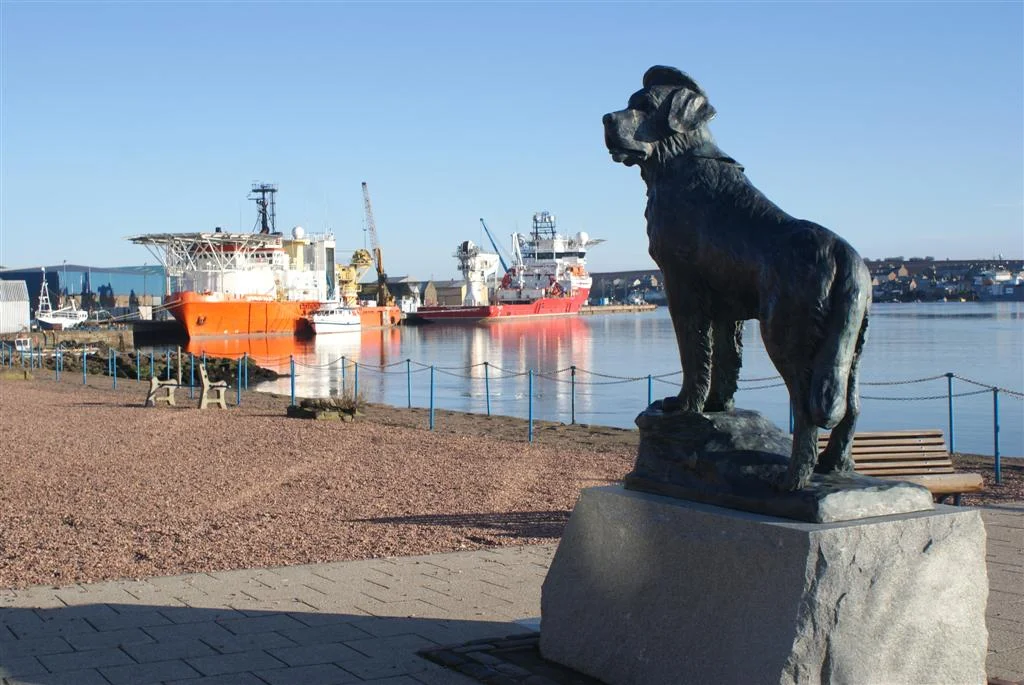
The bronze statue at the harbour shows a St Bernard standing watch, and the dog had a name and a story that locals will tell you if you ask. Bamse, which means teddy bear in Norwegian, arrived in Montrose during the Second World War aboard the Royal Norwegian Navy minesweeper Thorodd, with Captain Erling Hafto, his owner, who had registered him as crew. Bamse stood over six feet on his hind legs. He broke up sailor fights in dock pubs. He travelled unescorted on the buses to round up crew members late returning from outlying drinking houses. He saved the life of Lieutenant Commander Olav Nilsen at Dundee Docks. He once clamped his paws on a knife-wielding assailant and ended the matter. When Bamse died in July 1944, Montrose schools closed and 800 children lined the route of his funeral. On 17 October 2006 the Duke of York unveiled the statue, paid for by donations split evenly between Scotland and Norway.
The Basin and the Beach
Just west of town the South Esk widens into Montrose Basin, the largest inland saltwater basin in the United Kingdom, a tidal lagoon nearly three miles across and a designated nature reserve of international importance. In October and November some 38,000 birds use it. Ospreys hunt the shallows in summer. Kingfishers flash past. The mute swan population is significant enough that conservationists consider this one of its most important British habitats. East of town the Blue Flag beach stretches for three miles of sand, though it is losing the contest with the sea. Erosion has carried away substantial stretches of dune; in November 2023 Storm Babet tore three metres off the beach in a single night, collapsing the promenade walkway. The Save Our Sands campaign has been arguing for serious coastal protection since 2009.
GSK and the Old Pretender
The biggest employer in Montrose today is GlaxoSmithKline, which makes active ingredients against HIV and other conditions at its plant on the north side of town; the plant was saved from closure in 2006. The pharmacy is a long way from the smuggling of the eighteenth century, when Montrose was a major centre for goods coming in under the customs officers' noses. The town's most famous fugitive was James Francis Edward Stuart, the Old Pretender, who spent his last night on Scottish soil here on 4 February 1716 before sailing to French exile after the failure of the 1715 Jacobite rising. Thirty years later, in February 1746, the largest naval engagement of his son Charles Edward Stuart's war would be fought in Montrose Harbour itself.
From the Air
Montrose sits at 56.71 degrees north, 2.47 degrees east on the Angus coast between the mouths of the North and South Esk, with the Montrose Basin tidal lagoon clearly visible just west of the town. The high steeple of the Old and St Andrew's Church (220 feet) is a useful landmark from the air. Nearest major airport is Aberdeen (EGPD) approximately 30 nautical miles north; Dundee (EGPN) lies about 25 nautical miles south-southwest. The site of the former RAF Montrose (the first British military aerodrome, opened 1913) lies just west of the town. Coastal weather can shift quickly; haar (sea fog) is common in summer.
Nearby Stories
- Lochnagar 5 km away
- Lindores Abbey 9 km away
- St Andrews Cathedral Priory 13 km away
- Blairgowrie and Rattray 15 km away
- Crathes Castle 17 km away
- River Dee Ferryboat Disaster 21 km away
- Girdle Ness Lighthouse 50 km away
- Eyemouth Disaster 59 km away