
Montrose (Scotland)
Pull into Montrose station from the south and the basin slides into view on the right: a tidal lagoon almost three miles across, ringed by salt marshes, dotted with wading birds, and so wide that on a still morning the water mirrors the sky in two perfect blue halves. The train slows. The town comes into focus on a low rectangle of land between two river mouths, a Hanseatic harbour that medieval Europe knew well and modern shipping mostly bypassed. About 11,200 people live here now. The buses still run hourly down the coast to Stonehaven and Aberdeen. The Caledonian Sleeper from London Euston deposits its early-rising passengers around 7 in the morning, blinking onto the platform with the basin reflecting back at them.
What The Port Outgrew
Montrose was an important harbour in medieval and Hanseatic times, trading with northern Europe long before Aberdeen swallowed up the regional shipping business. Modern vessels grew too big for it. The port could have died gracefully. Instead it adapted: fishing boats still go out, and support vessels for the North Sea oil and gas industry tie up at the quays. The pharmaceutical giant GSK became the town's biggest employer, manufacturing active ingredients against HIV and other conditions that are then shipped elsewhere for formulation. It is the kind of place that keeps finding ways to matter.
The Dog At The Bridge
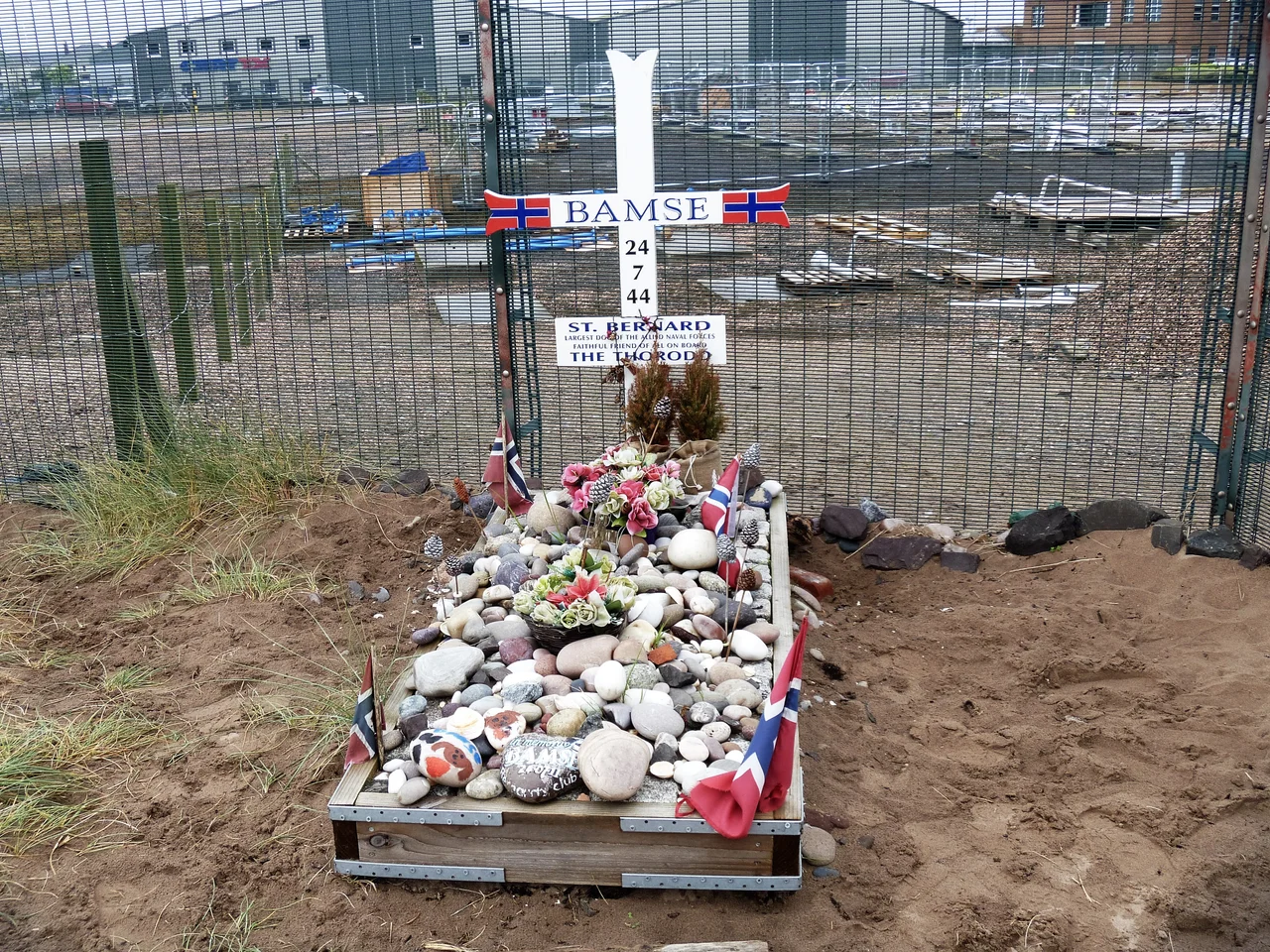
A bronze St Bernard stands guard at the bridge entering town, and the story behind the statue is so cinematic it is genuinely baffling that nobody has filmed it. Bamse, which means teddy bear in Norwegian, was an official crew member of the Thorodd, a whaling ship pressed into wartime use that escaped to Britain in 1940 when Norway fell. The Thorodd became a minesweeper working out of Montrose and Dundee, and Bamse became its self-appointed Shore Patrol. He broke up fights between his shipmates. He travelled unescorted on the buses to collect drunken crew members from outlying pubs. He pulled people out of the water. He once stopped a knife-wielding assailant by sheer mass. He died in 1944 at the age of seven and was buried with military honours, with crowds lining the funeral route. He became the symbol of Norwegian resistance. The travel writers tend to add that the only reason we have not heard of his work defusing bombs and cracking ciphers is military secrecy.
The Sculptor Who Withdrew
Walk a few minutes off the High Street and you find the William Lamb Studio at 24 Market Street, the workshop of a Montrose sculptor who briefly touched fame and then mostly hid from it. William Lamb (1893-1951) was scarred badly enough by the First World War that he became a recluse in his home town. Before the war damaged him, he sculpted the young Princess Elizabeth, the future queen, and that piece survives. The studio opens on an erratic schedule, typically the last Saturday of the month from February to June, when the Friends of William Lamb let visitors in. Elsewhere on the High Street, the Old and St Andrews Church opened in 1793, and the steeple that defines the town's skyline was added in 1834.
The Basin and What Lives In It
The Montrose Basin is the tidal lagoon formed by the estuary of the South Esk, lying along the west side of town, almost three miles in diameter, ringed by salt marshes. It is an important habitat for both resident and migratory birds, with the Scottish Wildlife Trust running a purpose-built visitor centre at Rossie Braes that offers good telescopic views. Curlews, redshanks, oystercatchers and pink-footed geese pass through with the seasons. The basin is one of the country's most significant wildfowl sites. Montrose Beach stretches long and sandy north of town, though dunes and golf course are losing ground to the sea each year. The Save Our Sands campaign has been arguing about the right response since 2009.
The Sights Around
Brechin sits about ten miles inland on the A90, where the eleventh-century round tower next to the cathedral is one of only two such Irish-style towers surviving in Scotland. Brechin City play football at Glebe Park, the only senior ground in Europe with a hedge along one of its perimeters. The Caledonian Railway runs steam trains four miles between Brechin and Bridge of Dun. The Angus Show fills Brechin Castle with livestock and tractors on the first Saturday in June, and the gardens of the castle itself open to the public for a few weeks in late spring. Closer by, the megalith called the Stone of Morphie stands three and a half metres tall up an unmarked lane half a mile west of the A92, with no record of its date. The Aberlemno Sculptured Stones, intricately carved Pictish monuments, lie southwest of Brechin near Forfar.
From the Air
Montrose sits on the Angus coast at 56.71 degrees north, 2.47 degrees west, between the mouths of the North and South Esk rivers. The tidal Montrose Basin lies immediately west of town, roughly three miles across, and is a useful navigation landmark from the air. The 220-foot steeple of the Old and St Andrew's Church marks the High Street. Nearest major airport is Aberdeen (EGPD) approximately 30 nautical miles north; Dundee (EGPN) lies about 25 nautical miles south-southwest. The A90 runs inland past Brechin, while the coastal A92 connects Montrose to Arbroath. Coastal haar can roll in suddenly in summer.
Nearby Stories
- Lochnagar 5 km away
- Lindores Abbey 9 km away
- St Andrews Cathedral Priory 13 km away
- Blairgowrie and Rattray 15 km away
- Crathes Castle 17 km away
- River Dee Ferryboat Disaster 21 km away
- Girdle Ness Lighthouse 50 km away
- Eyemouth Disaster 59 km away