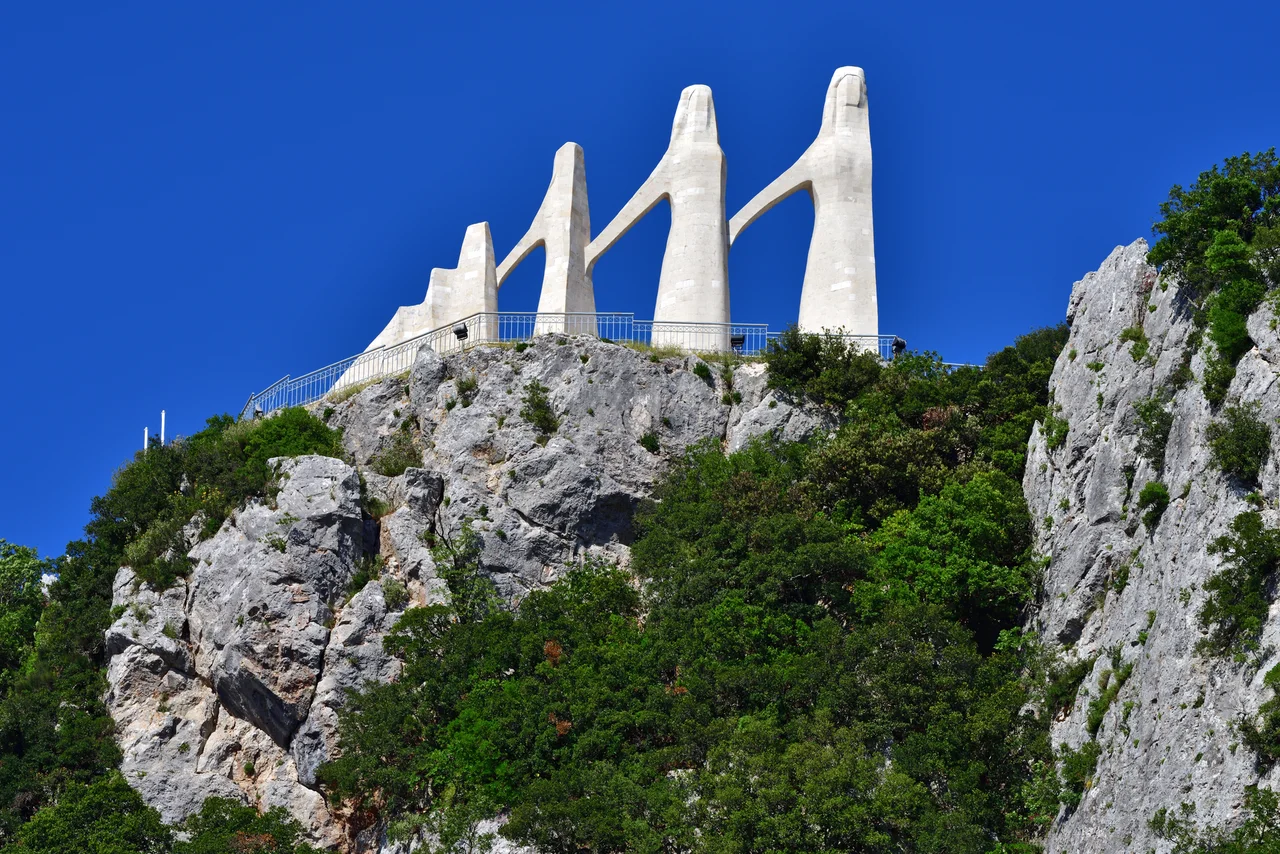

Monument of Zalongo
The 410 steps begin at the Saint Dimitrios Monastery, at 590 meters altitude, and climb a cobbled lane through scrub and silence to the summit of Mount Zalongo. At the top, at 700 meters, six abstract female figures stand holding hands in a chain that reaches 18 meters across the clifftop. They are made of concrete, supported by more than four thousand limestone blocks. They have no faces. They are George Zongolopoulos's answer to the question of how you represent something that cannot be represented — the choice made by women and children on this mountain in December 1803.
The Sculptor and His Task
George Zongolopoulos (1903–2004) was one of the most significant Greek sculptors of the twentieth century, a man who went on to represent Greece eleven times at the Venice Biennale and whose work defined Greek modernism across six decades. But in the early 1950s, when the competition for the Zalongo monument was announced, he was still building his reputation. The national contest was launched in May 1953, after Preveza schoolteacher George Sakkas had first proposed the idea in 1950 and a fundraising drive — run largely through Greek schools — had gathered 500,000 drachmas. The examination board considered proposals from architects and sculptors across the country. Zongolopoulos won, paired with architect Patroklos Karantinos. Both offered their supervision without pay.
Building the Memorial
Construction began in July 1954. There were no paved roads to the summit, no cranes. Every bag of sand, every load of gravel, every limestone block — 4,300 of them, each measuring 40 by 30 by 25 centimeters — was carried up by hand, until an improvised hoisting mechanism could be rigged. Each spring and summer for six years, Zongolopoulos and his wife, sculptor Eleni Paschalidou-Zongolopoulou, traveled by military vehicle to the mountain and worked for three or four months at a time. Citizens from the nearby village of Kamarina helped. Greek military forces helped. The marble craftsman Eleftherios Giftopoulos oversaw the technical stonework. The result — six figures, 13 meters high, arms linked across 18 meters of clifftop — was unveiled on June 10, 1961, with political and religious leaders in attendance. The inscription on the east base names the three men responsible for building it. It does not name the women it was built to honor.
What the Figures Say
Zongolopoulos chose abstraction deliberately. The six forms are not realistic women; they are not weeping or dramatic or posed for effect. They hold hands and they face outward and they offer nothing that can be called comfort. The choice of abstraction was important in 1961, when Greek official culture tended toward the heroic and monumental, and it remains important now. The monument does not tell you how to feel. It stands at the edge where the women stood, and it asks you to reckon with the place itself. From the clifftop, on a clear day, the Ionian Sea is visible to the west and the Ambracian Gulf glitters to the southeast. The distance to the ground below is the kind that makes the choice, whenever you think about it clearly, almost impossible to hold in your mind.
A Living Place of Memory
Around 30,000 people climb the 410 steps every year. The municipality of Preveza organizes the Zalongeia — a celebration held each summer in the central square of Kamarina, the village at the mountain's foot. Between 2008 and 2013, the municipality worked with the George Zongolopoulos Foundation to restore and maintain the monument, which faces the particular challenge of standing exposed on a cliff edge at 700 meters in all weathers. The monument's survival through more than six decades is itself a kind of statement: the community below kept climbing the steps, kept raising the money, kept caring for the concrete and limestone on the summit. Some places are held in place not by permanence but by continued attention.
From the Air
The Monument of Zalongo stands at 39.1485°N, 20.6843°E, at 700 meters altitude on Mount Zalongo in the Preveza regional unit. The six white concrete figures are visible from the air at low altitudes — look for the clifftop site above the village of Kamarina. The nearest airport is LGPZ (Aktion National Airport, Preveza), approximately 25 kilometers to the south-southwest. Best viewed from the northwest at 2,000–4,000 feet, where the cliff face and the sculpture's silhouette against the sky are most distinct. The Ionian coastline and the lagoon north of Preveza are visible landmarks to the south.
Nearby Stories
- Castle of Santa Maura 13 km away
- Battle of Olpae 19 km away
- Achilleion (Corfu) 24 km away
- Dodona 27 km away
- Stratos 28 km away
- Corfu 56 km away
- Meteora: The Monasteries Built on Impossible Pillars 60 km away
- Hellenic Trench 117 km away