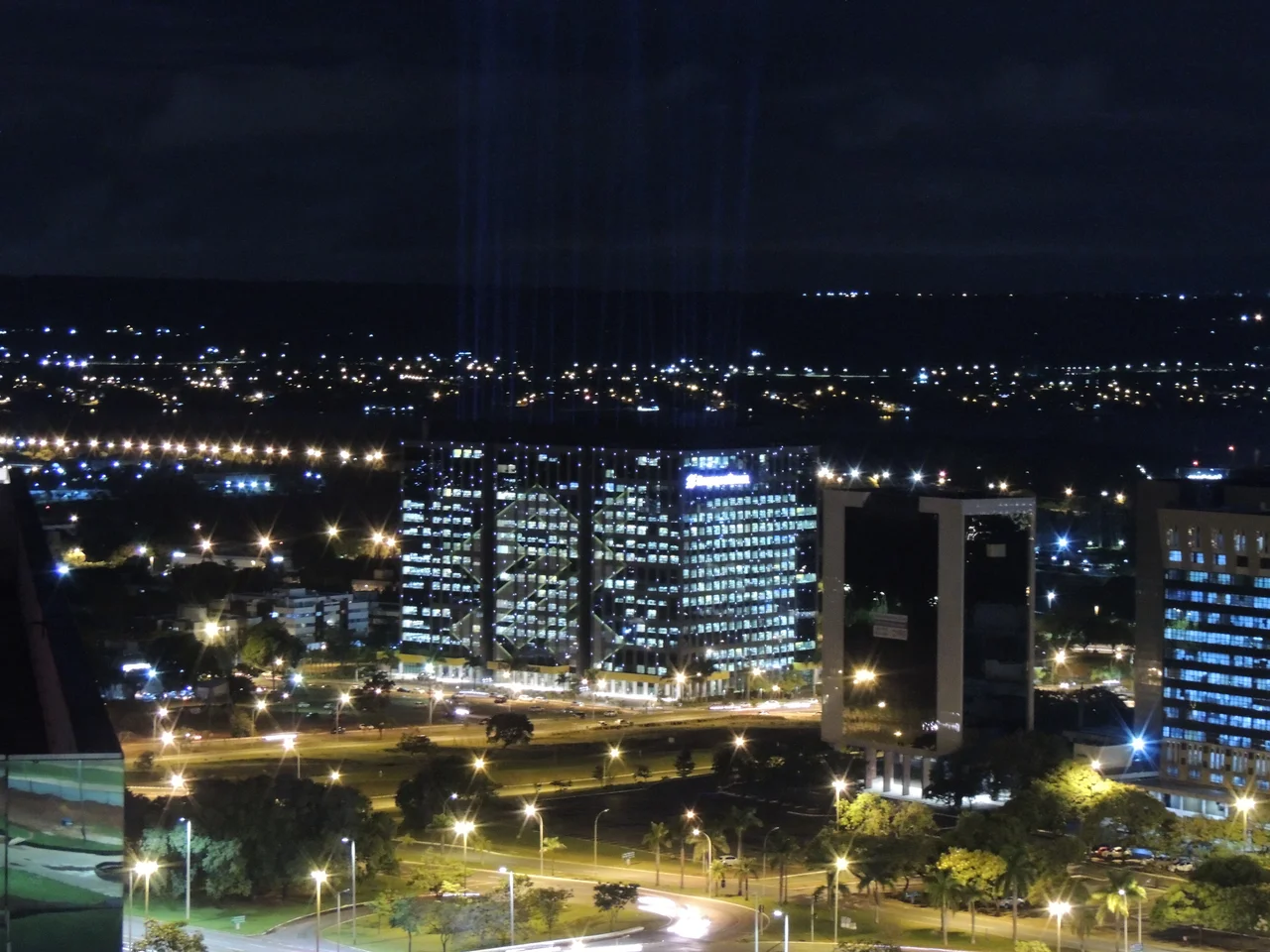

Monumental Axis
In 1957, when Lucio Costa submitted the design that would become Brasilia, he described its founding gesture as a cross - the primary mark of someone claiming a place. The two axes of that cross became the city's skeleton. One curved into a residential arc; the other stayed straight, and Costa called it the monumental axis of the system. That straight line is the Eixo Monumental: sixteen kilometers of ministries, museums, palaces, and pavement that run from the bus and railway terminal at one end to the Praca dos Tres Poderes at the other. On a flat red plain where nothing had stood before, Brazil drew a diagram and filled it in.
The Architect's Cross
Costa's entry for the 1957 competition was a hand-drawn sketch and a short explanatory report. He explained in item 1 of the report that he began with a cross - a primary gesture of taking possession of a place - and went from there. He curved one arm of the cross into a residential axis meant for 'everyday, bucolic life.' The other he left straight and declared it 'the monumental axis of the system,' naming the avenue for the first time. The two were meant to be opposites that completed each other. One axis for home, one axis for state. The airplane shape that most Brazilians now associate with the plan - Costa never intended it. The cross came first; the silhouette people saw in it came later. The term Plano Piloto was not even Costa's invention, but a generic term for modernist urbanism he borrowed to name his plan.
The Mall, Brasileiro Style
Costa thought of the monumental axis as a mall in the American or British sense - an open ceremonial space flanked by monumental architecture. His written inspirations ran through London's Piccadilly Circus, New York's Times Square, Paris's Champs-Elysees, and the National Mall in Washington. What he actually produced bears only a loose family resemblance to any of them. The first section, known as the Esplanada dos Ministerios, is lined with identical boxy ministry buildings on both sides - a modernist repetition that turns bureaucracy into composition. Further along, Oscar Niemeyer's white curved monuments punctuate the avenue: the Cathedral, the National Congress with its twin towers and opposing domes, the Three Powers Square at the far end. It is a city laid out as a single legible argument.
The Widest Road Myth
Brasilia loves its urban legends, and the persistent one about the Monumental Axis is that it is the widest road in the world, where 'between 100 and 160 cars can drive side by side.' This is not true. The road consists of two parallel twelve-lane avenues - six in each direction - separated by an enormous grass median. That median is what actually earned a Guinness Book of Records listing: the widest median strip of a highway in the world. Which is technically a distinction, if not the one people usually claim. Drive the full sixteen kilometers and the sense is less of speed than of passage through a ceremonial corridor, the government buildings standing back from the road on both sides as if at attention.
The Day Half a Million Came
The axis occasionally gets used for its intended purpose as a civic stage. On April 21, 2008 - the 48th anniversary of Brasilia's founding - the Mexican pop group RBD played a free concert on the Monumental Axis to a crowd estimated at 500,000. It was the largest audience the group had ever performed for, and it was recorded and released as the DVD Live in Brasilia, a year before the group formally broke up. Half a million people, spread out across the Esplanada and the Eixo Monumental, watching pop music in a space originally designed for the passage of state. Costa probably did not envision that. The Champs-Elysees probably did not either. But a ceremonial axis, once built, attracts whatever ceremony the culture has to offer.
Unfinished Business
The axis is not complete. Costa's plan called for a Cultural Complex of the Republic near the western end, a gathering of cultural institutions that would match the gathering of governmental ones near the eastern end. What has actually been built is the National Museum and the National Library - two white Niemeyer forms facing each other across a plaza. The intended symphonic concert hall, opera house, chamber-music auditorium, and one or two other cultural buildings have never been built. The Eixo thus remains, in a sense, in draft - a modernist diagram that has been mostly but not entirely realized. In 1960 Brazil set out to build a capital from nothing in three and a half years. The Monumental Axis is what that hurry produced, still being finished in slow increments, still the most legible urban idea in Brazilian architecture.
From the Air
Located at 15.79 S, 47.90 W in Brasilia, the capital of Brazil. The Monumental Axis runs east-west for approximately 16 kilometers through the center of Brasilia's Plano Piloto, clearly visible from the air as a straight ceremonial boulevard with a wide grass median. The National Congress towers mark the eastern end at the Praca dos Tres Poderes; the Rodoferroviaria bus and rail terminal marks the western end. Brasilia-Presidente Juscelino Kubitschek International Airport (SBBR) is approximately 12 km south. Best viewed in clear conditions - the axis aligns with the setting sun in late July.
Nearby Stories
- Valparaíso de Goiás 7.8 km away
- Formosa, Goias 26 km away
- Pireneus State Park 36 km away
- Planaltina, Goiás 40 km away
- Anápolis 59 km away
- Unaí 73 km away
- Ceres, Goiás 117 km away
- Mambaí 181 km away