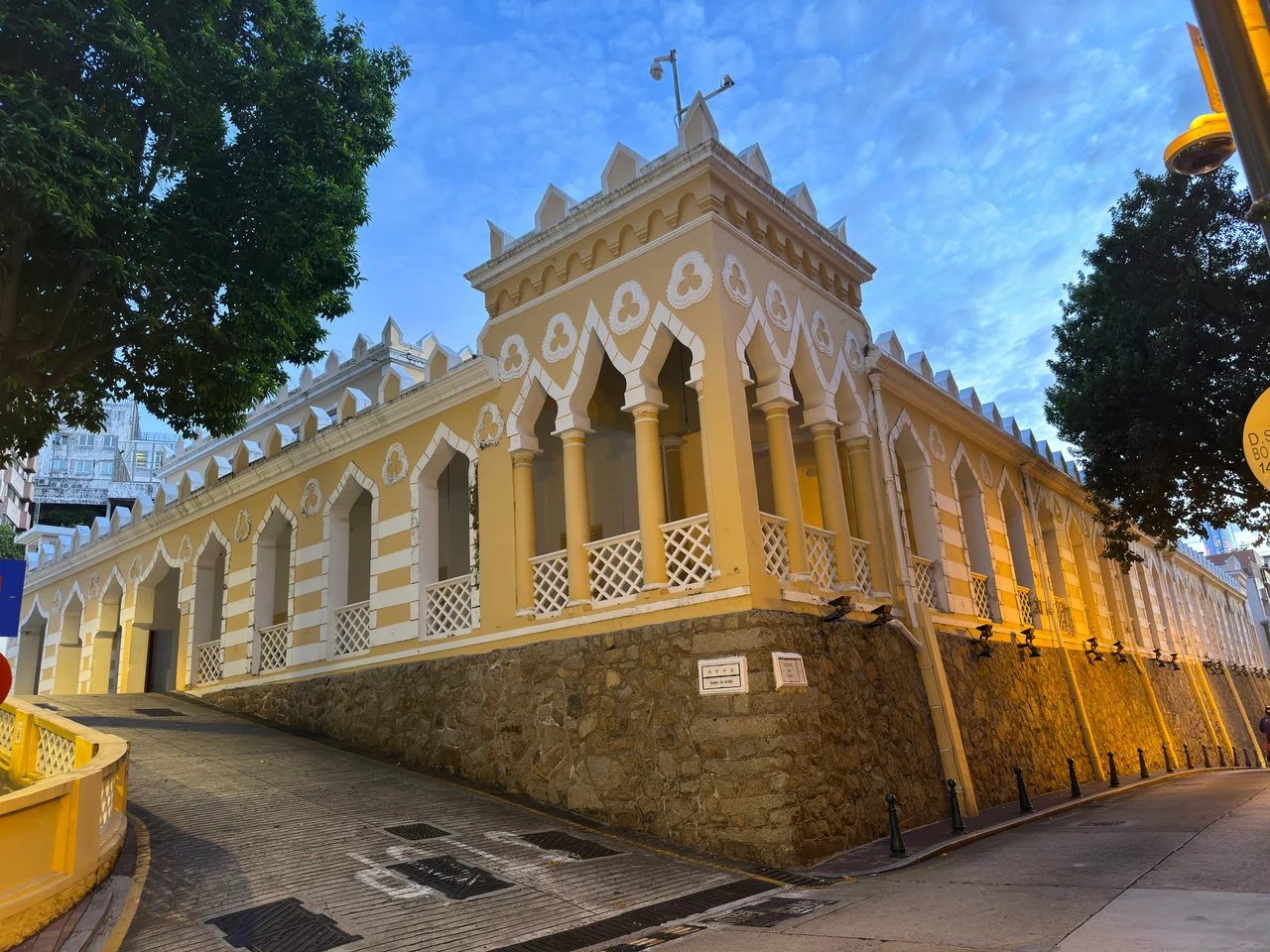

Moorish Barracks
In August 1874, a regiment of soldiers arrived in Macau from Goa — part of the Indian subcontinent that had been under Portuguese rule since 1510. They needed somewhere to be housed, and what was built for them is one of the more unexpected buildings in a city full of unexpected buildings. The Moorish Barracks was designed by an Italian architect, built with brick on the slope of Barra Hill, finished in yellow and white, and styled with elements of Mughal architecture — the ornate Indo-Islamic tradition of northern India. The name, the style, the soldiers, the architect: every element of this building arrived from somewhere else, assembled in a corner of China by an empire that spanned three continents.
A Regiment from Goa, a Style from the Mughal Courts
Portuguese India centered on Goa, and Goa had been under Portuguese administration since Afonso de Albuquerque seized it in 1510. By the 19th century, Goa provided soldiers, administrators, and laborers to Portuguese outposts across Asia and Africa. The regiment accommodated at Mong-Há and at the Moorish Barracks in Macau was part of this network. The architect assigned to design the barracks reached into the visual vocabulary of the subcontinent rather than Portugal: Mughal architecture, the tradition that produced the Taj Mahal and the Red Fort, with its characteristic arches, decorative symmetry, and the particular quality of weight and grace that defines the style. Built along 67.5 meters of frontage, 37 meters deep, the barracks rises to two stories at the rear and one story along most of its length — a practical asymmetry dictated by the slope of Barra Hill.
From Soldiers' Quarters to Port Authority
The barracks served its original military purpose for about three decades. In 1905, the building was converted into the headquarters of the Macau Port Authority — a repurposing that traded soldiers for harbor administrators but left the architecture intact. The transition makes sense given the location: Barra Hill overlooks the southwestern tip of the peninsula and the entrance to the Inner Harbour, exactly the kind of elevated, water-facing site from which a port authority would want to operate. The building continued in this administrative role through the colonial period and into the post-handover era, eventually becoming the headquarters of the Marine and Water Bureau. The Mughal arches and the yellow-and-white exterior have outlasted every regime that has occupied the building.
Heritage Status and What It Means Here
In 2005, the Moorish Barracks was designated as one of the historic sites of the Historic Centre of Macau, the UNESCO World Heritage property that encompasses 25 buildings and sites on the peninsula. The designation recognizes what the building represents: not just Portuguese colonial architecture, but the specific cross-cultural complexity that makes Macau architecturally unlike anywhere else in the world. A Mughal-influenced building designed by an Italian, built for Indian soldiers on a Chinese hillside under Portuguese authority — it is, in a single structure, an argument for the importance of place. The exterior restoration has kept the yellow and white palette that defines the building's appearance. Walking past it, you might not immediately read the Mughal references unless you know to look for the arches, but they are there, quiet and persistent.
Barra Hill and Its Neighbors
The Moorish Barracks stands in one of the densest concentrations of historic sites in Macau. A short walk in any direction brings you to the A-Ma Temple, the Maritime Museum, the Mandarin's House, and the narrow lanes of the Barra district where tile-faced Portuguese buildings lean over cobbled streets. The Inner Harbour is close enough to hear when conditions are right. This corner of the peninsula was the original Macau — the settlement that preceded the reclamations, the casinos, and the bridges — and the Moorish Barracks, still actively in use as a government building, is part of what keeps it alive. History in Macau is rarely cordoned off behind velvet ropes. It tends to still be working.
From the Air
The Moorish Barracks sits at 22.1874°N, 113.5326°E on the slope of Barra Hill at the southwestern tip of the Macau Peninsula, near the Inner Harbour waterfront. From the air at 2,000–3,000 feet, the southwestern point of the peninsula is easily identified — the Barra district's dense low-rise fabric and the visible waterfront of the Inner Harbour mark it clearly. The A-Ma Temple and Maritime Museum are within 300 meters to the south. Nearest airport: Macau International (VMMC) on Taipa island, approximately 3.5 kilometers southeast across the water. ICAO codes: VMMC (Macau International), VHHH (Hong Kong International, ~65 km northeast).
Nearby Stories
- 2024 Shenzhen Stabbing 0.8 km away
- Lantau Peak 1.5 km away
- Kweilin Incident 2.4 km away
- Taishan City 7 km away
- Wanshan Archipelago Campaign 38 km away
- Hong Kong 12 68 km away
- Battle of Nanpeng Island 82 km away
- Erhai Lake 1335 km away