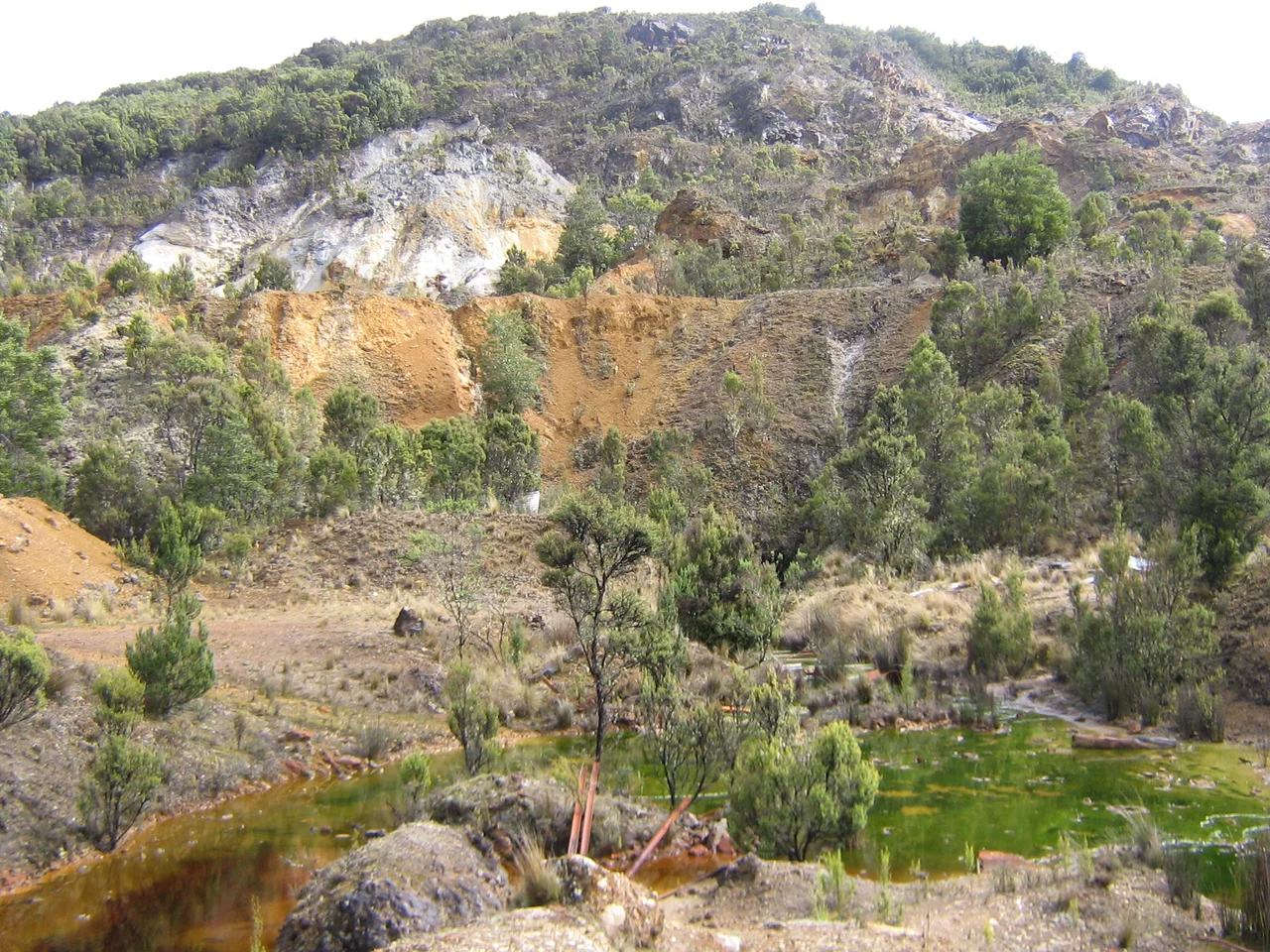

Mount Bischoff
James Smith had a reputation for thinking too much, and the nickname to prove it. "Philosopher" Smith, the other prospectors called him, half in mockery. But on 4 December 1871, philosophy paid off. Working the rain-soaked ranges of north-west Tasmania, Smith picked up a stream pebble heavy with tin oxide, traced the creek upward to its source, and stood at last on a mountain stuffed with one of the richest tin lodes the world had ever seen. Within two years a visiting expert pronounced Mount Bischoff the richest tin mine on Earth. He was not exaggerating.
The Philosopher's Hunch
Smith had wandered this country for years, reading its creeks the way others read scripture. The mountain itself already had a name, bestowed earlier in the century after James Bischoff, chairman of the Van Diemen's Land Company. What it lacked was anyone who understood what lay inside it. Smith did. Following his pebble of cassiterite up the watercourse, he found tin oxide near the summit in quantities that would underwrite Tasmania's economy for decades. The find set off a chain reaction: the wealth and confidence Mount Bischoff generated spurred the prospecting that uncovered the Mount Lyell copper at Queenstown, the silver of Zeehan, and the Renison Bell tin field. One stubborn man and one heavy stone rewrote an island's fortunes.
A Town at the Top of a Waterfall
To work the lode, a town had to be conjured from the bush. Waratah rose beside a waterfall, its stream diverted to feed the sluices that washed tin from the mountainside. The isolation was brutal; for months each year the track to the coast was nearly impassable. Yet Waratah became a place of startling modernity. In June 1883, the mine installed one of the first hydro-electric generators in Australia, lighting the offices, workshops and manager's house. Three years later, in 1886, Waratah became the first town in Australia lit by electric street lights. A remote mining camp at the edge of the temperate rainforest was glowing with electricity while most of the world still burned gas and whale oil.
Digging Deeper as the Easy Riches Faded
The surface bonanza could not last. By 1893 the easy ore was gone and the sluicing stopped. Miners chased the tin into the mountain itself, carving open cuts down its face and tunnelling beneath. From 1907 to 1919 the operation was modernised under manager John Dunlop Millen, remembered as an effective hand in difficult country. The underground workings closed in 1914; surface mining limped on until tin prices collapsed in 1929. For decades the mine's lifeline to the outside world was steel: from 1900 until the mid-1940s, the Waratah branch of the Emu Bay Railway linked the workings to the coast, running from Guildford Junction down to the town. War briefly resurrected the diggings. The Commonwealth reopened the mine in 1942 to feed the war effort, then shut it again in 1947. Across its first seventy years, Mount Bischoff yielded some 62,000 tonnes of metallic tin, an extraordinary return from a mountain that most maps had barely bothered to name.
The Mountain That Keeps Being Reopened
Mountains of this wealth are not easily abandoned. In 2008, the Perth company Metals X, through its subsidiary Bluestone Mines Tasmania, returned to blend Bischoff ore with output from nearby Renison Bell, trucking it 80 kilometres for processing. A single large open cut swallowed the old historic workings whole. At the time the company put the remaining ore reserve at 845,000 tonnes grading 1.2 percent tin, and in 2009 and 2010 the pit produced 6,267 tonnes of tin in concentrate before the operation slipped onto care and maintenance by 2015, exploration quietly continuing. The pattern is now more than 150 years old: the tin runs low, the price falls, the work stops, and then someone with new methods looks again at the mountain the philosopher found. Few single discoveries have shaped a place so thoroughly. At its peak the mine drew more than 5,000 people to Waratah and prompted the first railway driven into Tasmania's rugged west coast, opening a region that would become the engine of the island's mining wealth.
From the Air
Mount Bischoff rises near the town of Waratah in north-west Tasmania at roughly 41.42°S, 145.52°E, adjacent to Savage River National Park. The scarred open-cut workings and surrounding cool-temperate rainforest make a distinctive terrain marker. The nearest sealed runway is Wynyard / Burnie Airport (YWYY) on the north coast, about 50 nautical miles north-east; Devonport (YDPO) lies further east. This is remote, high-rainfall mountain country: expect rapidly forming cloud, orographic turbulence, and limited visibility. Maintain generous terrain clearance and treat forecast conditions with caution.
Nearby Stories
- Cradle Mountain-Lake St Clair National Park 19 km away
- Overland Track 27 km away
- Stanley (Tasmania) 41 km away
- Queenstown (Tasmania) 48 km away
- Cape Grim Massacre 53 km away
- Bass Strait 126 km away
- Cataraqui 173 km away
- Chatham Islands 3142 km away