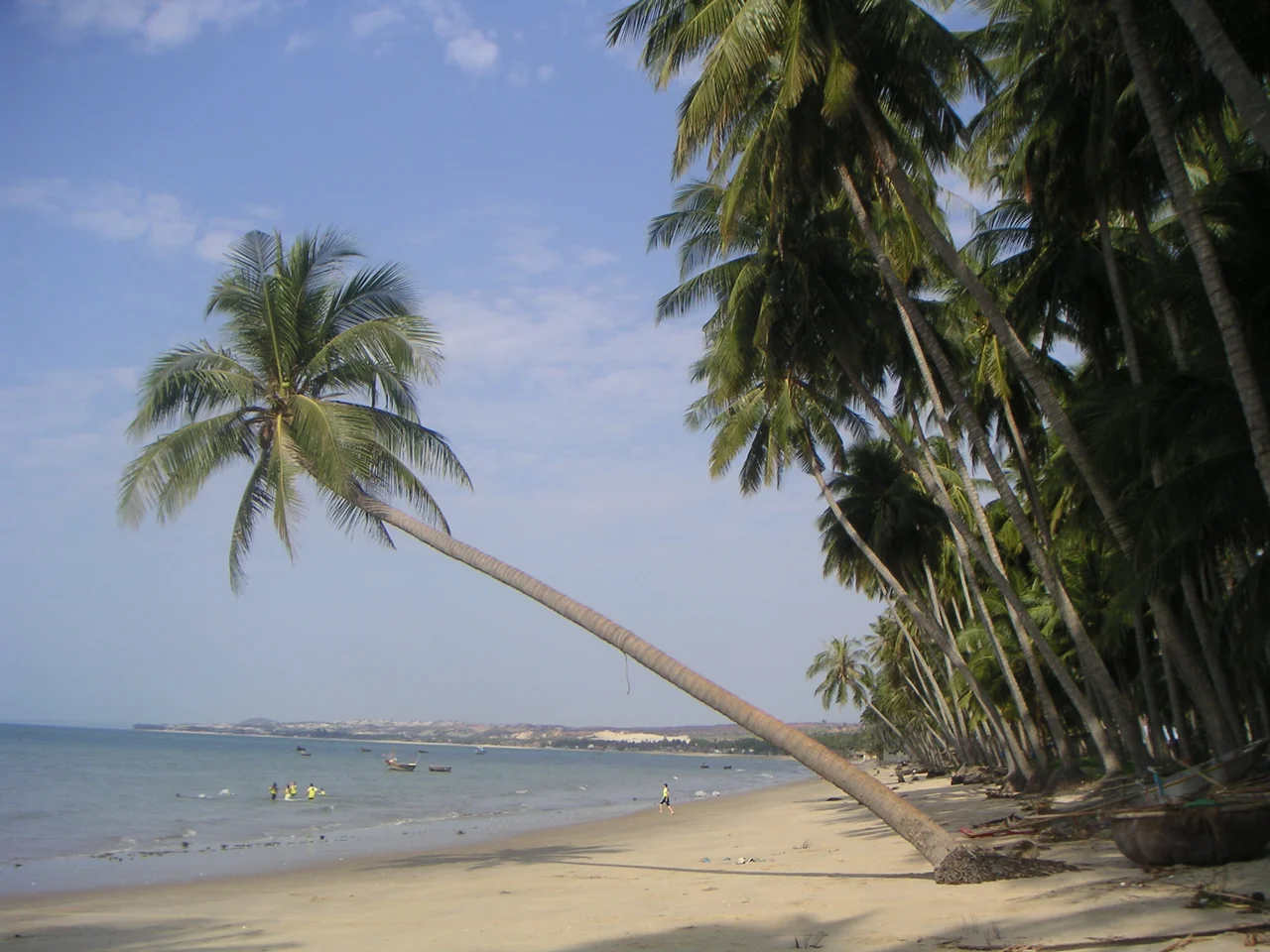

Mui Ne
On October 24, 1995, a solar eclipse swept across southern Vietnam and thousands of travelers converged on a quiet fishing village to watch the sky go dark. Most had never heard of Mui Ne before. By the time the sun came back, many had decided they never wanted to leave. The bay was simply too beautiful — a long, curving crescent of sand shaded by coconut palms, backed by rust-red dunes and flanked by a Cham tower-topped headland. What followed was one of Southeast Asia's most rapid beach resort transformations, turning a village of around 25,000 residents into a 15-kilometer strip of hotels, kite schools, and open-air seafood restaurants.
Where the Dunes Meet the Sea
The road from Phan Thiet climbs over a hill topped by ancient Cham towers, then drops into something that looks borrowed from the Sahara. Mui Ne's white sand dunes — the Bau Trang area — pile up in sweeping ridges that glow amber at dawn and brilliant white by midday. The red sand dunes a few kilometers east offer a different drama: iron-rich ochre slopes that cast long shadows over a landscape more Mars than Vietnam. Between the dune fields and the bay, the Fairy Stream cuts a shallow channel through rust-colored sandstone formations, its cool water threading between walls of eroded earth in colors that shift from cream to brick to deep burgundy. You can wade the whole length barefoot, the sand soft underfoot, the light filtering through palm fronds overhead. These are not manufactured attractions. The wind that sculpts the dunes is the same wind that makes Mui Ne's bay one of the finest kite-surfing spots in Asia.
The Fishing Village Beneath the Resorts
The resort strip along Nguyen Dinh Chieu Street can feel relentless — two hundred hotels pressed cheek-to-cheek along the oceanfront. But the actual village of Mui Ne sits at the eastern end of the bay, largely unchanged. At dawn, the harbor fills with the round woven basket boats — thung chai — that Cham fishermen once used and Vietnamese crews still deploy today. The catch comes ashore in wicker baskets: squid, barracuda, shrimp, the occasional ray. Fish sauce produced along this coast has been prized for centuries; the region's nuoc mam carries a reputation up and down Vietnam. The density of resorts decreases toward the higher addresses on Nguyen Dinh Chieu, where smaller family-run guesthouses coexist with local pharmacies and banh mi stands. This end of the beach mixes more naturally with the rhythms of the town — children on motorbikes, women carrying produce, the smell of pho from a kitchen that has nothing to do with tourism.
Wind Capital of the South China Sea
From November through March, the northeast monsoon arrives like a schedule. Thermal currents build each morning as the shore warms, and by 11:00 the wind is strong enough to hold a kite aloft without effort. In peak season up to 300 kite surfers take to the water simultaneously, their neon canopies turning the bay into a aerial patchwork. The waves here are free of rocks, which makes Mui Ne more forgiving than many kite destinations, though the surf can reach four meters during strong wind days. Several kite schools operate along the beach, all with qualified instructors and beach assistants who help launch and land equipment. For those who prefer to watch, the spectacle from the shore is genuinely impressive — the combination of wind, wave, warm water, and the dune backdrop makes Mui Ne look like a place designed specifically for this sport, which of course it was not. The monsoon simply arrived first.
Sand in Motion
One thing the resort developers did not anticipate was the sand. Mui Ne's beach migrates. The shore shifts seasonally — broad and golden in some months, reduced to a concrete sea wall in others — as longshore drift moves sand up and down the 15-kilometer coast in response to wind and current. Some resorts find themselves fronting an expansive beach in dry season and a narrow sliver by the time the rains arrive. The dunes themselves are equally restless: the white dunes at Bau Trang are protected within the broader National Tourist Site designation approved in 2018, part of a 14,760-hectare planning zone designed to balance development with natural preservation. The hope is that the ecosystem that made Mui Ne extraordinary can survive the success that threatens it.
Where Else the Day Takes You
The restaurants in and around Mui Ne specialize in the seafood landed each morning at the harbor. The best ones sit away from the main tourist strip, tucked into lanes where the fishing families live. Grilled barracuda with fresh herbs, clay-pot crab, platters of shrimp brought live to the table — these are meals built around what the boats brought in, not what the menu wanted to feature. The regional capital Phan Thiet, 10 to 20 kilometers west, offers a market and the Cham towers of Poshanu, remnants of the civilization that named this coast centuries before the first resort appeared. To the north, the old French hill station of Da Lat waits in cool mountain air, offering an entirely different version of southern Vietnam. Mui Ne is the kind of place that rewards staying longer than planned and leaving reluctantly.
From the Air
Mui Ne sits at 10.93°N, 108.28°E on Vietnam's southeastern coast, approximately 220 km northeast of Ho Chi Minh City. The bay forms a clear crescent visible at low altitude. The white sand dunes at Bau Trang and the red dunes to the east are unmistakable from the air — pale ridges against the green coastal scrub. The Fairy Stream drainage channel cuts inland from the bay. Recommended viewing altitude: 1,500–3,000 feet for the dune formations and bay coastline. Nearest airport: Cam Ranh International (CXR), approximately 85 km to the north; Phan Thiet Airport (PHH) is closer but serves limited traffic. Coastal visibility is generally excellent in the dry season (November–April); expect haze and reduced visibility during the southwest monsoon (May–October).
Nearby Stories
- Operation Byrd 34 km away
- Phan Rang–Tháp Chàm 35 km away
- Bao Loc 35 km away
- Phú Quý Island 57 km away
- Ile des Cendres 63 km away
- Battle of Long Tan 76 km away
- Núi Chúa National Park 82 km away
- Battle of Long Khanh 83 km away