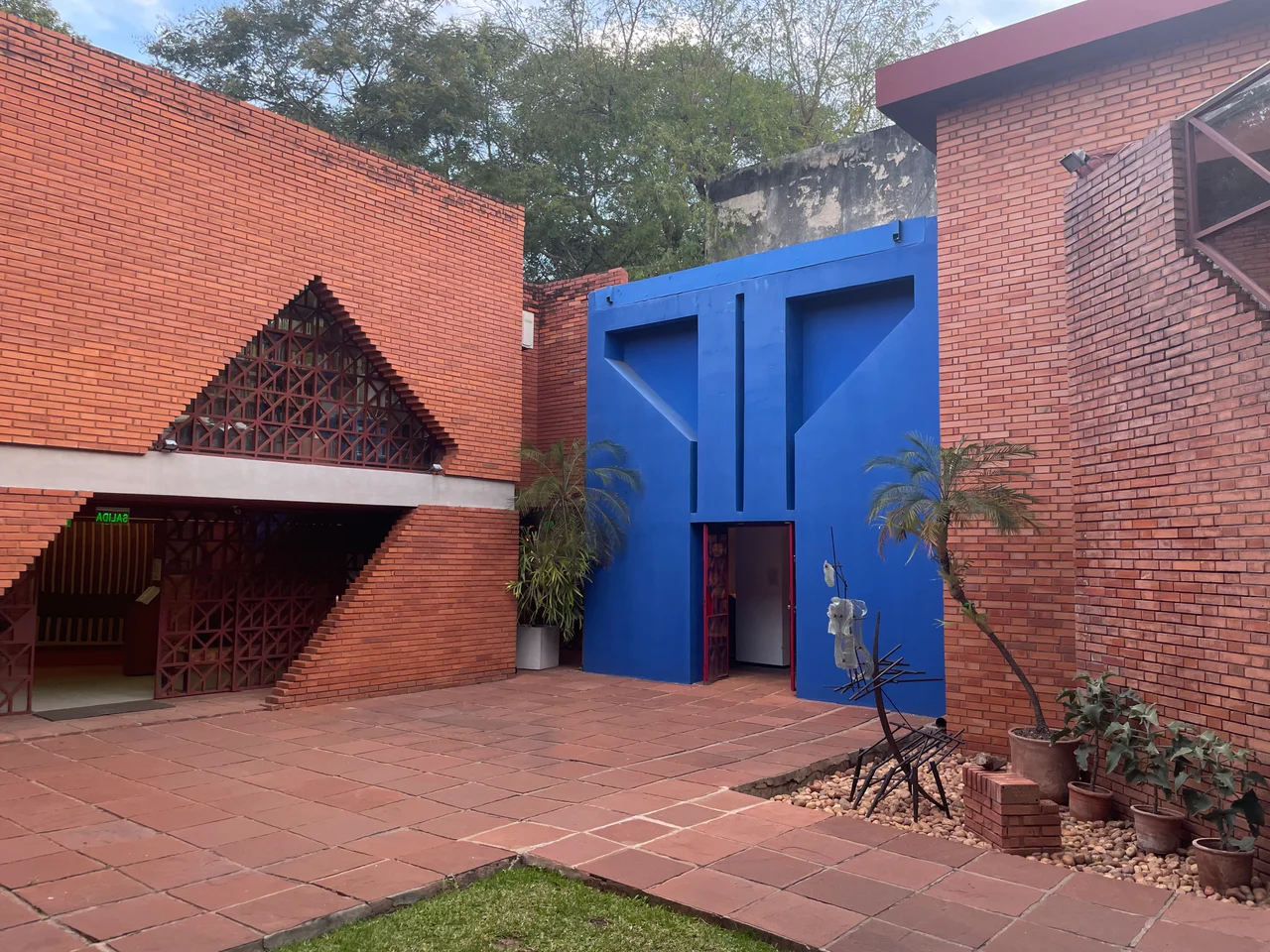

Museo del Barro
The name is humble on purpose. Barro means clay, the most ordinary material there is, and the Museo del Barro takes its name from the earthenware at its heart. But there is nothing modest about what this museum on the edge of Asunción attempts. It refuses the usual hierarchy that hangs European masters in grand halls and tucks Indigenous craft into ethnographic cases. Here, pre-Columbian pottery, the art of Paraguay's Indigenous peoples, and contemporary painting hang as equals, parts of one continuous human story told in clay, wood, fiber, and paint.
A Collection That Traveled
The museum began on the road. In 1972, two Paraguayan artists, Olga Blinder and Carlos Colombino, assembled a circulating collection of prints and drawings, meant to travel to public spaces and schools rather than wait for visitors to come to it. Art went looking for its audience. As the collection grew and branched, it outgrew that wandering life and needed a permanent home, which it secured seven years later. Both founders were significant figures in Paraguayan art: Colombino a painter, architect, and writer; Blinder a painter and pioneering printmaker. What they built was less a building than an argument, that the country's art could not be understood by looking only at its galleries, and that the folk and the Indigenous belonged in the same conversation as the modern.
Three Museums Under One Roof
Founded in 1979 as a private institution, the Museo del Barro grew into three divisions that share its grounds. The clay museum, the one the name honors, holds more than three hundred pieces of pre-Columbian ceramics alongside thousands of folk objects in wood, fabric, and metal, spanning the seventeenth century to the present. A second division is devoted to Indigenous art, and a third to the contemporary art of Paraguay. Together they make up the bulk of the collection. The effect of moving between them is deliberate. A visitor passes from ancient fired clay to the carved and woven work of living Indigenous communities to canvases by modern Paraguayan masters, and the walls never announce that one is finer than another. They are simply presented as what they are: the work of human hands across time.
Honoring the Makers
The respect runs deepest in how the museum treats its Indigenous holdings. Paraguay is a country where Guaraní is spoken alongside Spanish by most of the population, where Indigenous heritage is woven into daily life rather than confined to the past. The Museo del Barro reflects that reality. Its Indigenous collection gathers the work of the distinct peoples who have lived on this land, presented not as artifacts of a vanished world but as the living expression of cultures that endure. To stand before a feathered ornament or a carved figure here is to be reminded that these objects came from communities with their own aesthetics, their own meanings, their own names for what they made. The museum's quiet insistence is that they deserve to be seen as art, by artists, and not as curiosities.
The Long Road to Permanence
Settling was not simple. The collection was originally based in San Lorenzo, and over the years it weathered expansions and natural disasters before reaching its present home on the outskirts of Asunción. Around its founders gathered a circle of Paraguayan artists whose names recur in the country's modern art, among them Pedro Agüero, Mabel Arcondo, Luis Alberto Boh, and Ricardo Migliorisi. What endures is the idea more than any single object. In a region where so many museums inherited the colonial habit of ranking cultures, the Museo del Barro chose instead to flatten the hierarchy, to let clay and canvas, the ancient and the contemporary, the Indigenous and the cosmopolitan, all share the same air.
From the Air
The Museo del Barro sits on the eastern outskirts of Asunción, approximately 25.282°S, 57.559°W, in the Isla de Francia area between the city center and Luque. The terrain is flat and low, around 80–90 m (260–300 ft) above sea level. From 2,500–4,000 ft AGL on a clear day, the museum lies within the dense Gran Asunción suburban grid; the Paraguay River to the west and the green of Ñu Guasú Park to the northeast are the broad orienting features. The nearest airport is Silvio Pettirossi International (IATA: ASU, ICAO: SGAS) in Luque, a few kilometers northeast, whose runway is the clearest landmark in the area. Conditions are generally good except during humid summer afternoon storms.
Nearby Stories
- Yaguarón 21 km away
- Río Pilcomayo National Park 22 km away
- New Australia 45 km away
- La Colmena, Paraguay 46 km away
- Nueva Germania 120 km away
- Pilar, Paraguay 155 km away
- Concepción 174 km away
- First Battle of Nanawa 241 km away