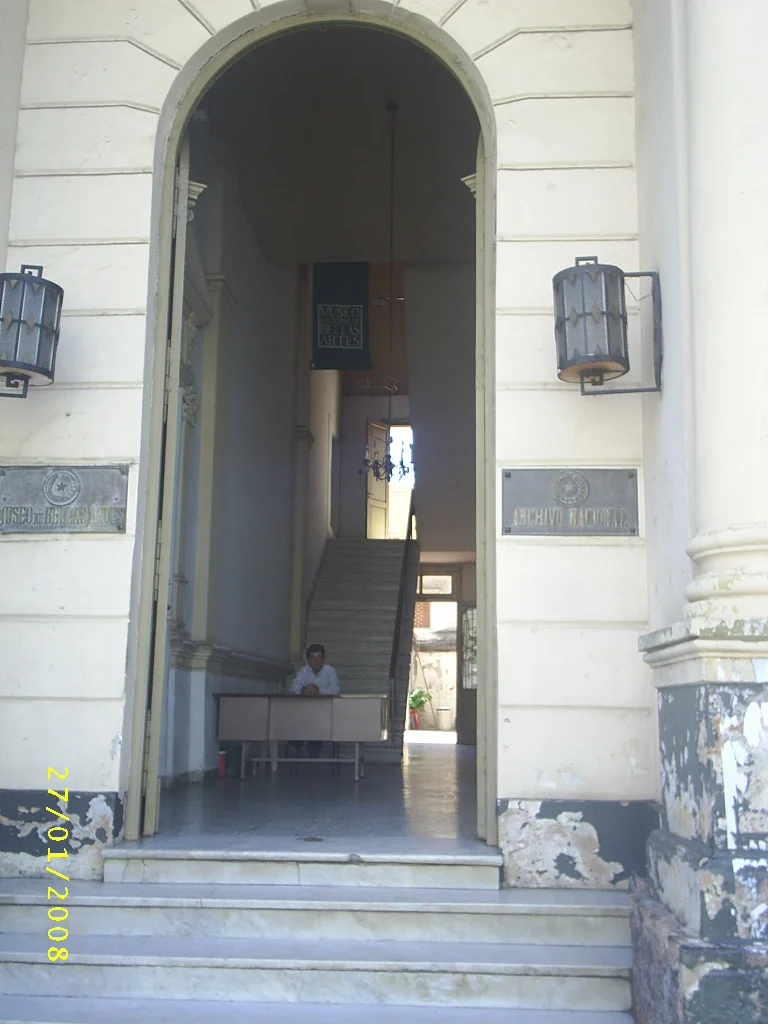

Museo Nacional de Bellas Artes de Asunción
Exile gave Paraguay its first great art collection. Juan Silvano Godoi was a politician from a wealthy family, born in 1850, and the turbulence of his country's politics forced him abroad again and again. Most men in his position counted the cost of banishment. Godoi spent it. Traveling through Europe and the cities of the Río de la Plata, he bought paintings and sculptures, assembling works by Courbet, Murillo, and Tintoretto. When he finally brought it all home, that collection became the seed of the National Museum of Fine Arts of Asunción, founded in 1909 with Godoi himself as its first director.
The Collector in Exile
Godoi inclined toward the painting of his own century, the naturalism and academic style of the late nineteenth century, though his acquisitions reached back to the seventeenth. He bought Italian and French works, sculptures, and pieces from Río de la Plata artists who would matter more in the decades to come. By the early twentieth century, the Paraguayan government wanted those works gathered into a single institution, and so the foundations of the museum were laid. It opened in 1909 under Godoi's own direction, and he led it until his death in 1926. In 1939 the state formalized it as the National Museum of Bellas Artes. Today it stands at Mariscal Estigarribia and Iturbe streets, displaying more than 650 works, and sharing its building with the National Archives, keeper of the largest documentary record of Paraguay's history.
Art Against the Odds
Paraguay's art did not develop the way its neighbors' did. Elsewhere in Latin America, artistic production flowed more or less continuously after the conquest. Here it was repeatedly broken. The skilled crafts of the Indigenous peoples went largely unrecognized during colonization, though the arrival of Franciscan and Jesuit missionaries slowly transformed music, architecture, and the carving of religious images, work in which native artisans excelled. When the Jesuits were expelled and the Franciscan presence faded, artistic production stalled again. Not until the nineteenth century did it stir, with two Paraguayan painters, Saturio Ríos and Aurelio García, emerging as European architects reshaped the look of Asunción. Paraguayan art has always had to fight its way into being, against war, isolation, and rupture.
Satire Printed at the Front
The War of the Triple Alliance, which ravaged Paraguay from 1864 to 1870, crushed almost everything, yet from it came one of the country's most remarkable artistic legacies. Trench journals, edited and printed at the war front itself, carried satirical illustrations of startling quality. Two of them, El Cabichuí and El Centinela, survive as priceless records, valued both as history and as art. Their illustrators worked in woodcut, with Gregorio Cáceres among the principal creators, and they turned the bitter humor of a besieged nation into images. That a country fighting for its very existence produced printmaking of such craft says something about the place. The impulse to make art persisted even where almost nothing else could.
An Immigrant Imprint and a National School
Waves of immigrants left their mark on Paraguayan art, several of them European artists. The Italian Guido Boggiani is remembered for documenting Indigenous art; the academic Héctor Da Ponte trained the young; the Frenchman Julio Mornet spent seven years in the country, painting works that adorned the ceiling of the Palacio de los López. Through the support of cultural institutions, young Paraguayans such as Carlos Colombino and Juan Samudio won scholarships to study abroad. They returned to paint the landscapes and portraits of home. Their generation, alongside names like Andrés Campos Cervera, Pablo Alborno, Jaime Bestard, and Olga Blinder, filled out a national school. The museum holds them all, including the prized fifty-seven satirical drawings of Miguel Acevedo, a wry portrait of the belle époque and its characters.
From the Air
The museum stands in central Asunción at approximately 25.289°S, 57.621°W, on Mariscal Estigarribia at Iturbe, within the colonial-era grid near the city center. Central Asunción rests on the east bank of the Paraguay River at low elevation, around 60 m (200 ft) above sea level. From 2,000–3,500 ft AGL on a clear day, the riverfront and the orderly grid of the old town are the main references, with the Palacio de los López and the Panteón Nacional helping fix the center. The closest airport is Silvio Pettirossi International (IATA: ASU, ICAO: SGAS) in Luque, about 10–12 km east-northeast, its single runway the dominant landmark of the metro area. Visibility is generally good outside humid summer afternoons when thunderstorms develop.
Nearby Stories
- Yaguarón 21 km away
- Río Pilcomayo National Park 22 km away
- New Australia 45 km away
- La Colmena, Paraguay 46 km away
- Nueva Germania 120 km away
- Pilar, Paraguay 155 km away
- Concepción 174 km away
- First Battle of Nanawa 241 km away