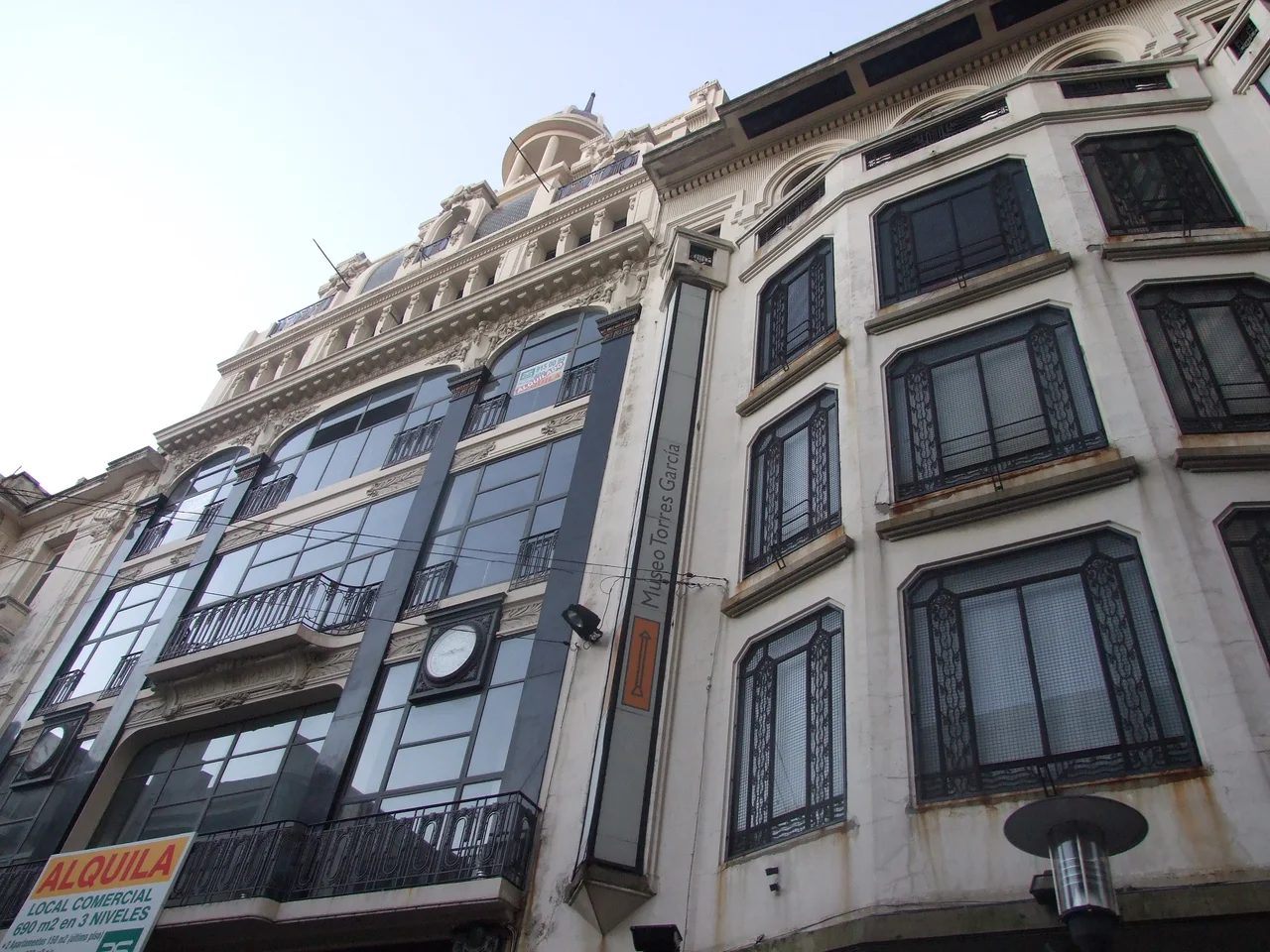

Museo Torres García
In 1943, Joaquín Torres-García drew a small map and flipped it. South sat at the top, Uruguay rode high near the crown of the continent, and the familiar orientation of the world was quietly overthrown in pen and ink on a sheet barely larger than a postcard. "I have called this the School of the South," he wrote, "because in reality, our north is the south." América Invertida became one of the most reproduced images in Latin American art, a manifesto disguised as a diagram. The museum that bears his name, tucked into a street in Montevideo's Ciudad Vieja, is where his upside-down vision still hangs the right way up.
A Painter Between Two Worlds
Torres-García was born in Montevideo on 28 July 1874, but he grew up an ocean away. Financial trouble pushed his family to his father's native Catalonia in 1891, and in Barcelona the young artist fell in with the avant-garde at Els Quatre Gats, the café that drew the likes of Pablo Picasso. He spent decades in Europe and New York, helping found the Paris group Cercle et Carré alongside Michel Seuphor and Pierre Daura, drawing in members including Piet Mondrian and Wassily Kandinsky. Then, in 1934, after a lifetime abroad, he came home to Uruguay for good. He spent his final years importing the European avant-garde to Montevideo and building something of his own, until his death in the city of his birth on 8 August 1949.
Universal Constructivism
What he built was a philosophy he called Constructive Universalism. He wanted to marry the geometric rigor of modern abstraction to the symbols of the Americas' own deep past, the imagery of pre-Columbian and indigenous cultures, and forge from the two a Latin American art that owed nothing to the cultural compass of the North. His canvases became grids, ordered compartments filled with simplified signs: a fish, a sun, a clock, an anchor, a human figure, each one a glyph in a private alphabet that drew on ancient American sources as much as on European modernism. The inverted map was that idea made literal. Why should a continent always be drawn looking up toward Europe and the United States? Turn it over, and Uruguay finds its own place at the top. It was geography as argument, and it landed.
The Widow's Legacy
The museum exists because of Manolita Piña, the painter's widow. After his death in 1949 she founded the Torres García Foundation, a private non-profit that gathered and guarded his paintings, drawings, original writings, archives, the very furniture he designed, and the magazines and publications that documented his life. It was an act of preservation that kept a national legacy intact at the moment it was most fragile, in the uncertain years after the master was gone and before the world had fully recognized what he had achieved. The collection she assembled became the heart of the museum, a way of holding one artist's universe together so the country would not lose it. Without her quiet stewardship, much of what hangs here today might have scattered into private hands and disappeared from public view.
A Living Museum
The Museo Torres García is no quiet mausoleum. It draws more than 85,000 visitors a year, and it does more than display canvases. A temporary library occupies the ground floor; a theater sits in the basement. Guided tours and educational workshops bring in art students, schoolchildren, and travelers, so that on any given day the building hums with the kind of activity its namesake would have wanted. Torres-García believed art was something to be built and taught, not merely admired behind glass. The museum keeps that belief alive in a city he chose, in the end, over all the capitals of Europe.
From the Air
The Museo Torres García sits in Ciudad Vieja, Montevideo's Old Town, at 34.91°S, 56.20°W, near the tip of the city's peninsula on the north bank of the Río de la Plata. From the air the dense colonial street grid of the old quarter and the adjacent working harbor are the best reference points; the museum is a single building among many in that grid. Carrasco/General Cesáreo L. Berisso International Airport (ICAO: SUMU) lies about 20 km east along the coast, with Ángel S. Adami Airport (ICAO: SUAA) to the northwest for general aviation. Clear estuary light and the broad brown river to the south make the peninsula easy to pick out at lower altitudes.
Nearby Stories
- Piriápolis 24 km away
- Minas 40 km away
- Tronador (rocket) 67 km away
- Nueva Helvecia 69 km away
- La Plata Museum 122 km away
- Battle of Sarandí 126 km away
- Mundo Marino 145 km away
- South Georgia Island 2584 km away