
Museum of the Gorge, Ironbridge
It looks like a small parish church if you squint - crenellated parapet, pinnacles on the corners, a riverward apse with lancet windows, narrow towers like miniature church steeples. It is not a church. It was built around 1840 as a warehouse for the Coalbrookdale Company, designed in fashionable Gothic Revival style by the architect Samuel Cookson. Iron castings went out through these doors onto Severn trows bound for Bristol and the world. Today the building is the Museum of the Gorge, the visitor centre and starting point for the ten museums of the Ironbridge Gorge - and behind its showpiece doors is a twelve-metre diorama showing what the gorge looked like at the height of the Industrial Revolution.
Why a Gothic Warehouse
Gothic Revival was the architectural fashion of the 1830s and 1840s. Augustus Pugin had made it respectable for churches. A. W. N. Pugin's followers had made it acceptable for everything else. So when the Coalbrookdale Company needed a new warehouse on the Wharfage, just upstream of the Iron Bridge, they hired Cookson to make a statement. The crenellated parapet at each end, the cross-shaped arrow loops that conceal chimneys, the church-like apse on the east face - all are pure Strawberry Hill romanticism applied to industrial purpose. The building is solid red brick with yellow brick dressing. Most of the walls are blind, with only small high windows in the gables for security. Buttresses brace the long sides. The result is a kind of medieval-revival military storehouse that has nothing to do with iron-founding and everything to do with looking impressive to passing traffic on the Severn.
The Severn as a Working River
Before the railway came to Ironbridge in 1862, the River Severn was the gorge's main artery. Severn trows - flat-bottomed sailing barges purpose-built for the river - moved up and down between Coalbrookdale, Bristol, and the Welsh coast. The trade was seasonal. Before the river was managed by weirs, water levels rose and fell with the rainfall, and in dry summer months the Severn could become too shallow to navigate. Finished goods piled up in warehouses like this one, waiting for winter rain to fill the channel again. The sandstone walls of the 1780s wharf still run for half a mile between the museum and the Iron Bridge itself. Set into the paving in front of the museum doors are grooves for plateway wheels - the precursors of railway rails - that carried iron castings the short distance from the warehouse to the waiting trows.
Floods, Year After Year
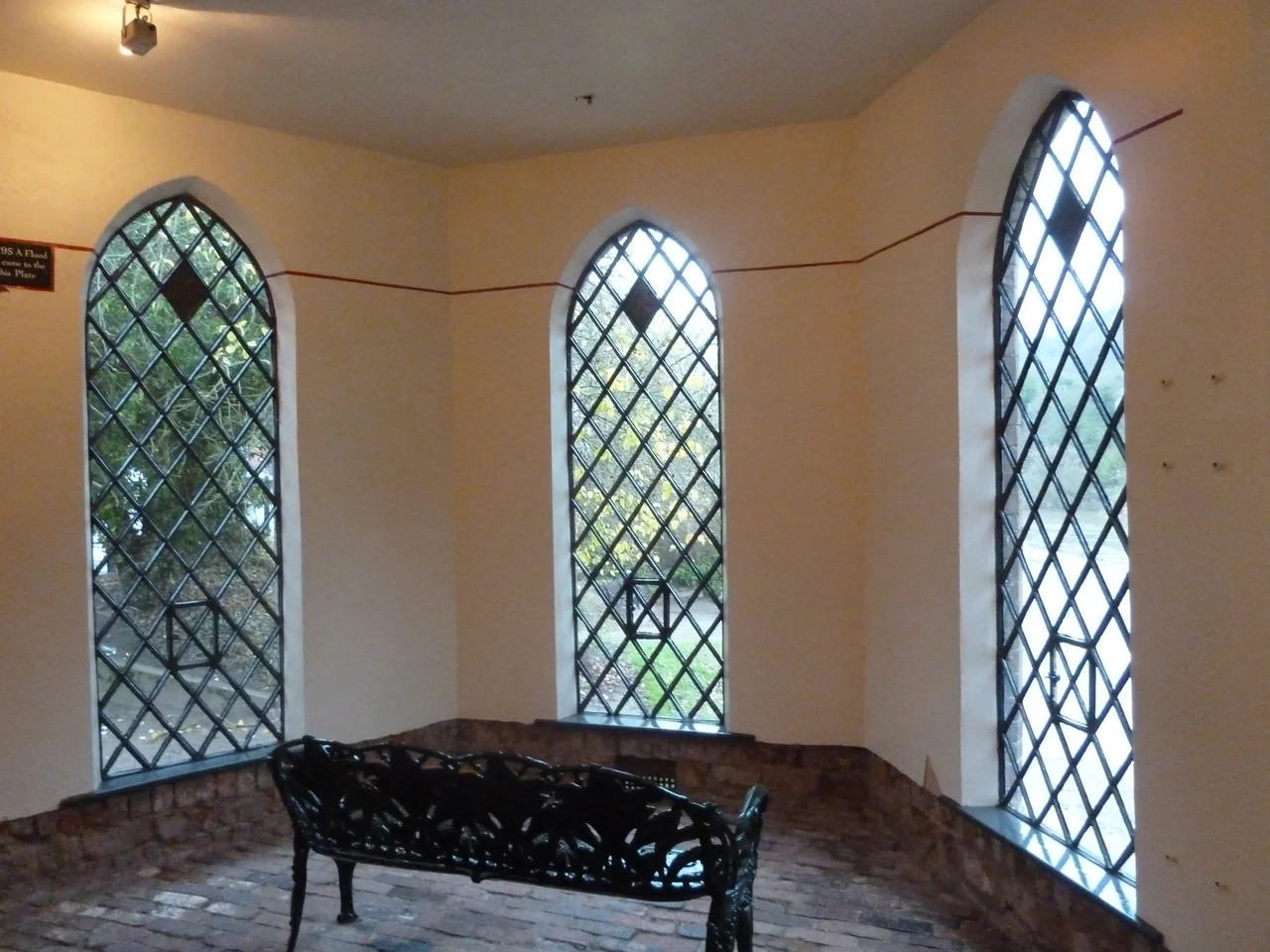
The Severn floods. It has always flooded. Inside the museum, on one wall, is a painted line marking the highest recorded flood at this building, almost up to the top of the windows. Lesser flooding to the level of the warehouse floor happens essentially every year. Photographs from the 2008 floods show the building's walls reflected in their own waterline, the wharf swallowed up, only the apse and the upper parapet still above water. This is a building that has weathered the river for nearly two centuries by being built solidly enough to take it. The Gothic style turns out to be remarkably good at shedding water. The brick stays dry above the flood mark. After each retreat of the river, the doors open again.
The Diorama
The centrepiece of the museum is a twelve-metre diorama showing the Ironbridge Gorge as it would have looked in the early Industrial Revolution. Smaller furnaces dotted the valley than would dominate in later decades. Shallow bell pits dug for coal used horse gins for winding - tiny models of which appear in the diorama. Steam power was rare, only the largest furnaces having steam blowing engines. The 350-yard Hay Inclined Plane of the Shropshire Canal opens in 1792, mostly gravity-worked but with a Heslop patent rotative beam engine winching canal tubs up from the foot. At the bottom of the inclined plane is the short Coalport Canal and the newly opened Coalport China factory of 1795, with its four bottle kilns. The whole landscape spreads out before the visitor like a model railway with the trains taken away - a frozen image of the moment before steam dominated everything.
The Gateway Museum
The Ironbridge Gorge Museum Trust manages ten museums across the gorge: the Iron Bridge itself, the Coalbrookdale Museum of Iron, the Jackfield Tile Museum, the Coalport China Museum, Blists Hill Victorian Town, and others. The Museum of the Gorge is the gateway - the orientation point where visitors get the overview before fanning out to the more specialised sites. The diorama serves as a map. The films explain how the gorge came to be the cradle of the Industrial Revolution: Abraham Darby smelting iron with coke in 1709, his grandson's iron bridge spanning the Severn in 1779, the Coalbrookdale Company casting everything from kitchen pots to the great gates of Hyde Park. Some of the later warehouses adjoining this one housed the Merrythought teddy bear factory for years, makers of Mr Whoppit - who survived two land-speed-record crashes with Donald Campbell. The gorge keeps producing stories. The museum tells visitors where to find them.
From the Air
The Museum of the Gorge sits on the north bank of the River Severn at 52.630°N, 2.492°W, on the Wharfage just west of Ironbridge village, where the river enters the steep-sided Ironbridge Gorge. The crenellated Gothic warehouse is small but architecturally distinctive from low altitudes. The Iron Bridge itself is 800 m downstream. The gorge runs roughly east-west, cutting through the limestone plateau between Coalbrookdale and Coalport. Nearest airfields are RAF Cosford (EGOC) 12 km east, Wolverhampton Halfpenny Green (EGBO) 18 km southeast, and RAF Shawbury (EGOS) 22 km north. The Wrekin (407 m) is 7 km north as the most prominent landmark.
Nearby Stories
- Ludlow 5.7 km away
- Llangollen 6.7 km away
- Murder of Shawn Seesahai 8 km away
- Avoncroft Museum of Historic Buildings 8.1 km away
- Caverswall Castle 8.4 km away
- Combermere Abbey 9.4 km away
- Battle of Maes Moydog 11 km away
- Cwmhir Abbey 16 km away