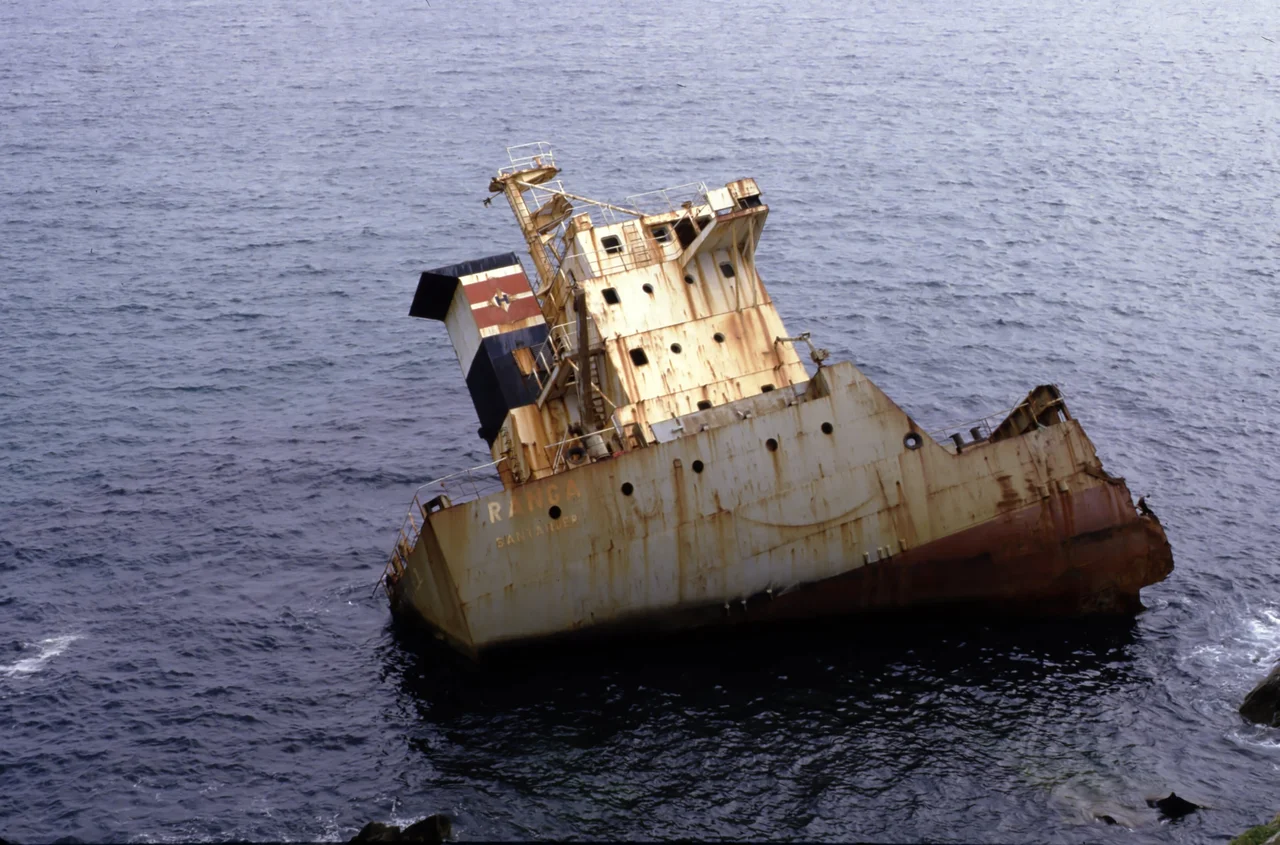

MV Ranga
Her name changed at sea. She had left Vigo in northwest Spain as the Berta de Perez and somewhere on the open water became the Ranga, the renaming a paperwork detail for her Icelandic charter to Hafskip. She was 1,586 tonnes of new container ship, on her maiden voyage from Vigo to Reykjavík under Captain Miguel Ángel Díaz Madariaga, fifteen men aboard. On 11 March 1982, off the southwest coast of Ireland, the storm took her engines. With no power and no propulsion, she drifted toward the cliffs at Dunmore Head, the westernmost point of mainland Ireland. By morning she was on the rocks, broken in two, leaking oil into the surf below Coumeenoole Beach.
Fifteen Men on a Wire
Dunmore Head is not a forgiving piece of coast — sheer Devonian sandstone cliffs dropping straight to the Atlantic. When the Ranga went aground close by, no boat could safely approach her in the storm. The Dingle Fire Brigade, the Garda Síochána, and local emergency services assembled on the cliffs above. They rigged a breeches buoy — a canvas trouser-shaped seat slung from a line strung between ship and shore — and began hauling crewmen across one at a time, suspended above the boiling water. When the line could carry no more, a Royal Air Force helicopter took the rest off the deck. Captain Madariaga, by the long tradition of his profession, was the last to leave his ship. All fifteen men survived.
The Ship That Refused to Be Salvaged
The Ranga did not last long once she was abandoned. The storm tore her in two — the bow on one section of rock, the stern with its superstructure on another. Oil leaked from her ruptured tanks for days, fouling the coast where the seals haul out and the gannets dive. In 1989 a salvage company called Eurosalve tried to scrap her, but the wreck site is among the most inaccessible on the Irish coast: no road, no beach to drag pieces across, just cliff and sea. They gave up. Two years later the stern section came off the rocks, but not for salvage. The Hollywood film Far and Away was filming scenes at Dunmore Head, and the production wanted the modern wreckage gone.
What the Sea Kept
The bow of the Ranga is still there. Walk the cliff path from the Slea Head Drive near Coumeenoole and you can see it — a rusted hulk wedged into the rocks at the base of the headland, the sea breaking white around it on most days, the red-orange of corrosion bright against the dark sandstone. Forty-plus years of Atlantic weather have flattened it, eaten holes through its plating, and stripped away most of the structure that once existed above the waterline. The wreck has become part of the landscape, the way old shipwrecks tend to — neither monument nor eyesore, just a fact of the coast, like the geology of the headland itself.
Coast of Wrecks
The Dingle Peninsula coast has been chewing up ships for centuries. In 1588 it was Spanish galleons from the Armada, blown north and west by storms and breaking apart on these same rocks. Local boatmen know the names of half a dozen wrecks within a few miles of Dunmore Head, some still visible at low tide, others marked only by debris that washes up every winter. The Ranga is the most recent of any size, and the most accessible to view — close enough to the cliff path that you can stand directly above her remains. She joined a register of lost ships her captain probably never imagined when he gave the order to weigh anchor in Vigo three days before.
From the Air
Coordinates 52.1092°N, 10.4683°W, at the base of Dunmore Head close to Coumeenoole Beach near Slea Head. The wreck is visible from the air at 1,000–2,500 ft AGL on calm days — look for the rusted bow section against the dark cliff base just west of the headland tip. Kerry Airport (EIKY) lies about 55 km east. The headland marks the westernmost point of mainland Ireland and is unmistakable from altitude. Watch for sea fog, which forms quickly along this exposed coast.
Nearby Stories
- Ballyheigue Castle 1 km away
- Killemlagh Church 2.8 km away
- Pouldergaderry Sinkhole 6.8 km away
- Derreen Garden 11 km away
- Kilkee 59 km away
- The Laki Eruption: The Volcano That Changed World History 1366 km away
- The Northern Lights: The Sky Show That Vikings Thought Was Bridge to the Gods 1469 km away
- Sao Miguel 1935 km away