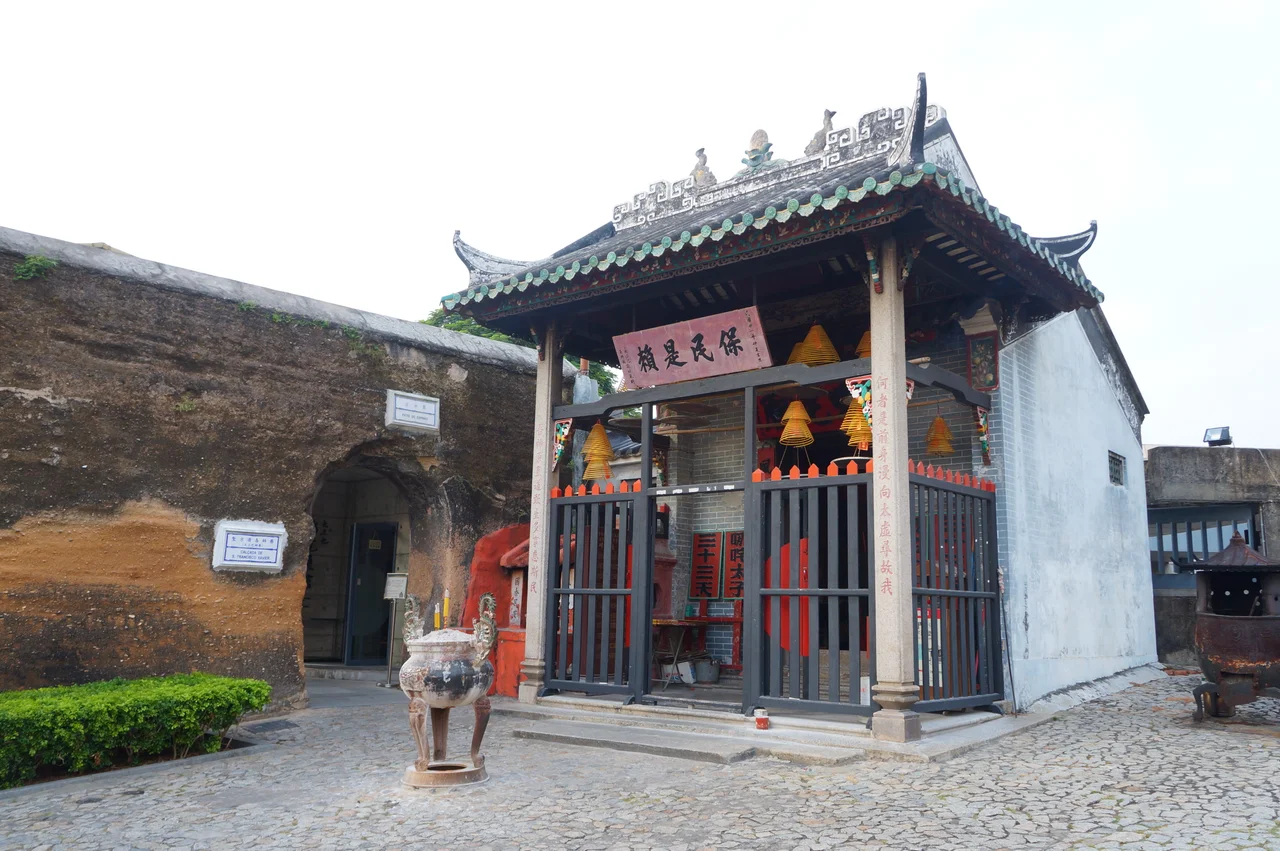

Na Tcha Temple
Plague came to Macau in the late nineteenth century, and the community turned to a child god for help. Na Tcha — known also as Sam Tai Tsz, the Third Prince — is one of the most beloved protector deities in Chinese folk tradition: a young warrior spirit fierce enough to vanquish demons and compassionate enough to guard the sick. In 1888, residents of Santo António parish raised a temple in his honor, trusting that dedication to this guardian would bring the epidemic to an end. Whether it was divine intervention or the natural burn-out of the disease, the plague passed. The temple remained.
A God Small Enough to Enter
The Na Tcha Temple is deliberately modest — almost defiantly so. The building measures just 8.4 meters long and 4.51 meters wide, painted gray rather than the flamboyant reds and golds of larger Chinese temples. A single chamber sits behind a shallow entrance porch, its walls decorated with folk paintings. The roof rises five meters to a traditional gable ridge, where ceramic animal figurines stand watch in the old architectural custom — a line of protective guardians that has been doing its job since Qing-era craftsmen set them in place. There are no grand courtyards, no flanking halls, no incense towers. Just a contained, intimate space for a community that needed a direct line to something protective.
Two Alleys, Two Worlds
The temple occupies the junction of two narrow lanes — Rua da Ressurreição and the Travessa of St. Francis — at the foot of the massive stone staircase leading to the Ruins of St. Paul's. That setting is no accident of urban planning; it is the condensed argument of Macau itself. Climb the stairs and you reach the soaring baroque facade of a seventeenth-century Jesuit cathedral, one of the most photographed monuments in Asia. Turn and walk a few meters the other way and you slip into the old city walls, through a gate into a compressed space of memory. The Na Tcha Temple stands exactly where these two traditions exhale into each other — Chinese popular religion and Portuguese colonial Catholicism breathing the same narrow air. UNESCO recognized this cultural density in 2005 when the temple became one of the designated sites of the Historic Centre of Macau World Heritage listing.
The Third Prince and His City
Na Tcha, or Nezha in Mandarin, is a figure whose story spans centuries of Chinese literature and mythology. He is a child deity — impulsive, courageous, riding on wind-fire wheels and wielding a cosmic ring — and his popular image is everywhere in Cantonese communities from Hong Kong to Singapore to Vancouver. In Macau, he carries an additional weight: he is the specific guardian invoked when the city faced a lethal threat, making the 1888 temple less a house of general worship and more a monument to collective fear and collective hope. Visitors today light incense and leave offerings in front of his image just as their great-grandparents did when the disease was still killing neighbors. The continuity is not nostalgic. It is simply alive.
Placed Between the Ancient and the Ornate
Macau's historic core is dense with competing grandeurs — the Monte Fortress, the Leal Senado, the Cathedral. The Na Tcha Temple participates in that historic landscape while refusing its scale. It is the small, plain thing among the impressive things, and that plainness makes it readable in a way that gilded interiors sometimes prevent. You can grasp it immediately: one room, one deity, one communal purpose. The ceramic animals on the ridge are slightly worn. The entrance porch paintings have the patina of something genuinely old rather than something recently restored for tourism. Coming to this temple after the crowded staircase of St. Paul's, you notice how quiet it is — not because few people visit, but because its smallness creates an intimacy that the ruins above cannot.
From the Air
The Na Tcha Temple sits at 22.1977°N, 113.5407°E on the Macau Peninsula, immediately behind the Ruins of St. Paul's — the large stone facade at the top of a grand staircase is clearly visible from the air. Recommended viewing altitude is 1,500–2,500 feet for a clear look at the peninsula's dense historic core. The principal nearby airport is Macau International Airport (VMMC), located on Taipa Island approximately 3 nautical miles southeast. The Pearl River Delta is visible to the north and west; the newer Cotai reclamation land stretches south between Taipa and Coloane.
Nearby Stories
- 2024 Shenzhen Stabbing 0.8 km away
- Lantau Peak 1.5 km away
- Kweilin Incident 2.4 km away
- Taishan City 7 km away
- Wanshan Archipelago Campaign 38 km away
- Hong Kong 12 68 km away
- Battle of Nanpeng Island 82 km away
- Erhai Lake 1335 km away