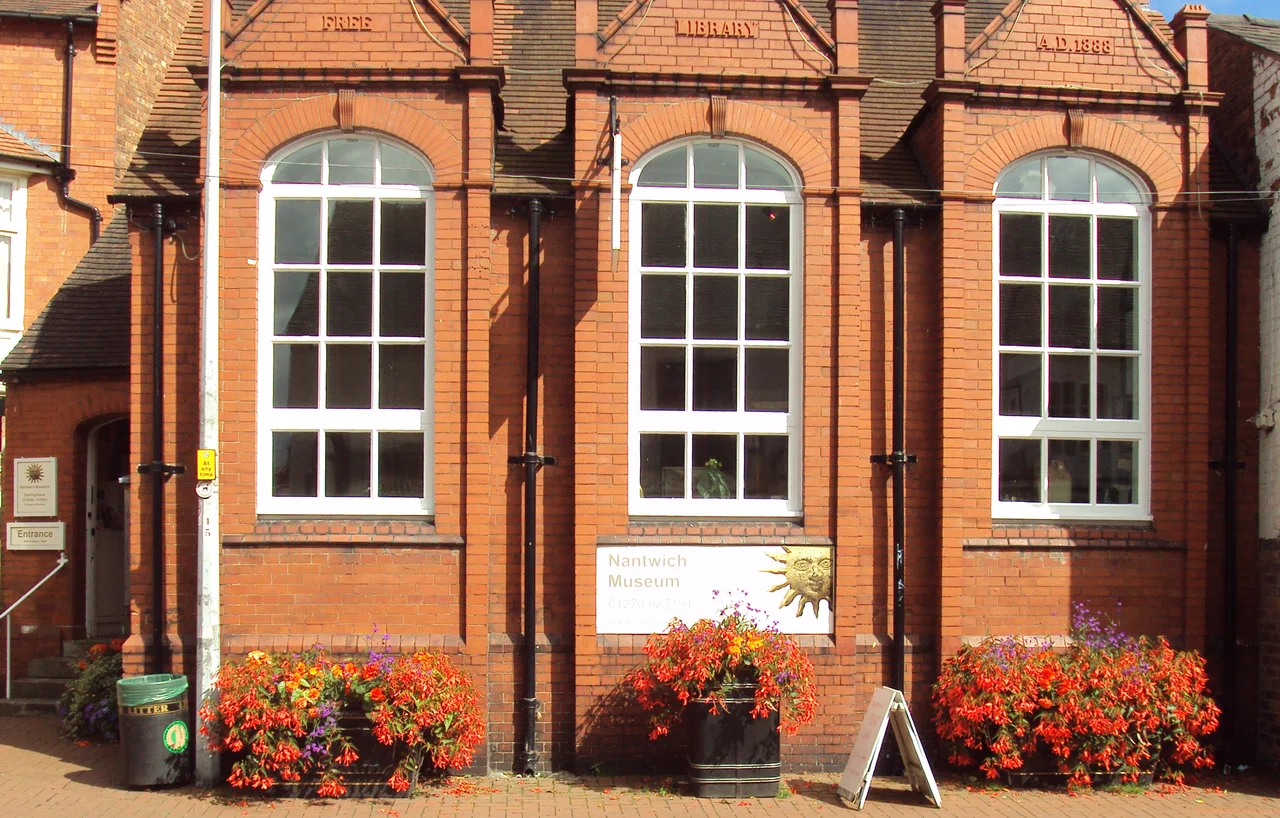

Nantwich Museum
Pillory Street is named for what once stood on it. The pillory itself is gone, replaced now by a quiet brick building of 1888 that began life as the town's free public library and ended up holding the entire memory of Nantwich. When the museum opened here in January 1980, the volunteers who set up the first galleries did not have to look far for objects: every block of the medieval town centre had something to give. A Roman lead salt pan from a vanished briney works. A musket ball from the siege. A wooden last from one of the shoe factories that filled the lanes off Welsh Row. The collection feels personal because it is. This is a town that has spent two thousand years curing things in salt, including its own story.
Inside the Old Library
The building was given to Nantwich as a free library by the same Victorian impulse that built reading rooms in every market town in England, and its stone facade carries the small grandeur of that civic ambition. Inside, the galleries are arranged loosely by era and trade. Roman Britain occupies one room, with reconstructed evaporating pans showing how garrisons at Chester and Stoke-on-Trent received Nantwich salt as a wage and a preservative. Another room handles the Great Fire of 1583, when most of the town east of the Weaver burned in a single December night, and Elizabeth I's subsequent appeal that drew rebuilding funds from as far as Bury St Edmunds. A third holds the Battle of Nantwich in January 1644 and the Civil War that hinged on it. The rooms are small. They are also dense.
The Civil War Centre
In April 2019, after years of fundraising and gallery redesign, Nantwich Museum opened the Cheshire Civil War Centre on its upper floor, making it the only museum in the county to focus specifically on what the seventeenth-century war did to ordinary lives here. Nantwich declared for Parliament early and paid for the choice with several sieges. The final one was lifted on 26 January 1644 when Sir Thomas Fairfax broke through Royalist lines outside town. Townsfolk pulled sprigs of holly from the hedgerows and pinned them to their caps to mark the relief, a custom that returned in 1973 when the Sealed Knot reenactment society revived Holly Holy Day. The museum holds the holly tradition's archive, alongside helmets, pikes, pamphlets, and the small terrible objects that made up a seventeenth-century life under siege.
Shoes, Cheese, Clocks
What Nantwich did with its salt mattered less in the end than what other industries grew up using it. Cheese-making turned the Cheshire Plain into a dairy economy, and the museum keeps the wooden moulds, presses, and ledgers of farms that supplied the cheese fairs at nearby Dorfold Hall. Tanning followed the salt. Shoemaking followed the tanning. By the nineteenth century, Welsh Row's shoe factories were sending boots to London and beyond. The clock-making gallery holds long-case movements by Joseph Smith and others, including pieces by Gabriel Smith of nearby Barthomley, who died in 1743. A portrait of the local historian James Hall, painted by his son Walter, watches over the room. So do the paintings of Herbert St John Jones (1872 to 1939), the Nantwich artist who captured the half-timbered streets just before motorcars changed them forever.
A Free Door
Entrance is free, which is a deliberate choice. Funding comes from Cheshire East Council, Nantwich Town Council, and the volunteers who run most of the museum's day-to-day life. The maps drawer is worth asking to see. So is the staff if you have a question; the people behind the desk often grew up two streets over from whatever you are looking at and know the half-shadowed stories that never made it onto the labels. Open Tuesday to Saturday, the museum sits across the small alleyway called The Cocoa Yard from the Nantwich Millennium Clock, a free-standing mechanism in a glass case built by Paul Beckett around 2001. The two timepieces, one Victorian and civic, one millennial and idiosyncratic, mark the same town from either end of its modern life.
From the Air
53.07 N, 2.52 W, in the centre of Nantwich on the Cheshire Plain. The building reads from low altitude as a small ornate brick block on Pillory Street, a few minutes' walk south of St Mary's Church (the parish church spire is the best landmark). Best seen at 1,500 to 2,500 feet AGL over the town. Nearby airports: EGCC Manchester to the north-east, EGNR Hawarden to the west, EGNX East Midlands further east.
Nearby Stories
- Valle Crucis Abbey 1.8 km away
- Caverswall Castle 2.9 km away
- Haughmond Abbey 2.9 km away
- Basingwerk Abbey 4.1 km away
- Battle of Winnington Bridge 6.6 km away
- RAF Hednesford 8.3 km away
- Anson Engine Museum 9.7 km away
- Battle of Maes Moydog 14 km away