.jpg)
National Museum of Flight
G-BOAA never flew again after she landed at East Fortune in April 2004. British Airways had retired Concorde the previous October, and the question of where to send the first production aircraft to enter commercial service was complicated by the fact that East Fortune did not have a runway long enough to receive her. The solution was a barge up the Firth of Forth, a low-loader across East Lothian, and a slow, escorted crawl through country lanes that took longer than a transatlantic crossing once had. She now sits in Hangar 4, her droop-snoot still articulating, the shape that defined supersonic civil flight parked in a former RAF hangar surrounded by the aircraft that came before her.
An Airfield That Outlived Its Wars
RAF East Fortune was a fighter and airship station in the First World War, a night fighter training base in the Second, and Edinburgh's temporary airport during the summer of 1961 while Turnhouse was rebuilt. When the museum opened to the public on 7 July 1975, the wartime buildings became its galleries. The whole site is now a Scheduled Monument, which means no permanent structures have been added. Visitors walk through the actual hangars, control tower, and stores the RAF used, with the original Nissen huts and brick perimeter buildings preserved around them. Few aviation museums in the world can show you both the aircraft and the place that flew them in the same breath.
From a Glider in 1909
The collection began before powered flight was common. In 1909, six years after Kitty Hawk, the Royal Scottish Museum acquired Percy Pilcher's Hawk glider, the first aircraft collected by any museum in the United Kingdom. The same year the museum picked up models of the Wright Model A and the Bleriot XI. In the early 1920s Orville Wright himself donated a 1910 33-horsepower Wright engine. By 1971 the holdings had grown enough that a Supermarine Spitfire XVI from the Ministry of Defence had nowhere to go and ended up in storage at East Fortune. A Sea Hawk, Sea Vampire, and Sea Venom followed from RNAS Lossiemouth the next year. By the time the doors opened in 1975, the museum essentially built itself by accretion.
What Sits Inside the Hangars
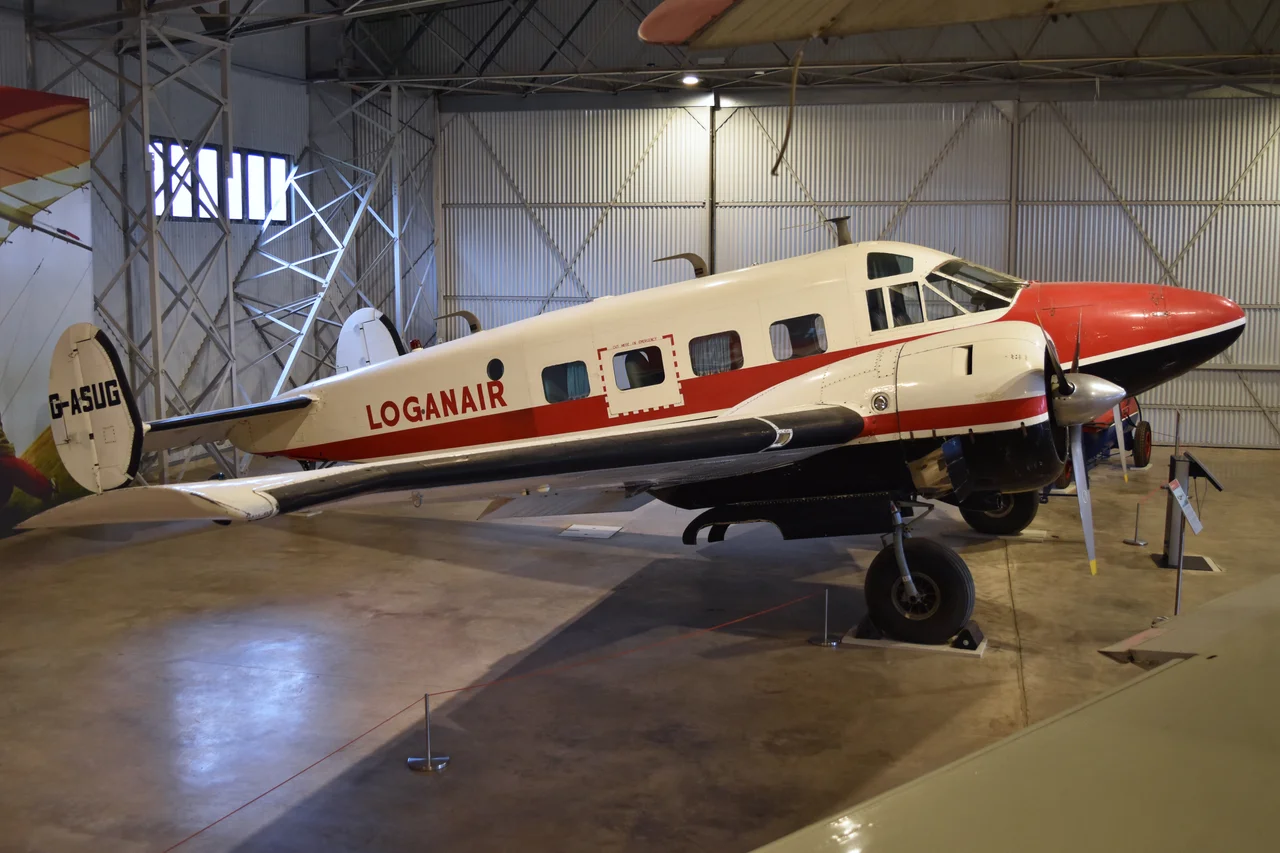
Hangar 2 holds the military collection. The Avro Vulcan B.2A on display, XM597, flew two of the Black Buck missions during the 1982 Falklands War, the longest bombing raids in history at the time. Beside it sits the Messerschmitt Me 163 Komet, a rocket-powered interceptor that was the fastest aircraft of the Second World War, flown for evaluation after the war by test pilot Eric Brown. The Hawker Siddeley Harrier XV277 is the oldest surviving Harrier in existence. There is a Daimler-Benz DB 601 engine from the very Messerschmitt Bf 110 that Rudolf Hess flew to Scotland in May 1941 on his bewildering peace mission. Hangar 3 leans civil: a Scottish Aviation Twin Pioneer built at Prestwick, a Britten-Norman Islander in Scottish Air Ambulance colours, and a Piper Comanche named Myth Too that Sheila Scott flew around the world twice.
The R34 Story
Before Concorde, East Fortune had already played a part in transatlantic aviation history. In July 1919 the British airship R34 left East Fortune for Mineola, New York, making the first east-to-west crossing of the Atlantic by air and then returning home a few days later. The outbound flight took 108 hours through fog and headwinds. The R34 hangars are long gone, demolished between the wars, but the museum's Fortunes of War gallery tells the story, complete with the cordial telegram from President Wilson that arrived when the airship moored at Mineola. The line from R34 to G-BOAA runs straight through this same airfield: from hydrogen and aluminum frames to Olympus turbojets and titanium, two attempts to make the ocean disappear.
From the Air
National Museum of Flight at East Fortune sits at 56.00N, 2.72W in East Lothian. From the air the runway pattern of the old RAF station remains clearly visible despite the airfield's closure to fixed-wing aircraft. Edinburgh Airport (EGPH) is 18nm west; Dundee Airport (EGPN) lies 20nm north across the Firth of Forth. North Berwick Law (613ft) rises 3nm north, with Bass Rock offshore. The Concorde G-BOAA is housed in Hangar 4 on the eastern side of the site. Best viewed at 2,000-3,500ft.
Nearby Stories
- Leith 0.8 km away
- Crail 1.4 km away
- Falkland Palace 2.8 km away
- Peebles 8 km away
- Mellerstain House 9.9 km away
- Eyemouth Disaster 11 km away
- Battle of Homildon Hill 19 km away
- River Dee Ferryboat Disaster 99 km away