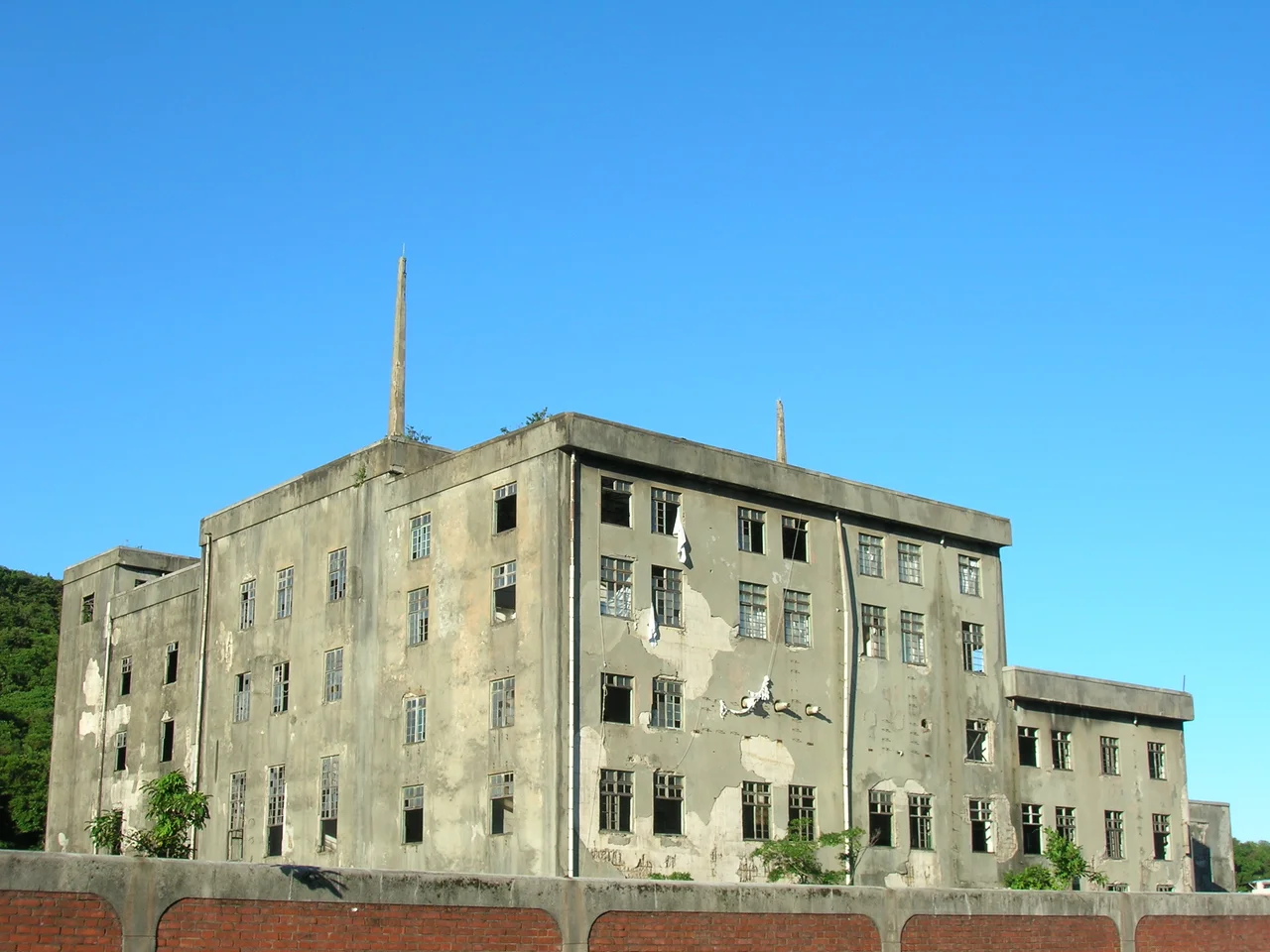

National Museum of Marine Science and Technology
The building generated electricity for forty-four years and then sat empty for another thirty-three. In between, it became something rare: an abandoned industrial structure that nobody demolished. The North Thermal Power Plant in Keelung, built by the Japanese colonial government in 1937 on reclaimed land, was the first power plant in Taiwan constructed on land that had not existed a generation earlier. When it finally reopened in 2014 as the National Museum of Marine Science and Technology, the turbine halls that once hummed with generators now echo with the voices of nearly 1.4 million annual visitors exploring the ocean's depths.
Power from Reclaimed Earth
The Japanese colonial administration built the North Thermal Power Plant in 1937, part of a broader effort to industrialize Taiwan's infrastructure. The plant's distinction was its foundation: it sat on reclaimed land along the Keelung coast, the first power generation facility in Taiwan built on ground that human engineering had wrested from the sea. For forty-four years, the plant supplied electricity to northern Taiwan. By 1981, it had become obsolete. Newer, more efficient plants had come online, and the North Thermal facility was decommissioned. But rather than being torn down, it simply sat. The massive concrete shell, designed to house industrial machinery, proved too substantial to demolish cheaply and too remote to attract developers.
The Long Conversion
Transforming an abandoned power plant into a world-class museum took nearly a quarter century of planning and construction. In 1990, a planning committee was established to explore the idea. Seven years later, a preparatory office was set up. In 1999, the Executive Yuan approved the construction plan. In 2001, the conversion concept was formally unveiled. Three more years passed before the Keelung City Government designated the building as a historical structure in 2004, protecting it from demolition while work continued. Premier Jiang Yi-huah finally opened the museum on January 26, 2014. The timeline speaks to the complexity of adaptive reuse, of taking a structure designed for one purpose and convincing it to serve another entirely.
Ocean Under One Roof
The museum's galleries cover the full spectrum of humanity's relationship with the sea. The Marine Environment Gallery examines ocean ecosystems and the forces that shape them. The Marine Science Gallery explores the physics and chemistry of seawater. A Naval Architecture and Ocean Engineering Gallery traces the evolution of shipbuilding, while the Fishery Science Gallery documents the practices that have fed coastal communities for millennia. The People and the Sea Gallery grounds the science in human experience. Below the main halls, the Wonders of the Deep Sea Gallery and the Deep Sea Theater take visitors into the abyssal zones where sunlight never reaches. A 3D IMAX Marine Theater adds spectacle, and the Kid's Exploration Zone ensures that the museum's youngest visitors leave with questions they did not arrive with.
Where Industry Meets the Tide
Beyond the main exhibition building, the museum complex extends to the Chaojing Ocean Center and its Coastal Ecology Exploration Park, where visitors can observe intertidal ecosystems in their natural setting. Rongxuan Park provides green space adjacent to the industrial architecture. The museum is accessible on foot from Haikeguan Station on the Taiwan Railway, a practical connection that links it to Taipei and the broader rail network. The setting itself tells a story. The museum sits where heavy industry once met the Pacific, on land that humans built and then filled with machines, and that now houses a different kind of engine: one designed to generate not electricity but curiosity about the ocean that surrounds Taiwan on every side.
From the Air
Located at 25.1406N, 121.7986E on the Keelung coast in Zhongzheng District. The museum complex occupies a large former power plant building on reclaimed land along the waterfront, identifiable by its substantial industrial architecture adjacent to the coast. Best viewed at 2,000-4,000 feet. Nearest airport is Taipei Songshan (RCSS), approximately 20 nm southwest. The Chaojing coastal area and Badouzi Fishing Port are nearby visual references. Haikeguan railway station is visible just to the south.
Nearby Stories
- Matsu New Village 5.9 km away
- Lanyang Museum 10 km away
- Singapore Airlines Flight 006 17 km away
- North Jiangsu Main Irrigation Canal 963 km away
- Sinking of MV Sewol 1031 km away
- General Cliff Rock Paintings 1039 km away
- Yellow Sea 1089 km away
- Sibuyan Island 1395 km away