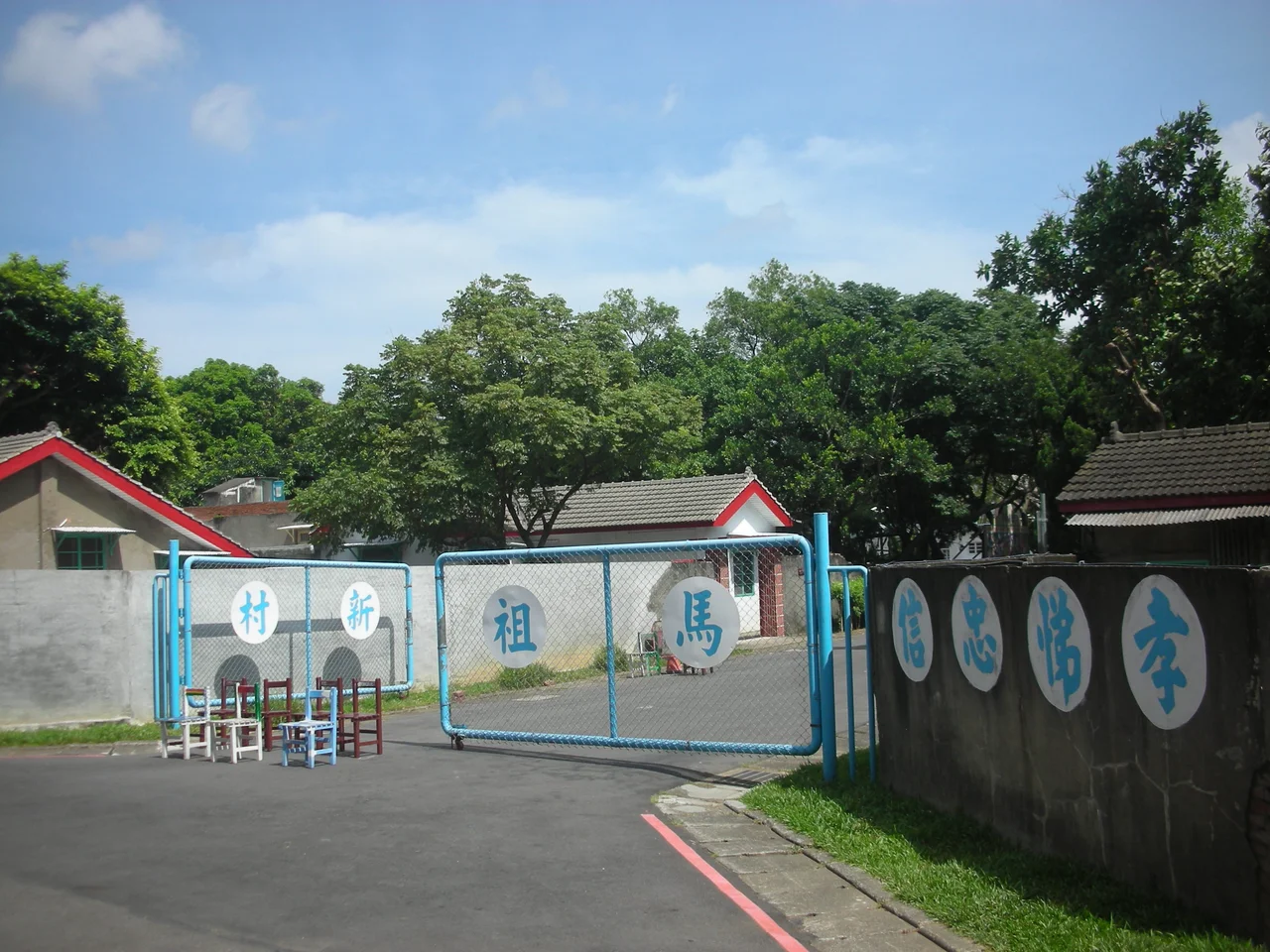

Matsu New Village
The village's name has nothing to do with where its residents came from. It takes its name from Soong Mei-Ling — Madame Chiang Kai-shek — who led an Armed Forces Entertainment Regiment to visit the garrison troops on the Matsu Islands as a morale-boosting gesture. When the new settlement in Taoyuan was named, that journey of solidarity was folded into its identity. Matsu New Village was built for officers, carries the memory of a first lady, and has survived long enough to become one of Taiwan's most important living records of the juancun era.
First Village, First Officers
Construction of the first phase of Matsu New Village was completed in 1957, less than a decade after the Nationalist government retreated to Taiwan following the loss of the Civil War to the Communists. The settlement was designed specifically for military officers: 84 army major-general level officers and lower ranking officers, along with their dependents, were allocated housing here. This made Matsu New Village notable from the start — it was the first military dependents' village of its kind built for officers in the Taoyuan area. The distinction mattered in the tightly stratified world of the juancun. Officer villages tended to have slightly better construction and more space than the crowded enlisted men's compounds, but all shared the fundamental condition of having been built as temporary shelter for people who expected to return to the mainland within a few years. The years stretched into decades.
The Name Behind the Name
Why name a village in landlocked Zhongli after a chain of small islands off the coast of Fujian? The answer lies in one of the Republic of China's most enduring figures. Soong Mei-Ling, Madame Chiang Kai-shek, was not merely a diplomat's wife — she was one of the most prominent political personalities of the twentieth century, known internationally for rallying American support for Nationalist China during World War II. Her decision to lead the Armed Forces Entertainment Regiment to visit troops stationed on Matsu was the kind of gesture that carried weight in the military culture of the time. Naming the new village after that visit was a way of honoring that spirit of solidarity. The Matsu Islands themselves — windswept, granite-studded, just a few kilometers from the mainland coast — remained symbols of Nationalist resolve throughout the Cold War. Their name, carried into a Taoyuan neighborhood, connected daily domestic life to a larger story of identity and survival.
The Taoyuan General Village
Over time, Matsu New Village earned an unofficial nickname: the Taoyuan General Village. The honorific acknowledged the settlement's origins as an officers' compound and its unusual degree of historical integrity. While most of Taiwan's juancun were gradually demolished as land values rose and residents aged out or moved on, Matsu New Village retained much of its original character. The low-rise residential blocks, the shaded lanes, the communal rhythms of a place built for people who shared a military background and a common displacement — these persisted through decades of urban change in Zhongli around it. Walking through the village today, visitors can see the kind of modest but dignified domestic architecture that defined a particular chapter of Taiwanese history: spaces built for temporary occupancy that became permanent homes.
Preservation and Recognition
In 2012, Taiwan's Ministry of National Defense selected Matsu New Village as one of thirteen sites across the country to be designated as national Cultural Preservation Areas for Military Dependents' Villages. It was the only village in Taoyuan to receive this distinction. The designation came at a moment when Taiwan was actively reconsidering how to relate to the juancun legacy — acknowledging both the political circumstances that created these communities and the genuine human culture that flourished within them. Preservation of the village involves restoration of the original structures, interpretive programming, and efforts to document the stories of families who lived there. The work is partly architectural and partly archival: saving buildings, but also saving the memories that lived inside them. Matsu New Village has since attracted visitors curious about an era of Taiwanese history that sits at the complicated intersection of war, exile, identity, and everyday life.
Flying Over the Western Plain
Matsu New Village sits in Zhongli District within Taoyuan City, on the broad western plain of northern Taiwan at roughly 200 meters elevation. The area surrounding the village is thoroughly urban now — Zhongli has grown into one of the major cities of the Taoyuan metropolitan area. But the village itself maintains its human scale, its lanes and buildings unchanged in spirit from the 1950s construction. Taoyuan International Airport (RCTP) lies just a few kilometers to the northwest, making this one of the juancun sites most easily reached by international travelers. On the approach to RCTP on clear days, the western plain unfolds below — the flat, densely populated coastal corridor where so much of post-1949 Taiwan was built, compressed, and improvised into existence by the million.
From the Air
Matsu New Village is located at 24.936°N, 121.2376°E in Zhongli District, Taoyuan City, Taiwan. Elevation is approximately 200 meters. Taoyuan International Airport (RCTP) is approximately 10 km northwest and is the main international gateway for northern Taiwan. On approach to RCTP, pilots and passengers can see the flat western plain where many of Taiwan's juancun settlements were built in the 1950s and 1960s.
Nearby Stories
- Former Residence of Chang Hsueh-liang (Hsinchu County) 3.8 km away
- Dawulun Fort 7.3 km away
- Cherry Orchard Cemetery 8.4 km away
- 2022 Chinese Military Exercises Around Taiwan 17 km away
- Suao 21 km away
- 2015 New Taipei Water Park Fire 28 km away
- Gaomei Lighthouse 33 km away
- Gaomei Wetlands 63 km away