
National Museum of Taiwan Literature
American incendiary bombs destroyed part of the building during World War II. Before that, it was the seat of Japanese colonial administration for Tainan Prefecture. Before that, the site served the Qing government. Today the former Tainan Prefectural Hall, constructed in 1916, holds approximately 130,000 literary artifacts in Taiwanese, Japanese, Mandarin, and Classical Chinese. The National Museum of Taiwan Literature is what happens when a country decides that its stories, written in four languages across three centuries of colonial rule, are worth preserving in a building that embodies every chapter of that complicated history.
A Building That Outlived Its Builders
The Tainan Prefectural Hall was built in 1916, during the Japanese colonial period, as a government administrative building. Its architecture reflects the Western-influenced style common to Japanese institutional buildings of the era. When American bombers targeted Tainan during World War II, parts of the structure were completely destroyed by incendiary fire. After the war, the building was patched together and repurposed, first as the Air Force Supply Command Headquarters, then as the Tainan City Government Hall. The repairs restored the historic section largely to its Japanese-period appearance, but decades of government use left the building worn. In 1992, scholars and cultural officials chose this battered survivor as the home for something Taiwan had never had: a national institution dedicated to its own literature.
The Gap That Needed Filling
The idea began at the 1990 National Culture Conference, convened by the Executive Yuan's Cultural Construction Committee. Scholars and experts argued that Taiwan lacked an authoritative institution for collecting and researching its literary materials. This was not an abstract complaint. Taiwanese literature had been written in at least four languages, suppressed under multiple regimes, and scattered across private collections, university archives, and personal libraries. Works in Taiwanese Minnan had been marginalized during periods of Mandarin-only policy. Japanese-language literature from the colonial period occupied an ambiguous cultural space. Tainan was chosen as the museum's location for its historical significance as Taiwan's oldest cultural center, and after years of administrative coordination and scholarly advocacy, the museum opened on October 17, 2003. It was designated a national historic site that same November.
Old Walls, New Stories
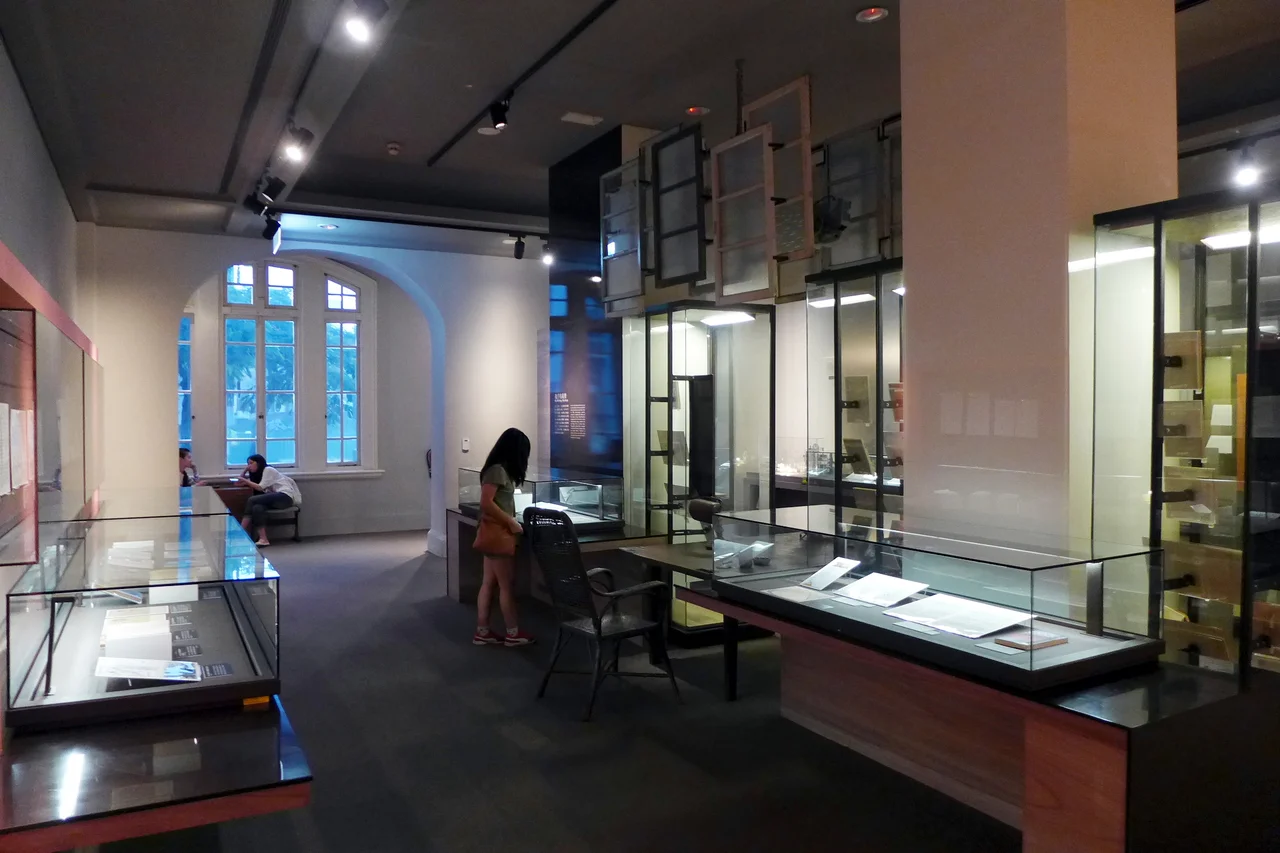
The museum today combines the restored historic building with modern construction, including two underground floors and two above-ground floors added after the war. The result is a deliberate act of architectural layering: Japanese-period facades sit alongside contemporary gallery spaces, each era visible and acknowledged rather than concealed. Inside, the museum researches, catalogs, preserves, and exhibits literary artifacts spanning the full range of Taiwan's linguistic and ethnic diversity. In 2021, it was elevated to a third-level central institution under the Ministry of Culture, a bureaucratic designation that reflects growing recognition of Taiwanese literature as a distinct field. A satellite facility, the Taiwan Literature Base, operates out of Japanese-style dormitories on Qidong Street in Taipei. Walking distance from Tainan Station, the museum sits at the heart of a city that has been writing its own story since the 17th century.
From the Air
The National Museum of Taiwan Literature is located at 22.992N, 120.2046E in the West Central District of Tainan, near Tainan Railway Station. The museum building, a Japanese colonial-era structure with a distinctive Western-influenced facade, is visible among the dense urban fabric of central Tainan. Tainan Airport (RCNN) is approximately 5nm to the south. The building's historical architecture makes it distinguishable from surrounding modern structures at lower altitudes.
Nearby Stories
- Chung Li-ho Museum 0.7 km away
- Jingzaijiao Tile-paved Salt Fields 8 km away
- Wanchin Basilica of the Immaculate Conception 9.3 km away
- Namasia District 16 km away
- Battle of Penghu 21 km away
- Shoushan (Kaohsiung) 21 km away
- Penghu Air Raids 62 km away
- Daya Bay 512 km away