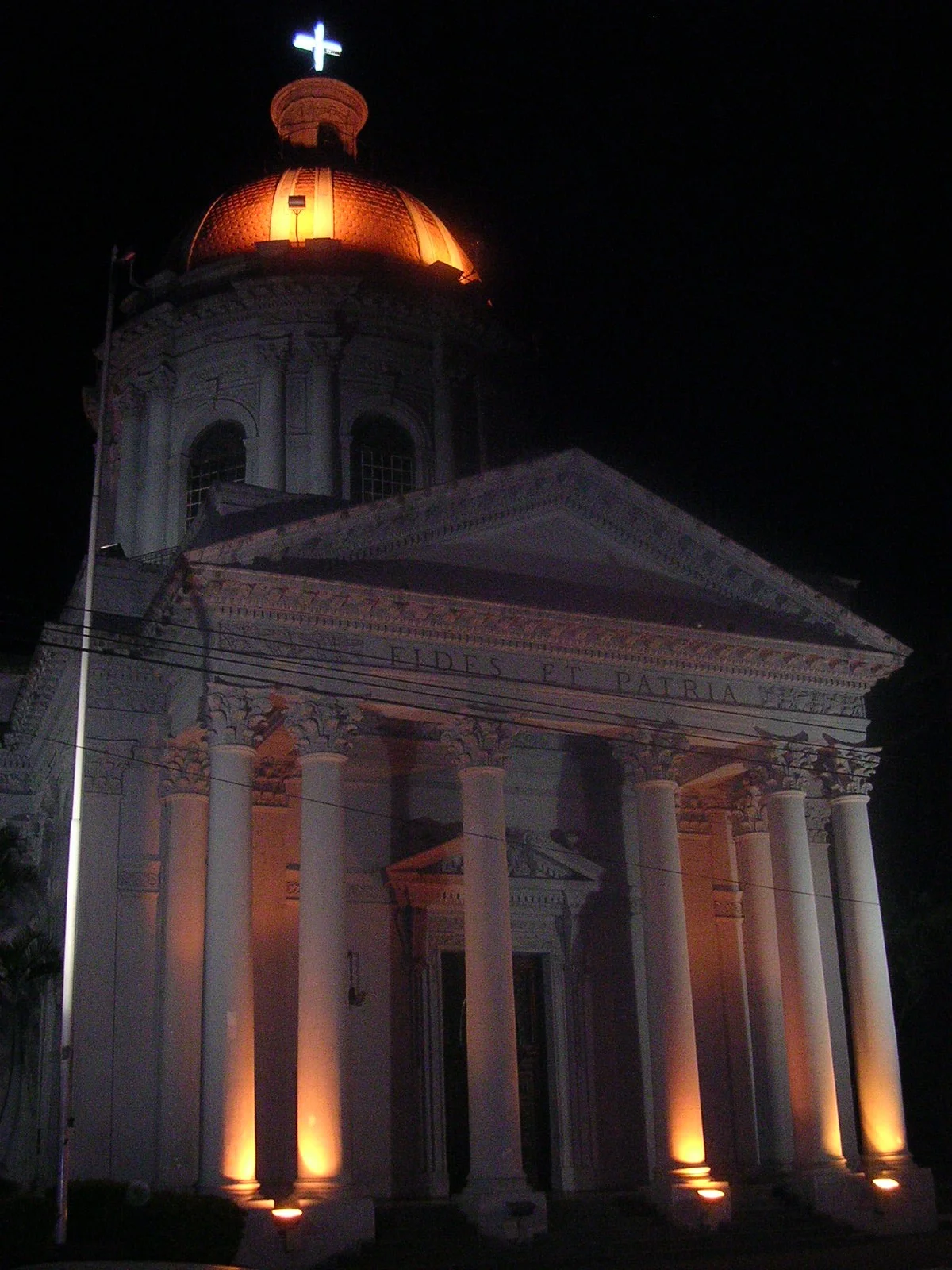

National Pantheon of the Heroes
For more than seventy years, the most important building in downtown Asunción stood half-built, wrapped in scaffolding, open to the rain. The man who ordered it raised would die leading his country into the deadliest war in South American history, a conflict that erased most of Paraguay's adult men. Only after a second war, generations later, did the nation finally finish the chapel he had begun and give it a new purpose. Today it holds the bones of the heroes who bled for the country, and a daily changing of the guard keeps watch over them in the heart of the capital. It is the closest thing Paraguay has to a national altar.
A Chapel Born in Wartime
In October 1863, President Francisco Solano López ordered the construction of a chapel honoring the Virgin of the Assumption, the patroness who gives Asunción its name. He hired the Italian architect Alejandro Ravizza, who worked alongside the builder Giacomo Colombino on a design of domes and columns meant to rival the great churches of Europe. Within two years López had marched Paraguay into the War of the Triple Alliance against Brazil, Argentina, and Uruguay. The fighting consumed the country. Work on the chapel stopped, and the unfinished walls stood exposed in the heart of the capital, a stalled dream surrounded by a nation in mourning.
The Children of Acosta Ñu
Among those who rest inside today are the child martyrs of the Battle of Acosta Ñu. By August 1869, Paraguay had lost so many men that General Bernardino Caballero fielded an army of roughly 3,500, most of them boys between nine and fifteen. They faced some 20,000 seasoned Brazilian and Argentine soldiers. To hide how young his troops were, commanders reportedly fastened false beards onto the smallest faces. Over eight hours the children fought and died on an open plain. Paraguay still marks August 16 as Día del Niño, Children's Day, mourning them rather than celebrating a victory. The Pantheon keeps their memory at the center of the city they could not save.
Faith and Fatherland
When the Chaco War with Bolivia ended in the 1930s, Paraguay at last completed the building, inaugurating it on October 12, 1936, as the National Pantheon of Heroes. Carved across the front is a Latin motto, Fides et Patria, faith and fatherland. Inside lie Carlos Antonio López, the country's first constitutional president, and his son Francisco Solano López, the very man who ordered the chapel built more than seventy years before. Nearby rests José Félix Estigarribia, the marshal who led Paraguay through the Chaco War, alongside his wife, and two Unknown Soldiers stand for all the dead who were never named. Honorary plaques sent by foreign kings and princes line the walls, along with verses of appreciation to the Paraguayan navy and air force, small diplomatic tributes to a country that had endured so much and survived.
The Living Square
The Pantheon is no quiet tomb. A ceremonial changing of the guard plays out several times a day, soldiers stamping across the stone in crisp formation while tourists and schoolchildren watch from the plaza. When something momentous happens in Paraguay, the people come here. After Fernando Lugo won the presidency in 2008, breaking sixty-one years of single-party rule, crowds streamed into the street out front, flags overhead, to mark the moment in the shadow of the dome. The building that began as one man's chapel has become the place where the whole nation gathers to remember, to grieve, and occasionally to rejoice. Its full name, the National Pantheon of Heroes and Oratory of the Virgin of the Assumption, still carries the memory of the chapel it was meant to be.
From the Air
The National Pantheon of the Heroes sits in downtown Asunción at 25.2822 degrees south, 57.6352 degrees west, between Palma and Chile streets, two blocks from the Paraguay River waterfront. Its pale dome and classical portico make a distinctive marker against the low colonial grid of the old city. Recommended viewing altitude is 1,500 to 2,500 feet for a clear look at the dome and the surrounding plaza. The Paraguay River, curving along the city's northwestern edge, is the easiest navigation reference. The nearest airport is Silvio Pettirossi International (ICAO: SGAS, elevation 292 feet) in nearby Luque, about 10 nautical miles northeast. Visibility is generally good year-round, though summer humidity and afternoon haze can soften the skyline.
Nearby Stories
- Yaguarón 21 km away
- Río Pilcomayo National Park 22 km away
- New Australia 45 km away
- La Colmena, Paraguay 46 km away
- Nueva Germania 120 km away
- Pilar, Paraguay 155 km away
- Concepción 174 km away
- First Battle of Nanawa 241 km away