
National Tramway Museum
In August 1948, a group of railway enthusiasts took a farewell ride on Southampton's dying tram system, climbed off at the depot, and pooled their money to buy one of the open-top cars they had just been riding in. Number 45 cost them ten pounds. They had no plan for what to do with it. From that absurd, sentimental purchase grew the Tramway Museum Society, and from the Society grew the largest collection of working trams in Britain - now installed in a Derbyshire limestone quarry that George Stephenson had once owned. The site is called Crich Tramway Village. Visitors ride electric trams that were built before electric light was common in homes, on a track that runs through a recreated Victorian high street into pasture and woodland above the Derwent Valley.
Stephenson's Quarry
Before the trams, there was lime. George Stephenson, the railway pioneer, lived his last ten years in Chesterfield, just over the ridge. While building the North Midland Railway from Derby to Leeds in the 1830s, he saw the chance to combine the rich coal seams he had found at Clay Cross with the limestone at Crich and turn the combination into burnt agricultural lime, distributable by his own railway. He bought Cliff Quarry. To link the quarry with his limekilns at Ambergate, three miles south, he built what was apparently the world's first metre-gauge railway. Stephenson died in 1848 and was buried in Holy Trinity Church, Chesterfield. The quarry kept working until 1957. When it closed, parts of his old narrow-gauge railway were still in the ground.
The Talyllyn Detour
By the late 1950s, the Tramway Museum Society had collected several trams and nowhere to put them. They were searching the country for a site when they heard that members of the Talyllyn Railway Preservation Society - the pioneers of the British railway preservation movement, in Wales - were salvaging rails from Stephenson's old mineral line at Crich and shipping them to Wales for their own narrow-gauge line. The Society followed the rails back to the quarry. They walked the site, agreed to lease part of it from the local authority, and in 1959 began the work that would last the rest of their lives. The first horse-drawn tram service ran in 1963. The first electric tram service ran in 1964. In 1967 the Society made a decision that defined everything since: rather than display the trams in a shed, they would recreate the kind of streetscape the trams had once run through.
The Salvaged Village
The buildings of Crich Tramway Village are real, just not from Crich. The Georgian facade of the Derby Assembly Rooms, built in 1763 and Grade II listed, was carefully dismantled in the city centre in 1972 and rebuilt here, reopening in 1976, as the museum's entrance front. The cast-iron tram shelter at Town End probably came from Birmingham. The Bundy clock that once regulated tram departures in West Bromwich is here. So is a cast-iron public urinal from Reading Corporation Tramways. A 1930s police box from London's Metropolitan Police, a 1920s police call post, an 1872 Penfold pillar box, a 1921 K1 telephone box - all Grade II listed in their own right - line the cobbled street. The effect is uncanny. The Victorian town never looked exactly like this, because no Victorian town ever held quite this concentration of municipal hardware. But every individual piece is the genuine article.
The Trams Themselves
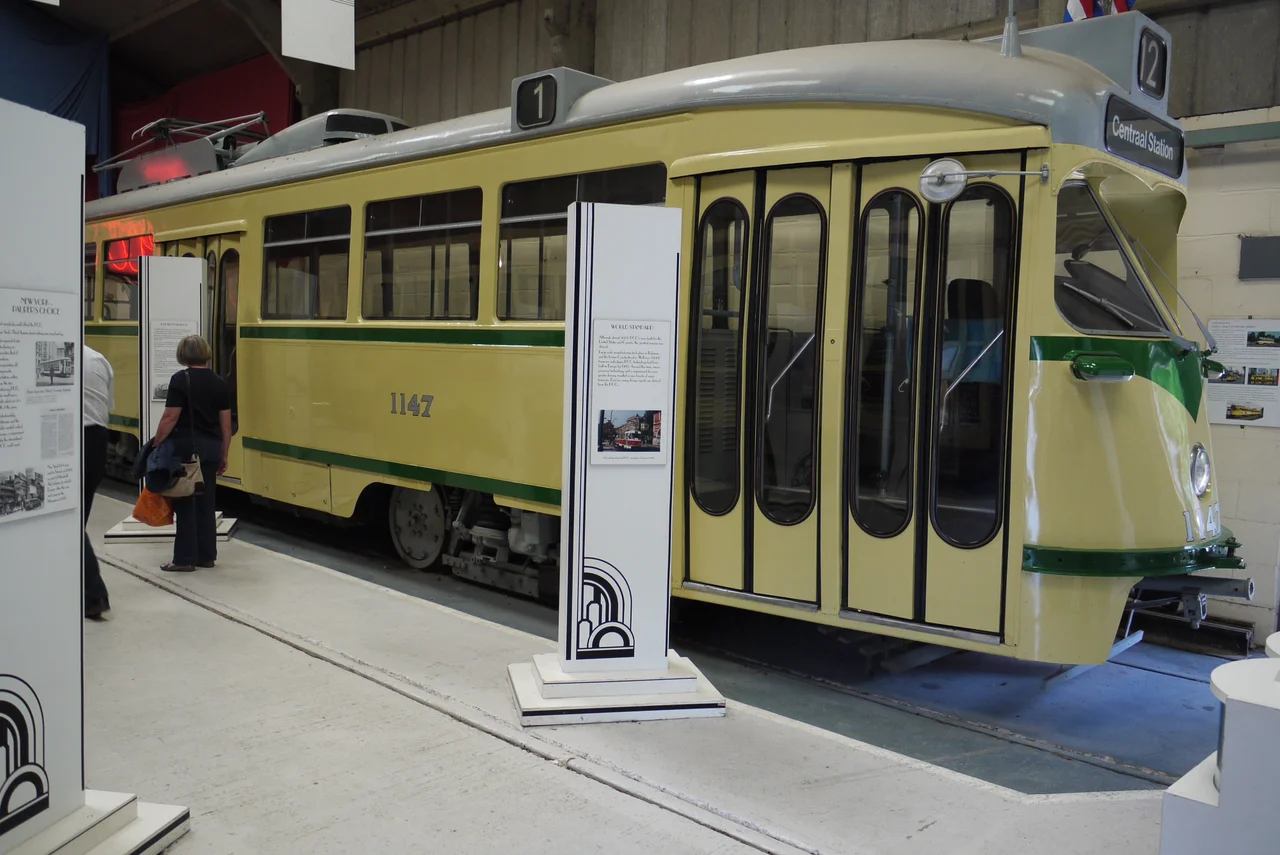
The collection covers more than a century of street transport. Sheffield 15, a horse-drawn tram from 1874, was the museum's first runner; it still does occasional horse-tram days. Blackpool 4, built in 1885 for the opening of Britain's first electric street tramway, has been at Crich since 1973. Southampton 45, the founding ten-pound car of 1903, runs again. London United Tramways 159, built in 1902 to a luxury specification for affluent western-suburb routes between Hampton Court and Hammersmith, is one of the most beautifully restored cars in the country. Glasgow 1282, a 1940 Coronation streamliner once described as the finest short-stage carriage vehicle in Europe, glides through the village like a chrome ocean liner. Sheffield 510 entered service in 1950 and was withdrawn nearly new when Sheffield closed its system in 1960; the city had decorated it as its last tram, and it still wears that decoration.
Beyond the Village
The mile-long running line begins at Town End, runs through the period street, ducks under the Bowes-Lyon Bridge, and emerges into the recreated Victoria Park - centrepiece a bandstand that used to stand in Longford Park, Stretford. Past the park, the tracks transition from grooved street rail to sleeper-laid country tramway, single track, climbing the hillside above the quarry. Beyond Wakebridge the line emerges onto an open hillside with views westwards across the Derwent Valley, which UNESCO has inscribed as a World Heritage Site for its early industrial mills. From the end of the line at Glory Mine, a footpath leads up to Crich Stand, a hilltop tower visible from much of the surrounding country. The Woodland Walk between Victoria Park and Wakebridge passes through native ash and sessile oak woodland on limestone soil, with sculptures by Andrew Frost carved from tree trunks with a chainsaw. They weather, split, and are replaced; the gallery is always changing. The museum opens from early March to early November, every day except Fridays in low season.
From the Air
The National Tramway Museum sits at 53.0893°N, 1.4863°W in the village of Crich, Derbyshire, on a limestone ridge above the Derwent Valley. From the air, look for Crich Stand - a square stone memorial tower on the hilltop - and the long scar of the former Cliff Quarry to its east; the tramway runs along the western edge of the quarry. Recommended viewing altitude is 2,500 to 3,500 feet AGL; the ridge tops out around 950 feet AMSL. East Midlands Airport (EGNX) lies about 22 nautical miles south-southeast, Sheffield City Heliport (EGSY) about 18 nautical miles north, Manchester (EGCC) about 38 nautical miles west-northwest. The Derwent Valley Mills World Heritage corridor runs west and south, with Cromford Mill about 4 nautical miles southwest. Expect typical Peak District weather with low cloud and orographic precipitation.
Nearby Stories
- Nottinghamshire 3.7 km away
- RAF Finningley 5.5 km away
- Grantham Canal 7.2 km away
- Repton Abbey 7.9 km away
- Manchester 8.8 km away
- Macclesfield 9.7 km away
- Wentworth Castle 11 km away
- Broad Eye Windmill 12 km away