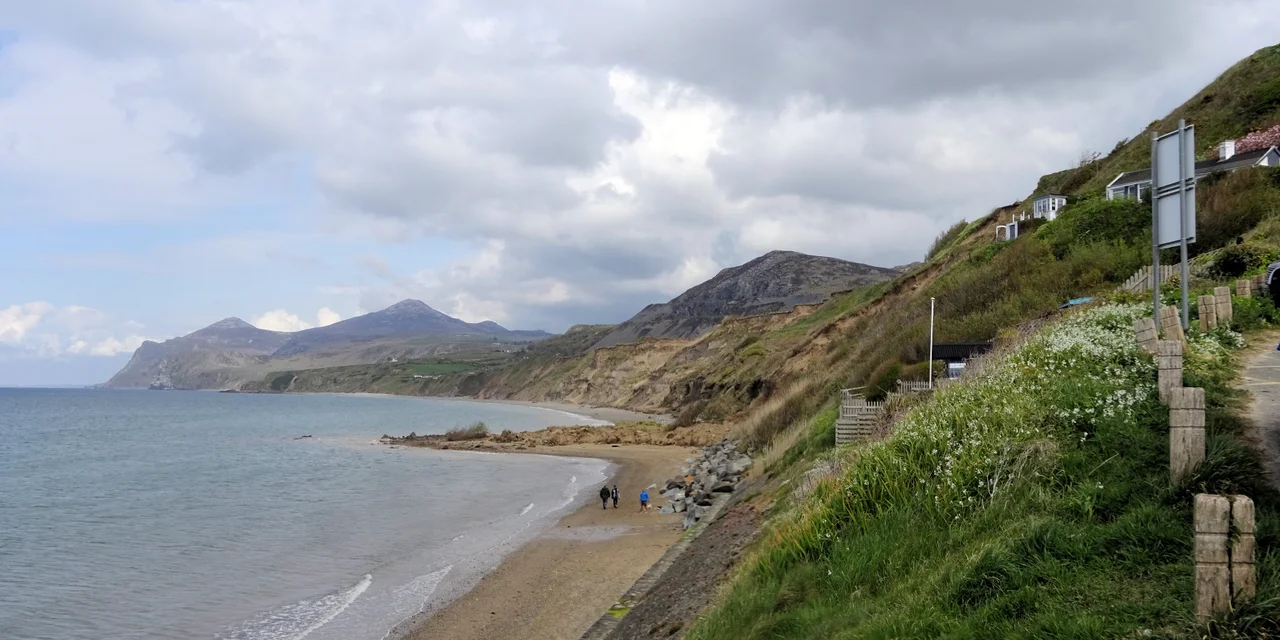

Nefyn
Edward I came to Nefyn in July 1284 with the conquest of Wales finally complete, his armies marching home through the peninsula, his treasurer's books closing on the cost of a war that had killed the last native Prince of Wales. The English king celebrated with a tournament -- one of the first recorded jousts in Britain -- on the open ground above the bay. Foreign knights came, and Welsh ones who had made their peace with the new order, and the town that hosted them was already centuries old. The hillfort of Garn Boduan overlooking Nefyn dates from 300 BC, and the remains of 170 round stone huts and ramparts still cover the 917-foot hill.
Gruffudd's Landing and Gerald's Pillow
Nefyn first appears in writing in the late eleventh century, when the chroniclers record that the Welsh prince Gruffudd ap Cynan landed here on his return from exile in Ireland to reclaim Gwynedd. Gerald of Wales -- Giraldus Cambrensis, the Norman-Welsh chronicler -- passed through in 1188 on his recruiting tour for the Third Crusade and wrote that he slept at Nefyn on the eve of Palm Sunday. It was a town that mattered: the seat of the commote of Dinlaen within the cantref of Llyn, and after Edward's tournament the king saw fit to make it a free borough in 1355. The old St Mary's parish church, whose foundations date from the sixth century, would have been a staging post for pilgrimages to Bardsey Island off the tip of the peninsula. The present church building went up in 1827 and now houses the Llyn Maritime Museum. Since 2013 archaeologists have been digging beneath it, uncovering a thirteenth-century brooch and the cist-grave remains of a woman buried between 1180 and 1250.
Nefyn Beef
From at least the eighteenth century, Nefyn lived on herring. The town's coat of arms still bears three of them. The catch was so important to the local economy that herring were called 'Nefyn beef' -- the protein staple of a community whose livestock was scarce and whose harvest could fail. In 1910 the town still had forty herring-fishing boats. Then the First World War came, the fish stocks moved, and the trade collapsed almost overnight. The age of sail produced its own peculiar prosperity: Nefyn nurtured ships' captains in dozens, and shipbuilding ran in yards along the bay. Three miles south-west, at Madryn Castle, lived Sir Love Jones-Parry, whose 1862 voyage with Lewis Jones to Patagonia helped establish the Welsh-speaking colony in Argentina. Nefyn and Puerto Madryn -- the Argentine port named for Sir Love's estate -- are formally twinned to this day.
The Golf Course on the Cliffs
Nefyn and District Golf Club was formed in 1907, added a second nine in 1912 and a third nine in 1933, and now offers a front ten followed by a choice of two back eights. The course runs along the narrow Porthdinllaen peninsula, with fairways set high on sea cliffs and the bay glittering below. It is the kind of golf course where a sliced drive can clear a cliff and finish in the Irish Sea, and where the eighteenth hole at the Ty Coch Inn is taken literally by walking down to the pub for a pint. Beyond the golf, Nefyn has its sandy beach, its one substantial hotel, a community pub and a beach cafe; the A497 ends in the town centre because there is nowhere further to drive. About 74 percent of Nefyn residents speak Welsh, putting it twenty-eighth on the list of Welsh-speaking communities in Wales.
Landslides and Tremors
The coast around Nefyn is alive in ways that occasionally remind the town it sits on rough ground. On 19 July 1984 an earthquake measuring 5.4 on the Richter scale had its epicentre near Nefyn -- one of the strongest tremors recorded in Britain in recent times, though structural damage was light. On 19 April 2021 a landslide brought a cliff down at Rhodfa'r Mor, damaging gardens but injuring no one. A further slip in October that year blocked vehicular access to the beach at Y Lon Gam. The British Geological Survey monitors the cliffs continuously now. Singer Duffy was born in Nefyn, as were the harpist John Parry -- known as Parry Ddall Rhiwabon, Blind Parry of Rhiwabon -- and the children's author Elizabeth Watkin-Jones. The fishing fleet is gone. The herring are gone. The cliffs keep moving. The Welsh keeps being spoken.
From the Air
Located at 52.94N, 4.52W on the north-west coast of the Llyn Peninsula. Caernarfon Airport (EGCK) lies 14nm north-east. RAF Valley (EGOV) lies 23nm north on Anglesey. Best viewed at 1,500-3,000ft AGL on a coast-following track. The town sits behind a sandy bay; the Porthdinllaen peninsula projects north-west, with the famous Nefyn golf course laid out on its cliff-top. Yr Eifl's three peaks rise inland to the north-east.
Nearby Stories
- GeoMôn 1.9 km away
- Battle of the Conwy 3.2 km away
- Irish Sea Bridge 5.2 km away
- Ysbyty Ifan 10 km away
- Machynlleth 16 km away
- Barmouth Lifeboat Station 23 km away
- Irish Sea 27 km away
- HMS Tyler 32 km away