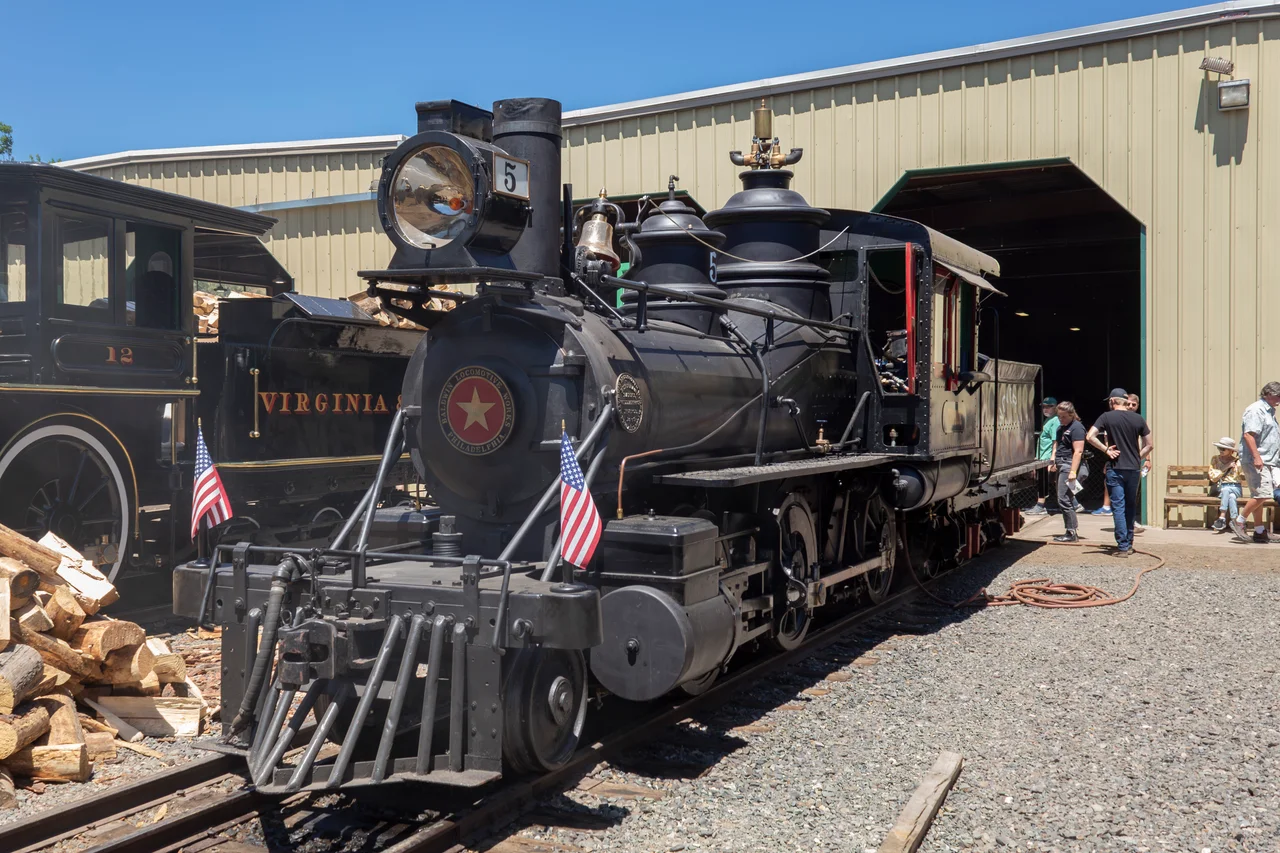

Never Come, Never Go: The Railroad That Hauled $200 Million in Gold
They called it the Never Come, Never Go. The nickname was affectionate, mostly -- the kind of ribbing that riders reserve for a train that runs on its own schedule through country too steep and too winding for hurry. But the Nevada County Narrow Gauge Railroad always did come, and it always went, for sixty-seven years without interruption, hauling $200 million in gold out of the Sierra Nevada foothills without a single attempted robbery. Every combination coach carried a small iron safe in its baggage compartment. Nobody ever tried to crack one open. Perhaps the bandits assumed a train that narrow and that slow could not possibly be carrying anything worth stealing.
The Committee of Twenty
On January 24, 1874, a civil engineer named Charles Marsh gathered nineteen other prominent citizens of Nevada City to form a committee with a single purpose: build a railroad from the Gold Rush towns of Nevada City and Grass Valley south to Colfax, where it would connect with the transcontinental Central Pacific line. Marsh, who had helped found the Central Pacific Railroad itself, purchased $10,000 in stock -- a five percent stake. By March, the California legislature and Governor Newton Booth had approved the right to build, and by June, an Act of Congress granted right of way through public lands. Construction began in January 1875 with 600 men employed within two months. The narrow gauge tracks ran 22.53 miles, climbing 1,159 feet and descending 1,042 feet from Colfax, threading through stations at You Bet, Chicago Park, and Grass Valley before reaching Nevada City.
The Woman Who Ran the Railroad
John Flint Kidder, the chief engineer who built the line, settled in Grass Valley and became the railroad's general superintendent, then its second president in 1884. When Kidder died in 1901, his widow Sarah took over the presidency, becoming by all accounts the first female railroad president in the world. She ran the NCNGRR for twelve years, overseeing the construction of a 3.56-mile cutoff in 1907 that improved the grade, and the completion of the Bear River Bridge in 1908 -- at the time, the highest railroad bridge in California. By 1912, under her leadership, the railroad was running three mixed trains daily each way between Nevada City and Colfax, with a fourth daily run between Grass Valley and Colfax. Sarah Kidder sold her interests in 1913 and retired to San Francisco, leaving behind a railroad that functioned as smoothly as any in the state.
Gold by the Trainload
The narrow gauge's primary cargo was the reason Nevada County existed at all: gold. Mining operations born of the California Gold Rush needed a way to move ore, equipment, and people through semi-mountainous terrain where wagon transport was slow and expensive. When the railroad arrived, freight rates dropped to a fraction of their former cost, stimulating every form of economic activity in the region. Timber operators gained access to markets via the Southern Pacific connection at Colfax. Fruit and grape growers in Chicago Park shipped their harvests. But gold was king. Two hundred million dollars' worth of it rode those narrow tracks during the railroad's lifetime, secured in small iron safes that no one ever attempted to rob. The NCNGRR was the economic bloodline of the county -- a fact that would make its eventual disappearance all the more stark.
One Dollar, Then Silence
In 1926, Earl Taylor and his associates purchased the entire railroad for one dollar. The automobile and paved roads had eroded the passenger business, and the mines that had sustained freight traffic were winding down. Taylor ran the line for sixteen more years, but when World War II broke out, he sold the railroad to Dulian Steel Products Company in 1942 for $251,000. The company wanted the metal, not the trains. On May 29, 1942, the last train ran over the line. The tracks were pulled up. The bridges came down. The stations closed. In 1976, exactly one hundred years after the inaugural run from Colfax to Grass Valley, the historical fraternity E Clampus Vitus erected a marker near the old NCNGRR depot in Colfax -- the southern terminus where it all began and where, in the end, there was nothing left but the memory of a whistle echoing through the pines.
From the Air
The Nevada County Narrow Gauge Railroad route ran from Colfax (39.100N, 120.953W) north through Grass Valley to Nevada City, a distance of 22.53 miles through the Sierra Nevada foothills. The route is no longer visible as intact track, but the corridor can be traced through the terrain. Key landmarks include the former Bear River Bridge site and the Nevada County Narrow Gauge Railroad Museum in Nevada City, which houses restored Engine No. 5. Nearby airports include Nevada County Airport (KGOO) approximately 3 miles south of Nevada City and Auburn Municipal Airport (KAUN) approximately 18 miles south of Colfax. Best viewing altitude is 3,000-4,000 feet AGL to trace the full route through wooded, hilly terrain.
Nearby Stories
- Sutter National Wildlife Refuge 10 km away
- The Lake That Swallowed a Gold Rush Town 13 km away
- Griffith Mansion 20 km away
- The Yuba County Five 34 km away
- Honey Run Covered Bridge 40 km away
- Western Pacific Railroad Museum 49 km away
- New Melones Dam 100 km away