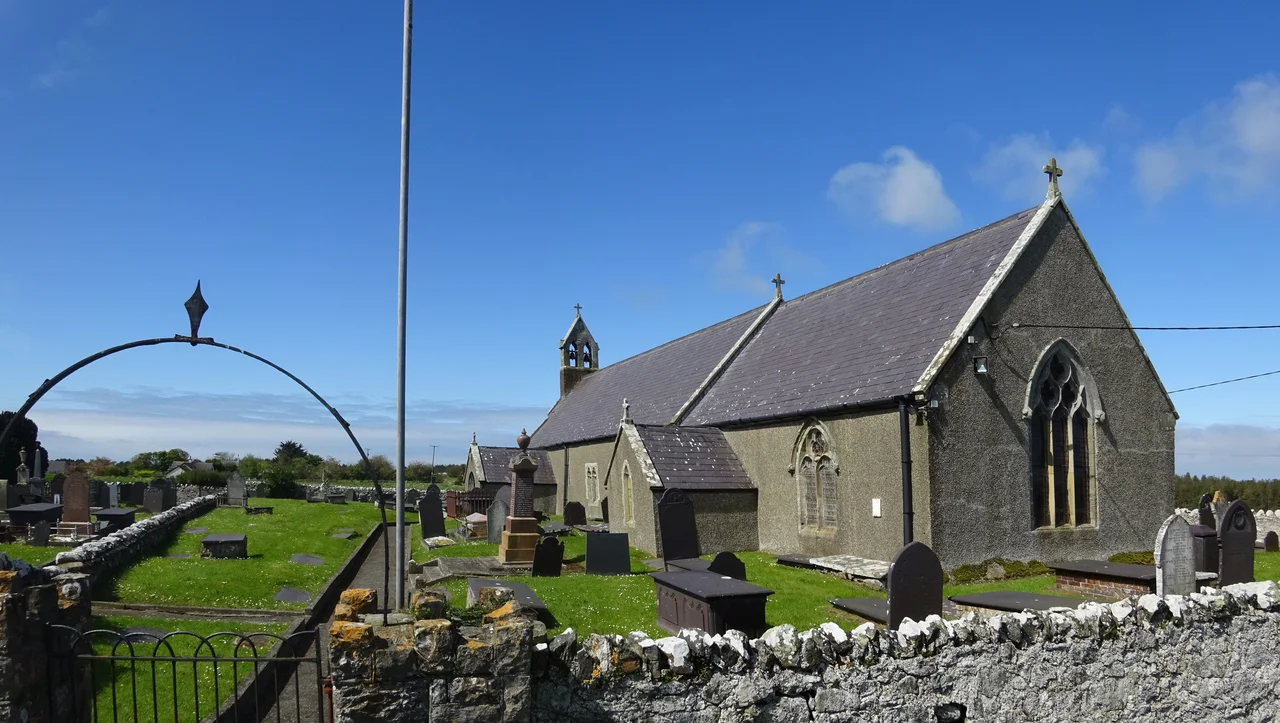

Newborough, Anglesey
In 1294, Edward I evicted the citizens of Llanfaes from their town on the eastern shore of Anglesey. He needed the land to build a fortified borough called Beaumaris, a Norman-French name meaning "beautiful marsh," which was anything but. The displaced Welsh had to go somewhere. They were marched across the island to the opposite coast and dropped beside the royal court at Llys Rhosyr, in a town that had been called Rhos Vair. The town was renamed Newborough - the literal English translation of a Welsh borough chartered new. The royal charter came through in 1303. Seven centuries later, the village is small, quiet, and surrounded by sand. Its name is the only reminder that everyone here is descended from a relocation order.
Royal Court, Planted Town
Before the eviction the place was already significant. Rhosyr was the royal demesne and seat of governance for the commote of Menai, with Llys Rhosyr - the prince's court - just on the outskirts. The court dated from 1237 and would remain in use for less than a century before the conquest swept Welsh princely rule away. When Newborough was chartered in 1303 it was given the status of a corporation and a guild mercatory among other privileges - the kind of trading rights that allowed a town to control its own markets. During Edward III's reign in 1327 those privileges were confirmed again. At its medieval peak the town had about 93 houses around the royal manor, and a steward of the English Crown collected ten pounds a year in salary for running the district. Repairs to Llys Rhosyr were still being made into the 14th century, suggesting the old Welsh court continued to function as a building even after the princes who built it were gone.
The Poet Who Sang Newborough's Hospitality
Dafydd ap Gwilym - arguably the greatest Welsh poet of the Middle Ages and one of the great European poets of his century - wrote a cywydd in praise of Newborough in the 14th century. His subject was the town's generous hospitality, especially toward visiting poets. He described it as both a sanctuary and a place of joyful abundance, conjuring vivid images of wine, mead, and song flowing through the hall. That a poet of Dafydd ap Gwilym's stature would compose a praise poem specifically about Newborough's welcome tells you something about the town's place in 14th-century Welsh culture: it mattered enough to be courted. The Pritchard-Jones Institute - the community hall in the centre of the village - was built between 1902 and 1905, a Neo-Tudor structure with a clock tower designed by Roland Lloyd Jones for £20,000. The money came from John Pritchard-Jones, a local boy who had risen to become chairman of the Dickins & Jones department store in London. The institute still serves as the village's social heart.
Saint Dwynwen's Island
South of the village, beyond the great pine plantation of Newborough Forest, a tidal sand causeway runs out to Ynys Llanddwyn. On the island stand the ruins of a 16th-century church dedicated to Saint Dwynwen, a Welsh princess and saint traditionally said to have died around 465 CE. Dwynwen is the Welsh patron saint of lovers - Wales's equivalent of Saint Valentine, and her feast day on 25 January is celebrated across the country with cards, flowers, and chocolate. The beach approach is a sandy Blue Flag stretch popular with kitesurfers, and at low tide you can walk dryshod onto the island. The view from its tip - lighthouses, ruined chapel, the snow-capped Snowdonia mountains rising across the sea - is one of the great panoramas in Wales. Just outside the village proper sits Tacla Taid, which translates roughly as Grandpa's Stuff, the Anglesey Transport and Agriculture Museum - the largest of its kind in Wales, with old tractors, motorcycles, and farm machinery filling several barns.
Dragons and Demi Moore
Newborough's combination of dramatic dunes, pine forest, empty beach, and mountain backdrop has made it a frequent film location. The 2006 horror film Half Light, starring Demi Moore, used the coast as a brooding lighthouse setting. The 2010 historical fantasy remake of Clash of the Titans filmed sequences here. Most recently, House of the Dragon - HBO's Game of Thrones prequel - shot major scenes in the area during the 2022 production. The BBC's Coast series has visited multiple times. The 2011 census recorded 892 people living in the village; the 2021 census showed a slight decline to 839. Today Newborough is part of the community of Rhosyr, restoring at the administrative level the older name that Edward's planning erased. The Welsh language is still everyday speech for the majority; sixty-eight per cent of residents were born in Wales. Seven hundred and twenty-two years after the charter, the eviction still echoes faintly through the place names. The town has settled in.
From the Air
Coordinates 53.165°N, 4.359°W on the south coast of Anglesey. RAF Valley (EGOV) lies 17 km northwest, and Caernarfon Airport (EGCK) sits 10 km southeast across the Menai Strait. The village clusters at the inland edge of the great Newborough Warren and Forest complex. Ynys Llanddwyn juts out to the south-southwest as a long, narrow island with two lighthouses. The Snowdonia mountains rise dramatically beyond the strait to the south. Best viewed at 2,000 to 3,000 feet on a clear day, ideally at low tide when the sand causeway to Ynys Llanddwyn is fully exposed.
Nearby Stories
- Wakestock 1.7 km away
- Trefriw 3.8 km away
- Irish Sea 8.7 km away
- Irish Sea Bridge 20 km away
- East–West Interconnector 30 km away
- Machynlleth 36 km away
- HMS Tyler 41 km away
- New Brighton Lifeboat Station 54 km away