_-_img_02.jpg)
Ngũ Hành Sơn
Five elements, five mountains. The Vietnamese name, Ngũ Hành Sơn, encodes a cosmology: Kim (metal), Thủy (water), Mộc (wood), Hỏa (fire), and Thổ (earth). Each peak in this cluster of marble and limestone hills south of Da Nang is assigned one of these elemental forces, and the assignment is not arbitrary — it places these particular outcrops at the center of a framework that organizes the natural world. To visitors who know only the English name, 'Marble Mountains,' the hills are scenic. To those who understand what they are named for, they are a diagram of the cosmos, rising unexpectedly from the flat coastal plain.
Stone That Shaped a Craft Tradition
The marble and limestone of these hills has been worked by local artisans for generations, and the area around Ngũ Hành Sơn became famous across Vietnam for stone sculpture. Workshops lining the roads nearby still produce statues, architectural elements, and decorative objects — though direct quarrying from the mountains themselves has been banned in recent years, with materials now brought from Quảng Nam Province to protect the hills' integrity. The ban came after the Ministry of Culture, Sports and Tourism granted the Marble Mountains the National Special Relic certificate on 20 January 2019, formally recognizing their cultural, historical, and natural significance. The sculpture tradition continues; the mountains that originally fed it are now protected.
Grottoes and Sanctuaries
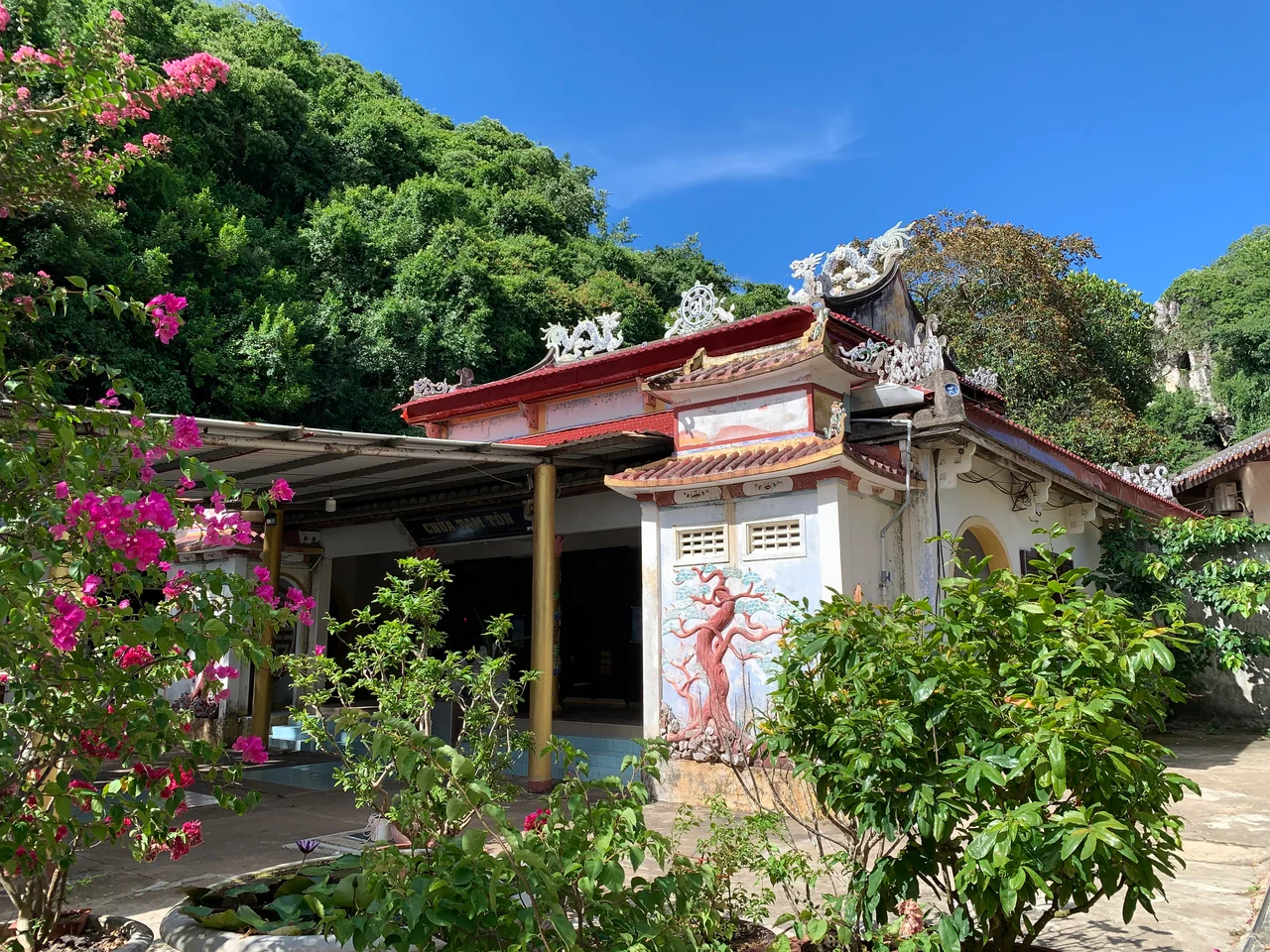
Beneath and within the peaks, the mountains open into a network of caves and grottoes that have served as places of worship for centuries. Mount Thủy is the one visitors can climb — 156 steps to a summit with panoramic views of the surrounding coastal plain and the other four mountains. Inside and on its flanks are the grottoes of Huyen Khong and Tang Chon, the temples of Tam Thai, Tu Tam, and Linh Ung, and the pagoda of Pho Dong. Buddhist and Hindu sanctuaries coexist here; the walls and niches hold statues and relief carvings cut directly from the marble. Among the objects found at Ngũ Hành Sơn is a Cham sculpture of Vishnu mounted on Garuda, dateable to the eighth or ninth century CE and linked stylistically to the Mỹ Sơn E1 school — evidence that the Cham, who built their great temple complex 40 kilometers away, also consecrated these hills.
Hidden in Plain Sight
During the Vietnam War, the Marble Mountains acquired a different kind of significance. The American Marble Mountain Air Facility — a major US Marine helicopter base — operated directly at the foot of the hills. American personnel could see the peaks from their bunks. What they apparently could not see was what was inside them. Writer William Broyles Jr., who served in Vietnam, later described the mountains as containing a Viet Cong field hospital, operating within earshot of the American airfield. He recalled the enemy as being 'certain of our ignorance' — so confident the Americans would not think to look inside the mountains they camped beneath that the hospital was hidden in plain sight. It is one of the Vietnam War's more striking ironies: a well-equipped American military installation overlooked by hills that sheltered the people they were fighting.
The Mountains Today
Ngũ Hành Sơn is a busy tourist destination, easily reached from Da Nang city and from the beach resorts of An Bang and Mỹ Khê. Visitors climb the stairs to Mount Thủy's summit, explore the cave temples, and browse the sculpture workshops below. The National Special Relic designation has brought both protection and attention. What remains striking is the density of history compressed into a small area: Cham religious sculpture from the eighth century, Buddhist and Hindu sanctuaries of indeterminate age, a record of wartime concealment, and a living craft tradition that shaped Vietnamese decorative arts. The five mountains named for the elements carry all of it — metal, water, wood, fire, earth — quietly, as mountains do.
From the Air
Ngũ Hành Sơn lies at 16.00°N, 108.26°E, approximately 9 km south of central Da Nang and 2 km inland from the South China Sea coastline. From the air, the five marble peaks are unmistakable — isolated rocky outcrops rising sharply from a flat coastal plain of rice paddies and urban development. The tallest, Mount Thủy, is the most prominent. Da Nang International Airport (VVDN) is approximately 7 km to the northwest; the former Marble Mountain Air Facility site (now the Da Nang Helicopter Base) lies 1–2 km to the northwest of the mountains. Recommended viewing altitude is 2,000–4,000 feet. The beach and the South China Sea are clearly visible to the east; the Thu Bồn river and Hội An lie to the south.
Nearby Stories
- Mỹ Sơn 6.7 km away
- Tomb of Tự Đức 9.5 km away
- Chàm Islands 16 km away
- Thiên Mụ Temple 41 km away
- Chu Lai Air Base 47 km away
- Tomb of Gia Long 54 km away
- Dong Ampham National Biodiversity Conservation Area 81 km away
- Battle of the Paracel Islands 321 km away