
North Berwick Lifeboat Station
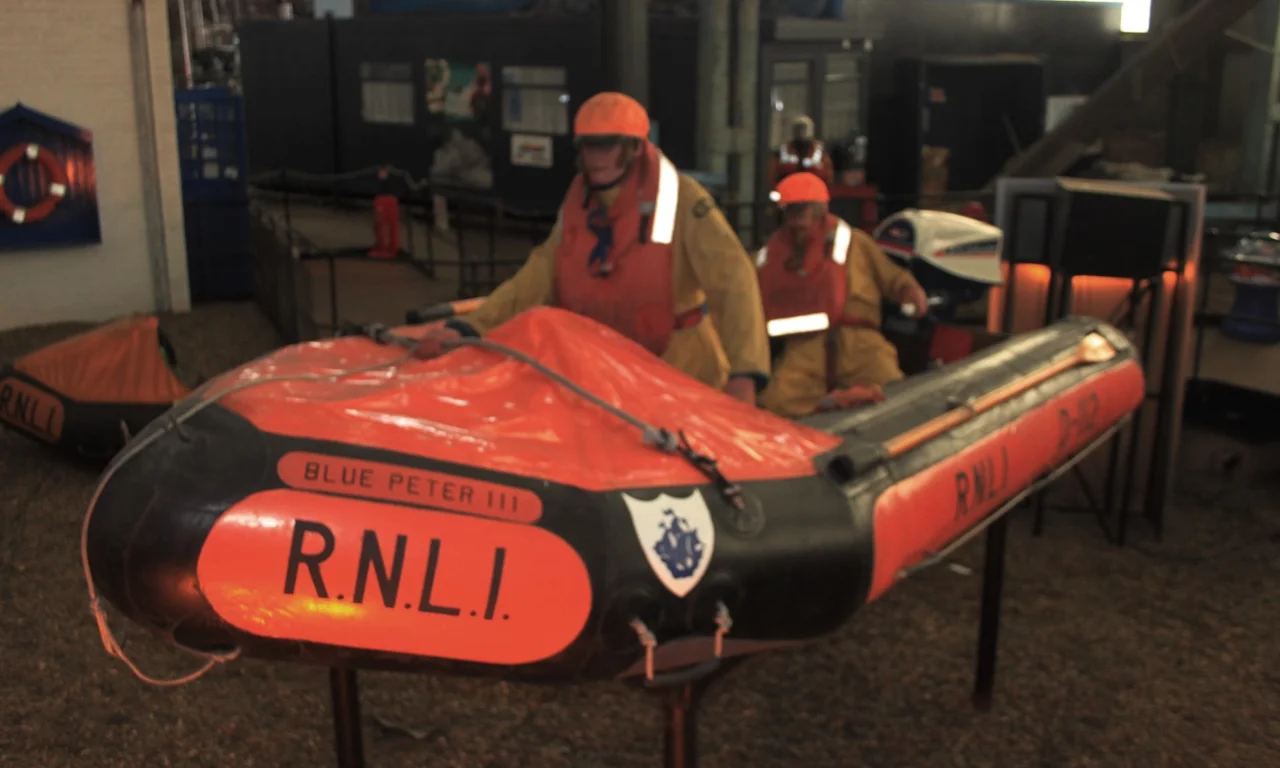
It is hard to imagine a charity drive succeeding so well that it embarrasses its own organizers, but on 5 December 1966 the BBC children's programme Blue Peter asked viewers to send in 60,000 paperback books, the resale of which would fund a single inshore lifeboat. More than four times that many books arrived. The Royal National Lifeboat Institution ended up able to buy four lifeboats instead of one. North Berwick, whose station had been closed for forty-two years, got one of them. Blue Peter III, registration D-112, slid down the launching ramp on Victoria Road in 1967, and the town that had once watched five sailors die within sight of the shore was back in the rescue business.
The Wreck That Started It
The schooner Bubona was heading to Aberdeen from Newcastle on Tuesday 25 October 1859, carrying coal in worsening weather. By nine in the evening the wind was nearly hurricane force. Her sails went, she ran for shore, and she grounded off Canty Bay just east of North Berwick. The Rocket Brigade got a line to her, but the crew were past being able to use it. A crowd gathered onshore in the dark. Around midnight they watched the vessel break apart, and all five of her crew drowned. The town had no lifeboat. The mass witnessing of the Bubona's loss prompted a campaign led by the Reverend Stewart of Liberton and two coastguards, and within a year the RNLI had established a station on Shore Street. The Town Council leased the ground for a penny a year.
Caroline and Her Successors
Messrs. Jaffray and Son of St Mildred's Court, London paid the 180 pounds the lifeboat, carriage, and equipment cost. They asked that she be named Caroline. After a grand parade through North Berwick directed by Sir Hew Hamilton-Dalrymple, 6th Baronet, the new lifeboat entered service in 1860. By 1867 she was reported unfit, and a replacement was sent up from the Isle of Wight, modified from six oars to ten, and christened Caroline as well. The original station boathouse went up in 1900 on the same Victoria Road site. The station closed in 1925 as motorized rescue concentrated on larger stations, and stood empty for forty-two years before the Blue Peter appeal brought it back to life.
What an Inshore Lifeboat Does
The current boat is Sunijo (D-891), on station since 2024, funded by Nigel and Patricia Dewar Gibb of Glasgow. The name is built from the first two letters of their three children's names: Susannah, Nigel, and Joanna. She replaced Evelyn M (D-758), which served the station for eleven years. The inshore boat is a small, fast inflatable, optimized for the kind of rescue work that defines this stretch of the Firth of Forth: capsized dinghies near the harbour, swimmers in trouble off the East Bay, walkers cut off by tides on the rocks below Tantallon. The boathouse, restored in 1991 and extended in 1997, sits where Caroline first lived in 1900, a continuous line of rescue from the gas-lamp era to the GPS one.
Crews and Causes
The lifeboat house often retells the story of Mr Pagett, returned to shore after a capsizing in which two would-be rescuers drowned attempting to save a girl in difficulty. The girl reached the shore. The two adults who first went in did not. Pagett, who had gone out in a small boat to help, was capsized himself, and was the one the lifeboat brought back. An RAF helicopter joined the search until 18:30 that day. The two rescuers were never found. It is the kind of incident that no station forgets: a reminder that the sea around North Berwick can take the strongest swimmer or the most experienced sailor without warning. The lifeboat exists because of moments like this, and because, since 1860, the town has decided to keep choosing to send people out into them.
From the Air
North Berwick Lifeboat Station sits at the harbour at 56.06N, 2.72W on the south shore of the Firth of Forth. From the air the volcanic plug of Bass Rock (white with gannet plumage) is 3nm northeast, with the conical hill of North Berwick Law (613ft) immediately south of the town. Edinburgh Airport (EGPH) lies 22nm west-southwest; Dundee Airport (EGPN) is 20nm north across the firth. The Victoria Road boathouse is recognisable as a small slipway running directly into the harbour at the eastern end of the town. Best viewed at 1,500-3,000ft.
Nearby Stories
- Leith 0.8 km away
- Crail 1.4 km away
- Falkland Palace 2.8 km away
- Peebles 8 km away
- Mellerstain House 9.9 km away
- Eyemouth Disaster 11 km away
- Battle of Homildon Hill 19 km away
- River Dee Ferryboat Disaster 99 km away