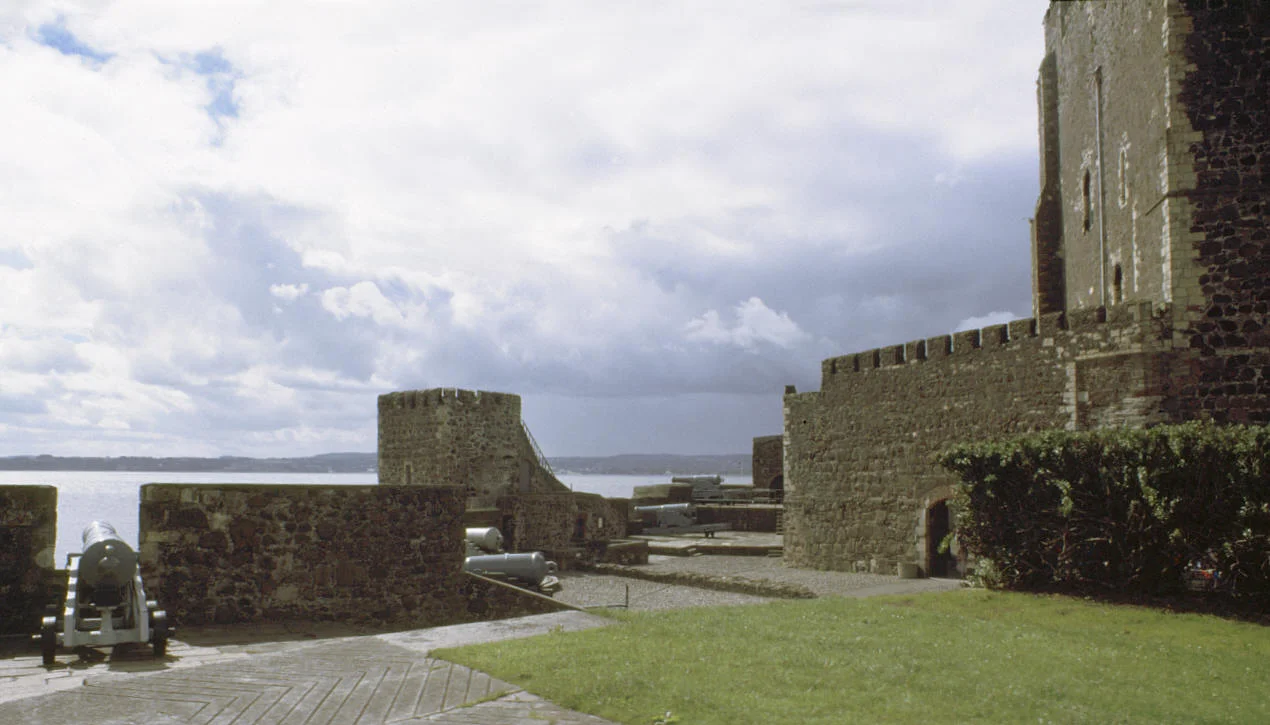

North Channel Naval Duel
John Paul Jones brought the American Revolutionary War home to Britain. On the evening of 24 April 1778, in the choppy waters of the North Channel between Ireland and Scotland, his small Continental Navy sloop Ranger forced the Royal Navy's sloop-of-war Drake to strike her colours in just over an hour of close-quarters gunfire. It was the first American naval victory in Atlantic waters, and one of the very few in the war achieved without a clear superiority of force. The fight was visible from the Antrim coast. The locals had come down to the shore to watch what they assumed would be a routine British capture of a presumptuous American privateer. They watched something else happen instead.
A Cruise Among the Trade Routes
By early 1778, American captains had already shown that British home waters were vulnerable. Lambert Wickes, Gustavus Conyngham and William Day had taken merchant prizes into French ports, drawing protests from London that France carefully ignored. After the American victory at Saratoga in October 1777, France signed treaties with the United States in February 1778 but stopped short of declaring war. The Royal Navy still had to assume that war was imminent and pulled its forces back into the English Channel to guard against a French invasion fleet. Jones spotted the opening. He sailed Ranger from Brest on 10 April with a plan more ambitious than any privateer cruise: he intended to bring the war directly to the British coastline, to attack ports and ships in their own waters and demonstrate that the war the British government insisted was an American problem had become a British one.
Whitehaven, Selkirk and Belfast Lough
Jones knew the Solway Firth: he had learned to sail there as a boy near Kirkbean in Kirkcudbrightshire before reinventing himself in America. On the night of 17-18 April, he attempted to burn the shipping at Whitehaven in Cumberland. The raid failed but it shook the British coast. He then crossed into Belfast Lough on the night of 20-21 April, hoping to seize HMS Drake at anchor off Carrickfergus. Conditions were against him and the plan was abandoned. Ranger returned to Whitehaven and on 22-23 April Jones led a landing party that set fire to a merchant vessel in the harbour. Within hours, he was leading another raid on the shore mansion of the Earl of Selkirk near Kirkcudbright. The plan there had been to kidnap the Earl as a hostage; the Earl was away, so Jones's men took the family silver instead. He returned the silver after the war, at his own expense. Word of the raids spread up and down the British coast. The Royal Navy began an urgent pursuit. Jones turned Ranger back toward Carrickfergus.
Drake Comes Out
By the morning of 24 April, Drake had been hastily prepared for action. Her captain, the aging George Burdon, was reportedly in poor health. Her gunner, her master's mate, her boatswain and her lieutenant were all absent. She had taken on extra volunteers from the Carrickfergus area, raising her crew from 100 to about 160, but many of the new men were landsmen with no naval training, intended only for close-quarters fighting. Drake got under way around 8 am with wind and tide against her, making little progress. She sent a small reconnaissance boat out toward the strange ship in the lough. Jones had hidden most of his men and run out only a few guns. The reconnaissance boat came alongside, the disguise held, and Jones captured the entire boarding party. One of the prisoners told him about Drake's volunteer reinforcements. The intelligence was useful. The morale boost was more useful. Jones's own crew had been on the edge of mutiny for days.
The Battle
Around 6 pm, the two sloops closed within hailing distance. Drake's captain demanded to know the strange ship's identity. Jones gave a warning, then ran out his guns. The first broadsides took down Drake's spars and rigging. Royal Navy Lieutenant William Dobbs, a Carrickfergus man who had just married and volunteered for the action only that afternoon, was struck in the head by shrapnel from Ranger's third broadside. He was mortally wounded. Drake's situation deteriorated quickly: her four-pounder guns could not penetrate Ranger's reinforced hull, her slow matches kept dropping into fire-safety tubs and going out, and her powder boys, the small children who carried gunpowder up from the magazine, became reluctant to expose themselves above deck. After more than an hour of exchange, Captain Burdon was killed by musket fire and the senior surviving officer struck Drake's colours. Forty-two of Drake's crew had been killed or wounded. Jones lost two killed and six wounded on Ranger. The prize crew sailed Drake back to Brest. Lieutenant Dobbs died of his wounds a day or two later. Jones wrote a careful, personal letter of condolence to Dobbs's young widow. He wrote one to the Earl of Selkirk too. The British press, which had been calling Jones a pirate and worse, did not know quite what to do with a man who behaved this way.
What the Action Meant
The Drake capture changed how the Royal Navy and the British government thought about coastal defence. Until April 1778, the war had been a long-distance affair: troopships sailing for New York and Boston, fleets engaging in the Caribbean, prizes brought into French ports under careful diplomatic cover. Jones brought it home. The fight was over in just over an hour, but its effect on British strategy was long. Coastal militias were reorganised. Ports were fortified. The Royal Navy could no longer treat the North Channel and the Irish Sea as a safe operating area. Jones went on to greater fame the following year aboard Bonhomme Richard, which captured HMS Serapis in a desperate night action off Flamborough Head. The North Channel action established his reputation and the United States Navy traces part of its institutional identity to him. The waters where he and Burdon fought have no monument. They never needed one. The story has carried itself across the centuries on the strength of how strange and improbable the day actually was.
From the Air
The North Channel Naval Duel was fought at approximately 54.72 degrees north, 5.45 degrees west, in the waters off Belfast Lough between Bangor and Carrickfergus, with the action drifting eastward toward the open North Channel as the engagement progressed. From the air, the position is most easily fixed by reference to Belfast Lough to the west, the Copeland Islands to the south, and the Antrim coast at Carrickfergus to the north. Belfast City Airport (EGAC) lies about 8 miles to the southwest; Belfast International (EGAA) about 18 miles west. The site is now traversed by commercial ferry routes between Cairnryan in Scotland and Belfast or Larne in Northern Ireland.
Nearby Stories
- Ballycarry 3.2 km away
- Drummore 7.6 km away
- Hillsborough Castle 7.9 km away
- Cushendall 8.8 km away
- Castle Upton 9.3 km away
- Girvan 25 km away
- International Institute of Space Commerce 29 km away
- Ballantrae Lifeboat Station 30 km away