
The Day Crockett Burned Twice
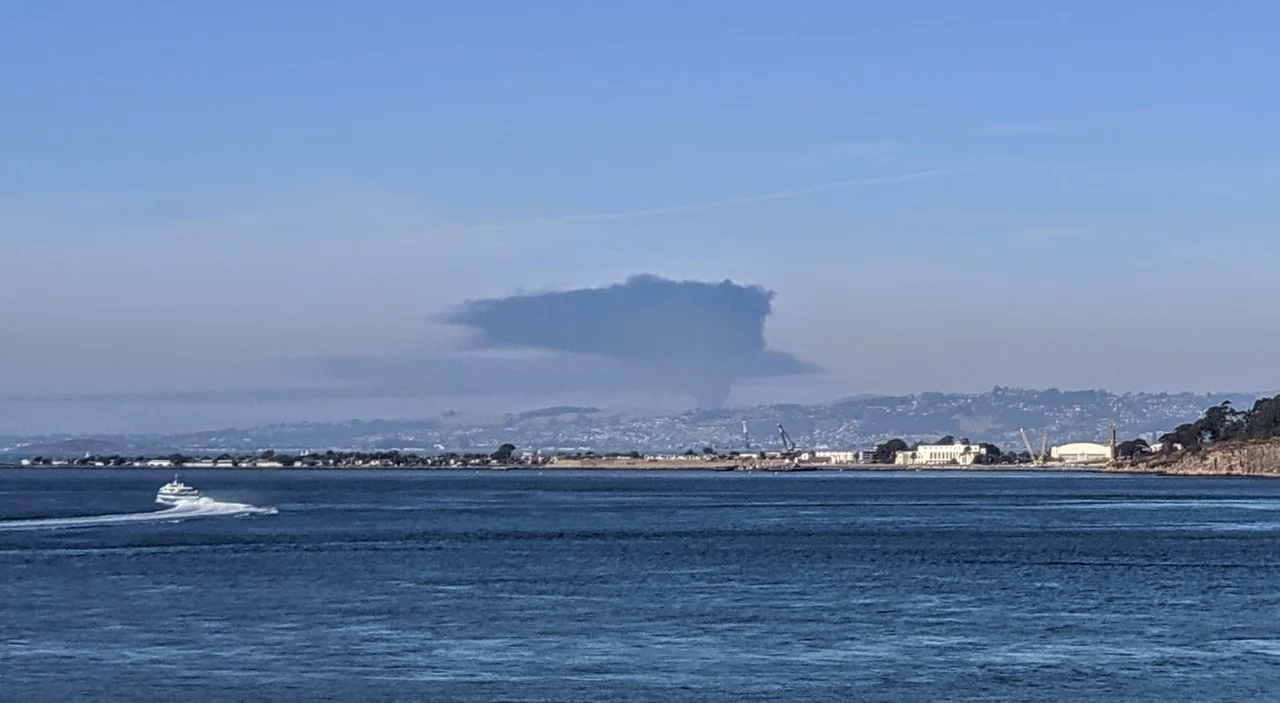
Fifteen hours before the explosion, the ground shook. A magnitude 4.5 earthquake rattled the East Bay on the night of October 14, 2019 -- strong enough to wake sleepers, too mild to make headlines. But at the NuStar Energy fuel storage terminal in Crockett, California, a small unincorporated community wedged between the Carquinez Strait and the brown hills of Contra Costa County, something may have shifted. At 2:00 PM the following afternoon, a tank of ethanol erupted. The fireball rose above the refinery stacks, visible from freeways and ferries across the Bay Area. Investigators would spend two years searching for an answer -- and ultimately, the final report eliminated the earthquake as a cause entirely, ruling that improper grounding of electrical equipment was to blame.
Two Tanks, Seven Hours
The fire started in one of NuStar's ethanol storage tanks and quickly spread to a second. Flames consumed roughly 15 acres of the hillside facility, sending a column of black smoke drifting southwest across the strait. Contra Costa County fire crews responded alongside hazmat teams, and a shelter-in-place order went out to Crockett and neighboring communities. The fire was contained by 9:00 PM that evening -- seven hours after ignition -- but the two ethanol tanks continued to burn, their contents too volatile to extinguish quickly. The ATF served a search warrant at the facility the following day, joining state and county investigators already on the ground. The NuStar terminal sat adjacent to a Phillips 66 refinery tank farm in nearby Rodeo, and the proximity of the two facilities added urgency to the response.
A Fault in the Wiring
The Contra Costa County Fire Protection District spent nearly two years investigating the cause. Their final report, presented on May 21, 2021, concluded that the initial explosion was most likely triggered by an electrical fault. The fault ignited ethanol vapor that had accumulated in the headspace of the first tank -- the gap between the liquid surface and the tank roof where flammable fumes concentrate. Investigators found improper grounding at the facility, a condition that could allow static discharge to spark in exactly the wrong place. They also discovered that a pallet had been removed from the vapor line pressure relief valve following a separate incident in 2012, potentially compromising the tank's ability to safely vent excess pressure. The second tank was not the victim of a spreading fire in the conventional sense; it was struck by debris from the first explosion, which ruptured its shell and ignited its contents.
The Only Terminal in the Bay
The fire's consequences rippled outward in ways that had nothing to do with flame. NuStar's Crockett facility was the only terminal in the San Francisco Bay Area equipped to receive imported ethanol -- a blending component required in California's gasoline supply. When the state shut the terminal down for investigation, the supply chain seized. By October 25, ten days after the fire, two tanker ships loaded with ethanol sat at anchor in the bay with nowhere to unload. Lloyd's List, the shipping industry's paper of record, reported that the vessels were stuck indefinitely. The shutdown forced fuel blenders to scramble for alternative sources and raised uncomfortable questions about the concentration of critical infrastructure in a region prone to earthquakes, wildfires, and industrial accidents.
Fire Returns to Crockett
Twelve days after the NuStar explosion, Crockett burned again. On October 27, the Sky Fire ignited along Cummings Skyway above the town, consuming 150 acres of dry grass and brush on the ridgeline. This was no industrial accident -- it was a wildfire, one of dozens that swept Northern California during a period of extreme fire weather in late October 2019. But for the residents of Crockett, already shaken by the refinery explosion, the timing felt cruel. The entire town was evacuated, along with the NuStar facility itself. Firefighters extinguished the Sky Fire by October 28, but the back-to-back emergencies underscored how exposed this small community was -- pressed between industrial infrastructure on the waterfront and fire-prone wildlands on the hills above.
Refinery Neighbor
The NuStar fire became a catalyst for broader scrutiny of the Carquinez Strait's industrial corridor. Within a week of the blaze, public opposition mounted against Phillips 66's proposed expansion of its refinery tank farm in Rodeo, directly adjacent to the NuStar site. Residents and environmental groups argued that adding more fuel storage capacity to an area that had just demonstrated its vulnerability was reckless. The debate exposed a tension that defines much of the East Bay's waterfront: communities like Crockett and Rodeo grew up alongside refineries and fuel terminals, their economies intertwined with the very facilities that periodically threaten them. The NuStar fire did not resolve that tension, but it made ignoring it harder. The blackened hillside above the strait, visible for months afterward, served as a reminder that the infrastructure on which California's fuel supply depends sits in a landscape that does not forgive complacency.
From the Air
Located at 38.05N, 122.25W on the southern shore of the Carquinez Strait in Crockett, California. The NuStar facility and adjacent Phillips 66 refinery are visible as clusters of white cylindrical storage tanks on the waterfront, east of the Carquinez Bridge. The industrial corridor stretches along the strait between Crockett and Rodeo. Interstate 80 and the Carquinez Bridge are prominent visual references. Nearby airports include Buchanan Field (KCCR) approximately 12nm southeast and Napa County Airport (KAPC) 20nm northwest. The terrain rises steeply behind the facility into the fire-prone hills where the Sky Fire burned.
Nearby Stories
- Rancho Nicasio 2.6 km away
- From Wartime Runways to Racing Legends 3.9 km away
- Ghost Ship Warehouse Fire 5.5 km away
- Altamont Free Concert 9.2 km away
- The Night Napa Burned 10 km away
- Isleton: The Half-Square-Mile Town That Made Perry Mason Famous 12 km away
- The Last Lakes in the Valley 14 km away
- The Farallon Islands: California's Forbidden Rock 29 km away