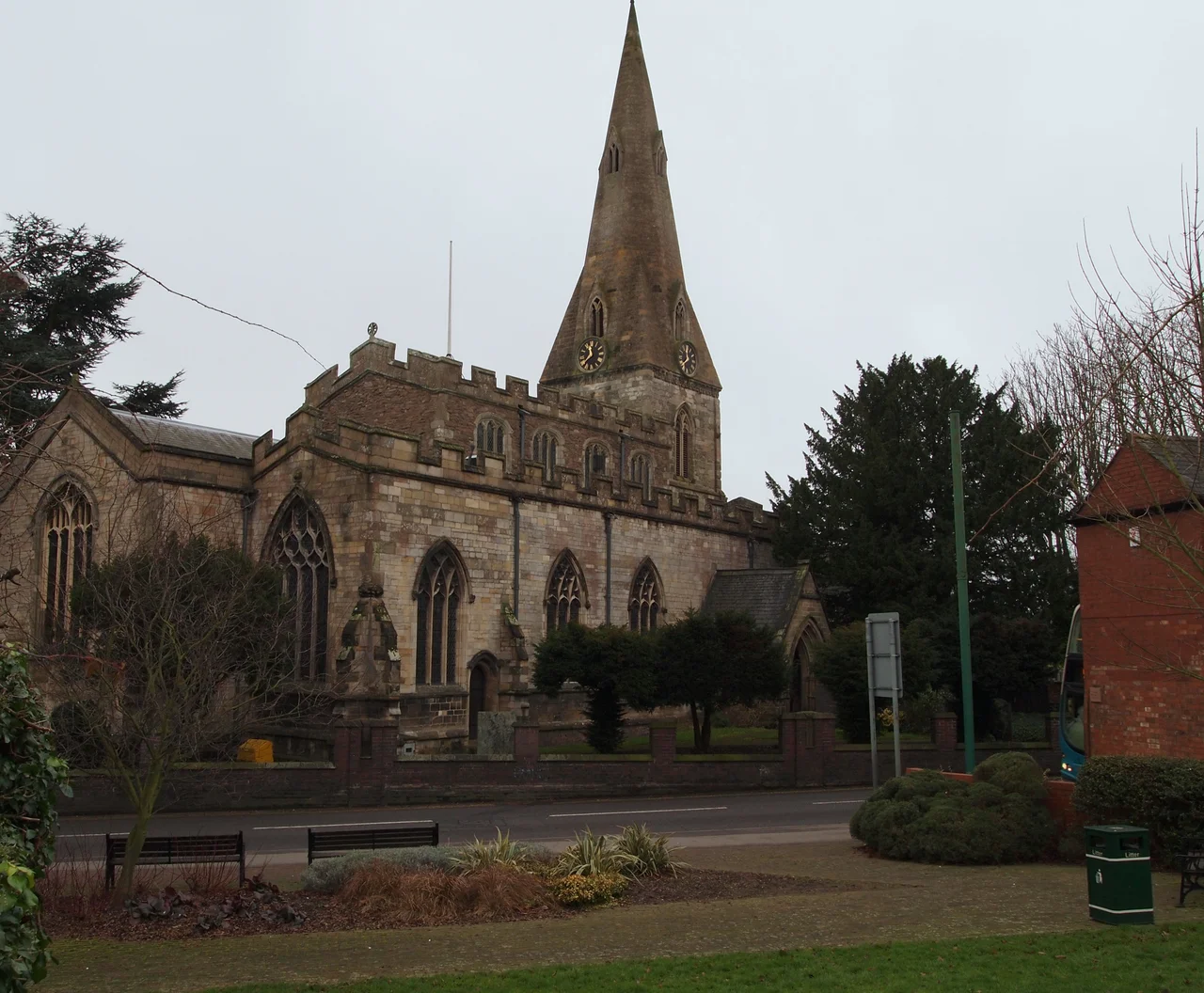

Oadby
Long before the town was called Oadby it had another name, in a language nobody now speaks. The original Anglian settlement here has been completely overwritten, its name lost to whatever happened in the ninth and tenth centuries when Danish invaders renamed half of Leicestershire. The Danes called this place Auðarbýr, meaning Auði's settlement, and that name has shortened through the centuries into Oadby. The only clue that something older lay beneath is a pagan Anglian cemetery discovered in 1760 on Brocks Hill, where the dead have been waiting much longer than the place name that now covers them.
The Conquered and the Conquerors
Oadby is one of seventy Danish settlements in Leicestershire whose names still end in -by, the Old Norse word for village. The Danes came to stay; the suffix is their fossil. King Alfred the Great's wars against the Danelaw concluded in 920, and tradition holds that one of the battles was fought on Oadby ground itself. The Domesday Book of 1086 recorded the place as Oldebi, by which time William the Conqueror had given the land to Hugh de Grandmesnil, his governor of Leicestershire. Grandmesnil founded the parish church on the site where St Peter's still stands. The medieval records list the tenants meticulously: Roger holding a carucate and a half; Countess Judith with nine carucates, two bovates and 30 acres of meadow; 46 socmen and eleven bordars and three serfs working her land. Names of people no one remembers now.
The Shoe Money Built Here
For most of its history Oadby stayed small. Then, in the late nineteenth century, the factory owners of Leicester needed somewhere to live that wasn't Leicester. Oadby was four miles south-east of the city on the A6, close enough to commute, distant enough to feel suburban, and the shoe and stocking manufacturers built substantial houses here that survive today. The University of Leicester now uses some of them as halls of residence. Stoughton Road still has the Framework Knitters Homes built in 1909 to house the workers, and the North Memorial Homes built in 1927 with money from Sir Jonathan North, a former mayor of Leicester. The Prince of Wales who later became Edward VIII opened them, nine years before he abdicated for an American divorcee. The neo-Georgian North Memorial Hall on the same site has been a Free Church since 1974. The Edwardian houses sit beside post-war estates, the way most of suburban England now sits beside itself.
The Diversity of a Quiet Town
Today Oadby has around 23,849 residents in five wards. About a fifth are under seventeen and another fifth are over sixty-five, the demographic shape of a town where families settle and stay. Seventeen percent were born outside the British Isles. Between a fifth and a third come from ethnically diverse backgrounds, and the places of worship along the streets reflect this: St Peter's Anglican church near the site Grandmesnil chose nine hundred years ago, the Trinity Methodist Church, the Baptist church, St Paul's, the Sikh Gurdwara Shri Guru Harkrishan Sahib Ji, and Oadby Central Mosque. The town has three major supermarkets, an industrial estate to the south-west, a student village to the north-east, and a high street called The Parade where most of the daily commerce happens.
Racecourse, Botanical Garden, and a Bass Player
Leicester Racecourse straddles the northern boundary of Oadby on the road to Stoneygate, and the University of Leicester Botanical Garden lies in the town as well, an attractive set of grounds occupying former villa gardens. Leicester Tigers, one of England's premier rugby union clubs, train at Oval Park on Wigston Road. Oadby is also the home of Beauchamp College, formerly Kibworth Beauchamp Grammar School, and Gartree High School, both of which were attended by a quiet local boy named John Deacon. He grew up to be the bass player for Queen, the band Freddie Mercury fronted, the band that wrote Bohemian Rhapsody and Under Pressure. Deacon wrote Another One Bites the Dust and You're My Best Friend. He retired from public life entirely in the 1990s. He still lives privately, and the schools that once educated him still teach a new generation of students who pass under the same red-brick gateways.
A Town Built for Quiet Days
Brockshill Country Park, Ellis Park, Coombe Park, Rosemead Park, Uplands Park: Oadby is generous with its open spaces. Brockshill in particular is named for the hill where the Anglian burial ground was found in 1760, the layered past sitting comfortably under the present-day grass. The Travellers Rest inn was torn down in 1939 and replaced by the Oadby Owl, both of them once run by a man called Walter Cufflin who descended from James Hawker, a notorious nineteenth-century Leicestershire poacher whose memoirs became a minor classic of rural English literature. That kind of detail is what gives small towns their texture: not the famous bass player or the racecourse, but the publican who descended from a poacher, all of them buried in the same county where a thousand years ago someone named Auði claimed a settlement that ended up bearing only the worn-down memory of his name.
From the Air
Oadby, Leicestershire (52.60 N, 1.08 W). The town lies four miles south-east of Leicester city centre, immediately east of the A6 dual carriageway and bordered to the north by the A563 Leicester Ring Road. Leicester Racecourse is visible on the northern edge of town. East Midlands Airport (EGNX) is 22 miles north-west; the small private airfield at Stoughton lies just to the east of Oadby. From low altitude, look for the racecourse oval, the dense suburban housing of the Parade, and the green wedge of Brockshill Country Park on the south-western side.
Nearby Stories
- National Shell Filling Factory, Chilwell 1 km away
- Staffordshire Regiment Museum 2 km away
- Rutland Water 3.3 km away
- Grantham 4.4 km away
- Wellingborough 9.9 km away
- Croxden Abbey 11 km away
- Bordesley Abbey 14 km away
- Electric Railway Museum 17 km away