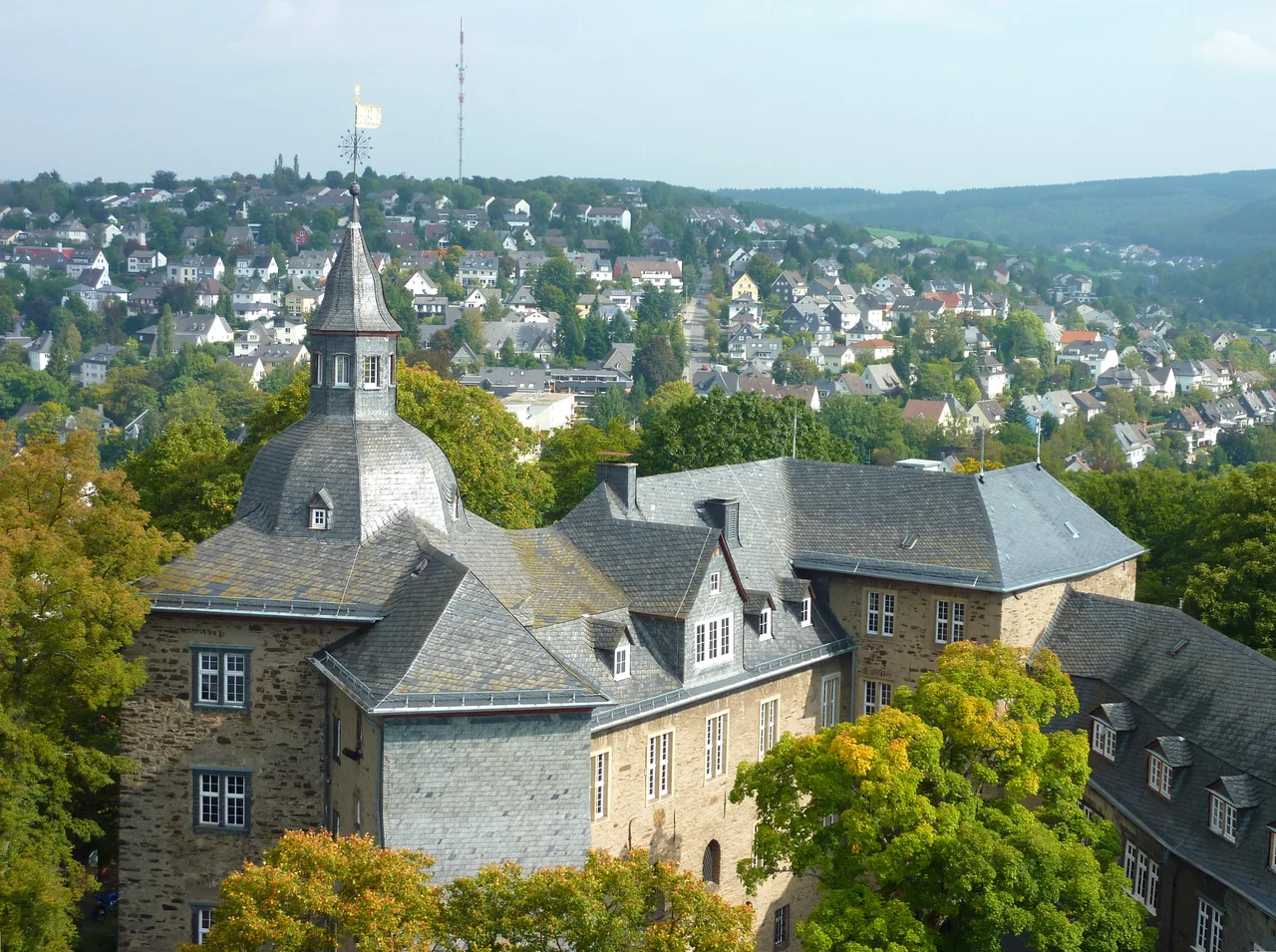

Oberes Schloss (Siegen)
On the 307-metre Siegberg, a flat-topped knob above the river Sieg, the Counts of Nassau and the Archbishops of Cologne once shared a castle wall like quarrelling neighbours sharing a fence. They split the building right down the middle: the rooms facing the Sieg river belonged to the archbishop and were called the Bischofshaus; the rooms facing the smaller river Weiss belonged to the count and were called the Grafenhaus. A single courtyard, two gates, one tower - and from this awkward thirteenth-century timeshare grew the dynasty that would one day produce William the Silent, the kings of the Netherlands, and the British house of Orange.
A Castle Divided
The Obere Schloss is first mentioned in a Liege document of 2 September 1259 as 'burch inde der stad zen Sigin' - the castle and town at Siegen. A second document, from 1261, references an earlier event: in 1224 Henry II, Count of Nassau, and Archbishop Engelbert II of Berg had divided the entire town of Siegen between them, and the castle along with it. A 1343 contract spells out the arrangement: two gates, the main tower, an inner courtyard with a fountain, all jointly owned. The buildings facing the Sieg belonged to the archbishop; those facing the Weiss belonged to the count. It was a strange shared sovereignty - two halves of a single fortress run by two different overlords - and it lasted until 1381, when the city passed fully into Nassau hands.
The Family That Became the Orange
From the Obere Schloss the Nassau-Siegen line projected itself outward across early-modern Europe. Through marriage and inheritance the family acquired the French principality of Orange in the sixteenth century, and one of its sons - William, born in 1533 at the Nassau castle of Dillenburg just down the road - would lead the Dutch revolt against Spanish rule and found the modern Netherlands. The Siegerlandmuseum, which occupies the upper castle today, holds one of the most important surviving collections of Nassau and Orange portraits anywhere. You can walk from one canvas to the next and watch a family's face change across three centuries, from late-medieval Westphalian counts in armour to the long-jawed Stuart-era princes whose descendants now reign in The Hague.
Rubens in the Rubens Hall
Siegen has a particular claim on Peter Paul Rubens: the painter was born here in 1577, while his family was living briefly in the town in exile from Antwerp. The castle museum honours that connection in its Rubens Hall, which holds nine works by the master, including the loaned Rape of the Daughters of Leucippus, an oil sketch for his Ecce Homo, and the first of his many versions of the Descent from the Cross. The Hall sits within a building that has lived many lives. Large parts of the central buildings were destroyed in the early sixteenth century, and the Gothic Hall and Oraniersaal were created in the 1506 rebuilding. The Gothic Hall still has its original fourteenth-century greywacke pavement laid in a herringbone pattern - the floor a Nassau count once walked across, polished by 700 years of feet.
A Museum and a Mine
The Siegerlandmuseum, founded in the castle to 'present the essence of the Siegerland homeland in terms of history, culture and folklore', began with just three exhibition rooms in 1905. By 1929 it had grown to thirty-five rooms and now occupies 1,500 square metres of the building. Other rooms honour figures the Siegerland claims as its own: the doctor-mystic Johann Heinrich Jung-Stilling, friend of Goethe; the musical Busch brothers; assorted local poets and engineers. Below the courtyard, the museum hides a particular curiosity. On 8 July 1938, a hundred-and-fifty-metre tunnel was opened beneath the castle, fourteen metres deep, fitted out as a working show mine to demonstrate the original facilities and equipment of a Siegerland iron mine. The Siegerland was iron country for two thousand years. The Obere Schloss, sitting on its hilltop above what was once one of Europe's most heavily mined valleys, contains an entire mine of its own.
From the Air
The Oberes Schloss crowns the 307-metre Siegberg in the centre of Siegen at 50.88N, 8.03E, in the upper Sieg valley of South Westphalia. From cruise altitude, Siegen reads as a dense urban basin set into wooded hills, with the castle's pale walls and tower on the prominent hill rising above the city centre. Cologne-Bonn (EDDK) lies 80 km west; Frankfurt (EDDF) is 90 km south-southeast. The Rothaargebirge hills rise sharply to the northeast. Approach views from the southwest, looking down the Sieg valley, show the castle most dramatically.
Nearby Stories
- Dahlerau Train Disaster 9.3 km away
- Schloss Allner 13 km away
- Festspiele Balver Höhle 21 km away
- Marburg 25 km away
- Edersee Dam 44 km away
- Zwingenberg Castle 140 km away
- Basilica of Saint-Pierre-aux-Nonnains 189 km away
- Fort Jeanne d'Arc 214 km away