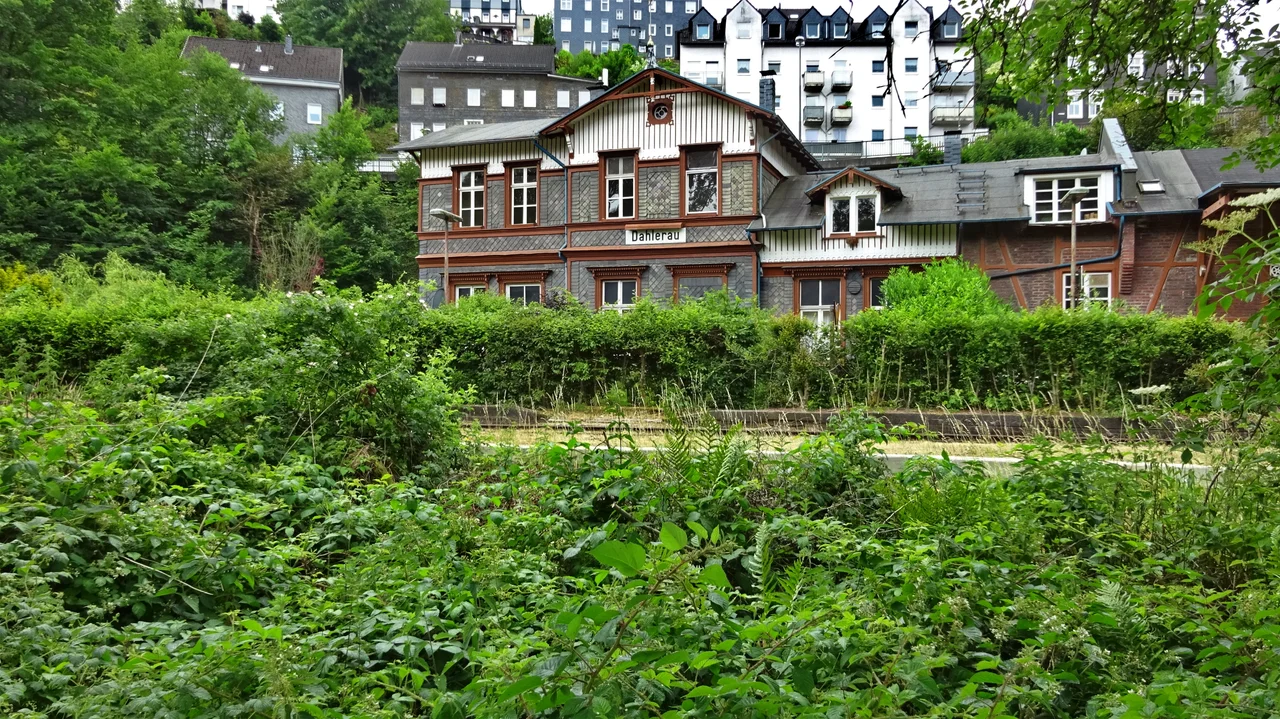

Dahlerau Train Disaster
They had been to Bremen. It was the school trip every senior class at the Geschwister-Scholl-Schule in Radevormwald looked forward to - a few days at the coast, a long bus ride home, then a transfer onto the small two-car railbus that ran the single-track line from Wuppertal back up into the hills. The train was thirty minutes late leaving Wuppertal-Beyenburg on the warm evening of May 27, 1971. Parents waited at Radevormwald station. Some had brought flowers. About 800 meters short of Dahlerau station, on a sharp curve north of town, the railbus met a freight train coming the other way at 21:13, head on. Forty-six people died: forty-one of them senior-year pupils, two of their teachers, one mother who had accompanied her child, and two railway crew. One pupil walked away uninjured. It was the deadliest accident on West German soil since the country had been founded in 1949.
A Small Light, Red or Green
What had happened, in the simplest description, was that two trains could not both occupy the same track. Dahlerau station, on the small branch line, had entrance signals at each end but no exit signals - the German railways considered them unnecessary on a sleepy line where unscheduled stops were rare. Instead, departing trains were governed by a stop board at the end of the platform, and the signalman could wave a green or a red hand lamp at the driver. That night, the freight train Ng 16856 was supposed to stop at Dahlerau and wait for the delayed school special to pass. The signalman swore in court that he had shown the freight a red lamp. The freight's driver swore that he had been shown green. Whatever happened - a misread color in the dusk, a slip of an aging lens, a man tired from a long shift - the freight rolled out toward Wuppertal, onto the same single track that the school train was already coming down. The signalman ran along the freight, waving his arms, shouting; the driver did not see him. The signalman ran back to his telephone and called Beyenburg to stop the passenger train. It had already left.
The Two Trains Meet
The freight engine was a class V 100, a stout diesel, five times the mass of the lightweight VT 95 railbus from the 1950s. When they met on the curve, the railbus compacted into a third of its original length and was pushed a hundred meters back down the line. The collision had been forecast, with terrible precision, in a single panicked phone call from the Dahlerau signalman to the emergency services minutes before it happened. Ambulances were already rolling out of Radevormwald, Wuppertal, and Solingen when the trains struck. Parents who had been waiting at Radevormwald station with their flowers heard sirens and started up the hillside on foot. The accident scene was hard to reach: a narrow path along a wooded slope, late spring growth. Some of the funeral directors who were telephoned that night, asked to bring an unbelievable number of coffins, hung up convinced it was a hoax. Twenty-five people survived, often with severe injuries. One pupil out of forty-two on the train was uninjured.
A Town That Lost a Year
Radevormwald was a town of about 20,000 people, set in the hills above the Wupper. An entire senior class - forty-one out of forty-two pupils dead on a single curve, on a single evening, on the way home from a school trip - is a particular kind of wound. Almost every family in the town knew someone in the carriage. Most of the dead were buried together in a long row in the Radevormwald cemetery. The funeral was held on June 2, 1971, an unseasonably hot day. About 10,000 people attended; the shops closed; rail service through the town was suspended out of respect. Chancellor Willy Brandt came. The federal transport minister came. The president of the Bundesrat came. One uncle of a dead pupil suffered a heart attack at the graveside in the heat and died a few days later. A stone pillar with the verse from Ezekiel - come from the four winds, O breath, and breathe upon these slain, that they may live - was placed beside the row of graves the following year. Some townspeople said the verse was inappropriate. The complaints settled, over time, as complaints in a small town do.
What the Disaster Changed
The legal case was never concluded. The Dahlerau signalman was killed in an unrelated car crash before the hearings finished. The driver of the freight survived to testify but could not be charged with what the court could not prove. What changed instead was the regulation. The Deutsche Bundesbahn removed the colored lens from hand lamps, eliminating the possibility of a red-green confusion at dusk; trains now had to be stopped at the entry signal before any unscheduled stop at a station without exit signals. The lightweight VT 95 railbus was replaced from the mid-1970s by the heavier, sturdier DB Class 628. Exit signals with automatic train-stop protection were installed at Dahlerau in 1975. None of which brought back a graduating class. The branch line itself closed in 1976; part of the track south of Dahlerau later disappeared under the Wupper Dam reservoir.
A Quiet Place in the Hills
Today Dahlerau is, as it always was, a quiet village in the Wupper valley. A volunteer society since 1989 has been working to make the old station a small museum, and part of the closed line is now a walking and cycling path. There is a memorial plaque near the curve where the trains met. Trains do not run there anymore. In Radevormwald the long grave is well tended, the names easy to read. Researchers have noted that the town behaved differently from other communities that survive a disaster, partly because the dead were not strangers passing through - they were the children of nearly every family in town - and partly because in 1971 nobody offered counseling to survivors. Some children born long after the accident are reported, decades later, to refuse to ride a train. The accident is talked about in Radevormwald every May, sometimes more than the people who lived through it would prefer, sometimes less than the people who lost children would want.
From the Air
The accident site is at approximately 51.227 degrees north, 7.322 degrees east, on a curve about 800 meters north of Dahlerau station in the Wupper valley between Wuppertal and Radevormwald. The Bergisches Land hills around Dahlerau are heavily wooded; from cruising altitude the valley appears as a narrow green corridor. Nearest airports are Dusseldorf (EDDL) about 45 km west-northwest and Cologne-Bonn (EDDK) about 55 km southwest.
Nearby Stories
- ZOOM Erlebniswelt Gelsenkirchen 8 km away
- Hochschule Niederrhein 11 km away
- FC Viktoria Köln 13 km away
- Battle of Werl 14 km away
- Rheinisches Braunkohlerevier 14 km away
- Festspiele Balver Höhle 15 km away
- Wesel Station 18 km away
- Siegen 23 km away