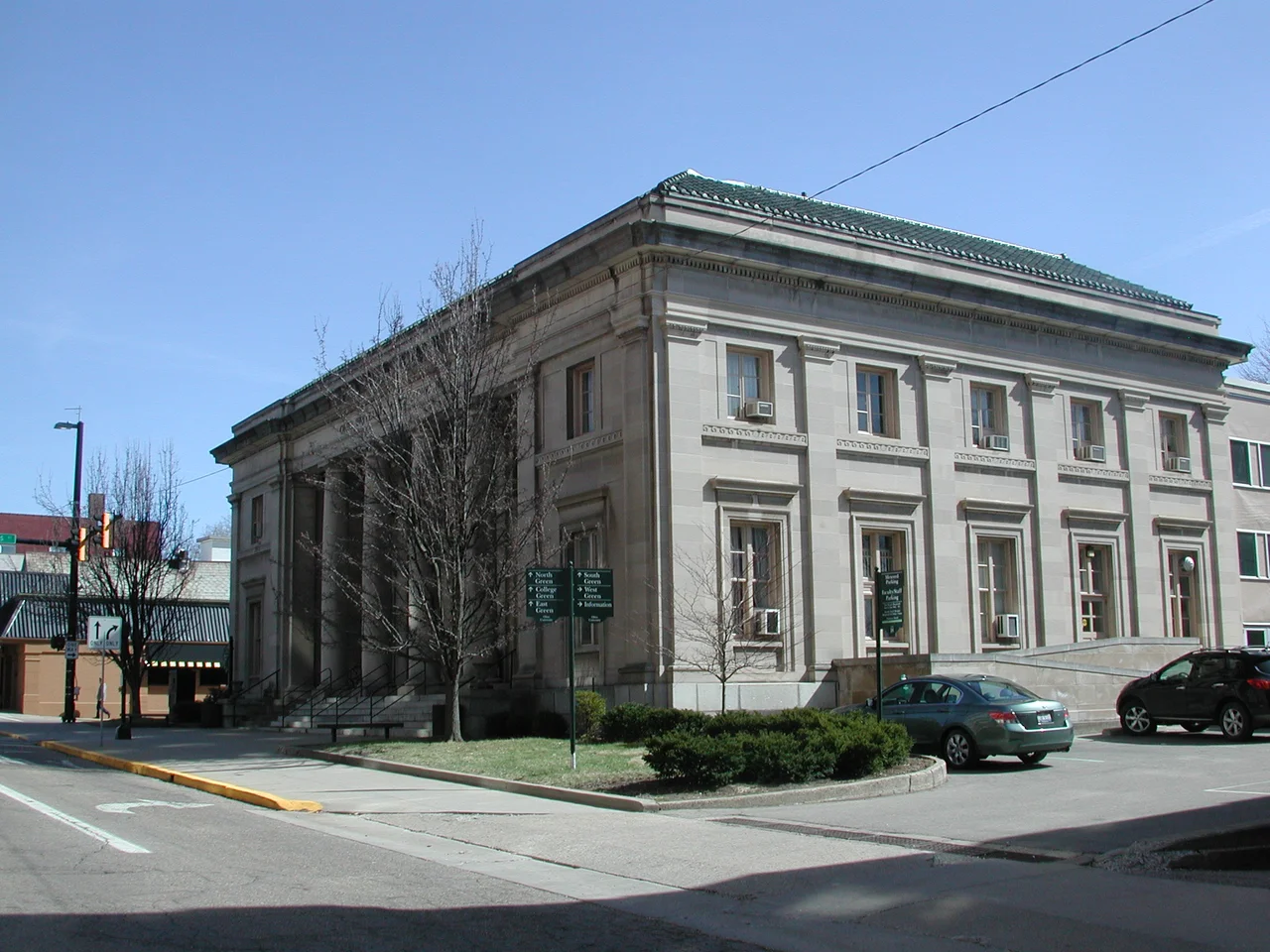

Ohio University
Two townships of land were set aside specifically for it. That was the deal Manasseh Cutler negotiated with the Confederation Congress in 1787 - the Ohio Company of Associates would not buy land in the Northwest Territory unless the contract included a reservation of public land sufficient to fund a university. The two contiguous townships near the future Athens, Ohio, were the result. Settlers arrived from Marietta in 1797 by way of the Ohio and Hocking rivers to scout the location. The school was officially chartered as Ohio University on February 18, 1804 - the first university in the former Northwest Territory, three years before Ohio statehood was even a decade old. It granted its first two bachelor's degrees in 1815. Two hundred and twenty years later, Ohio University enrolls more than 36,000 students across its main Athens campus and five regional campuses, and the same College Green that the founders laid out remains the campus's center.
Founders, Charter, and the Closure
Manasseh Cutler - a New England minister, physician, and botanist - and Rufus Putnam, the Revolutionary War general who led the founding of Marietta, are credited as the university's two founders. Putnam was a charter trustee; Cutler wrote the founding documents. The early years were difficult. The first two bachelor's degrees were granted in 1815, but the institution struggled financially through the 1820s and 1830s. From 1843 to 1848, the university was closed entirely, unable to pay its bills. The school reopened, slowly recovered, and admitted women for the first time in 1868. When the Ohio General Assembly created Ohio State as a land-grant institution in 1874, there were proposals to demote both Ohio University and Miami University to preparatory schools. The 1896 Sleeper Bill, sponsored by Athens-area representative David L. Sleeper, established permanent state funding and ended the question of OU's survival.
The College Green
The College Green is the campus's historic quadrangle, laid out on the model of an English or New England town green. Cutler Hall stands at its center, with Wilson Hall to its left and McGuffey Hall to its right - the three buildings forming a Federal-style ensemble that has appeared on Ohio University's logo for generations. Galbreath Chapel's spire, modeled on John Nash's All Souls Church in London, anchors one corner. The 1907 University Sundial marks the original location of the school's first building. Alumni Gateway carries the inscription 'That thou Mayest Grow in Knowledge, Wisdom and Love' - a translation from a Latin phrase over a gate at the University of Padua. The College Gateway, built in the 1960s, carries words from the Northwest Ordinance of 1787 about public education. The green has changed remarkably little in two centuries.
The Great Society and May 1970
Two political moments mark the modern campus. In 1964, Lyndon Johnson came to the College Green and used the phrase 'Great Society' publicly for the first time - the speech became foundational to his domestic agenda. Six years later, on May 4, 1970, the Ohio National Guard killed four students at Kent State during anti-war protests. Athens responded with sit-ins and demonstrations more intense than Kent's. Students from other Ohio universities that closed traveled to Athens, where the administration refused to shut down, to keep protesting. When the Guard was eventually called to Athens, a three-hour confrontation at the Baker Center left 23 injured and 54 arrested. The campus was closed on May 15. The contrast between Johnson's speech and the violence six years later captured how thoroughly the country had moved through the 1960s.
The Ridges and the Cherry Trees
Above the campus to the west, on a high ridge across the Hocking River, stand the Victorian buildings of what was once the Athens State Hospital - a massive Kirkbride Plan mental asylum that operated from 1874 to 1993. Ohio University acquired the complex in the 1980s and renamed it the Ridges. The buildings now house the Kennedy Museum of Art, archives, classrooms, and the university police department, surrounded by a nature preserve. Down by the Hocking River along West Green, 175 cherry trees stand in two rows - a 1979 gift from Chubu University in Japan, donated on the university's 175th anniversary. Japanese students sponsor a Sakura Festival each spring when the trees bloom and are illuminated at night. Bicentennial Park nearby features Input, a landscape artwork by Maya Lin commissioned for the university's 200th anniversary in 2004.
The Marching 110, the Athletics, and the Bobcats
Ohio University's intercollegiate athletic teams are the Bobcats, charter members of the Mid-American Conference since 1946. The football team plays at Peden Stadium, the oldest active stadium in the MAC, a designated Ohio Historical Site. The Marching 110 is the official marching band, founded in 1923, named for the band's original member count though current rosters run closer to 225. The 110 became the first collegiate marching band to perform in Carnegie Hall, in 1976. They marched in Bill Clinton's first inaugural parade in 1993. They have performed in the Macy's Thanksgiving Day Parade in 2000, 2005, and 2017, and the Rose Parade in 2010.
Flying Over the Old Campus
From the air, Ohio University reads as a layered campus growing out from the small, perfect rectangle of the College Green. The original Federal-style brick buildings cluster on the green's edges. South of the green, the Hocking River bends around the campus, with athletic facilities and South Green's residence halls strung along the floodplain. Peden Stadium sits at the southern edge. The Ridges occupy a high ridge to the west, the old hospital buildings visible from far above. The town of Athens wraps around the campus on the lower hills. From cruising altitude, the geometry of the school is obvious: a settlement that grew up around a green, on a horseshoe of high ground above a river, surrounded by the forested hills of Appalachian Ohio.
From the Air
Located at 39.33°N, 82.10°W in Athens, Ohio. The College Green, with Cutler Hall at its center, is the obvious visual anchor. The Hocking River loops around the southern and eastern edges of campus. The Ridges (former state hospital) sits on a high ridge west of the river. Peden Stadium is at the south edge of campus. Nearest airport: Athens-Albany (KUNI) about 7 nm southwest, plus a small university field at Gordon K. Bush Airport (KUNI co-located). Best photographed from 2,500-4,500 feet AGL, where the full campus, the Ridges, and the Hocking River are all in frame.
Nearby Stories
- Julia-Ann Square Historic District 1.9 km away
- Lakin State Hospital 7.7 km away
- Ratcliffe Mound 9.8 km away
- Burning Springs Complex 21 km away
- Hardin Village Site 41 km away
- The Y-Bridge of Zanesville 44 km away
- Columbus: The Test Market Where America Tries Things First 56 km away
- West Virginia Penitentiary 81 km away