
Old Aberdeen
Concordia res parvae crescunt. Through harmony, small things increase. The motto belongs to Old Aberdeen, the smaller and older of two cities that lived for centuries as suspicious neighbours on the northeast coast of Scotland. Old Aberdeen was the ecclesiastical and academic settlement - cathedral town, university town, dignified and inward-looking - while New Aberdeen down by the harbour did the commercial work of shipping and fishing and quietly grew rich. Old Aberdeen was erected into a burgh of barony on 26 December 1489 and ran its own affairs for four centuries afterward. Only in 1891 did an Act of Parliament finally merge the small things into the larger city next door. The two have been one Aberdeen ever since, but the old burgh still has its own community council, its own medieval street pattern, its own granite quietness - and the motto, like the cathedral and the chapel and the bridge, has outlasted the arrangements that produced it.
Cathedral Ground
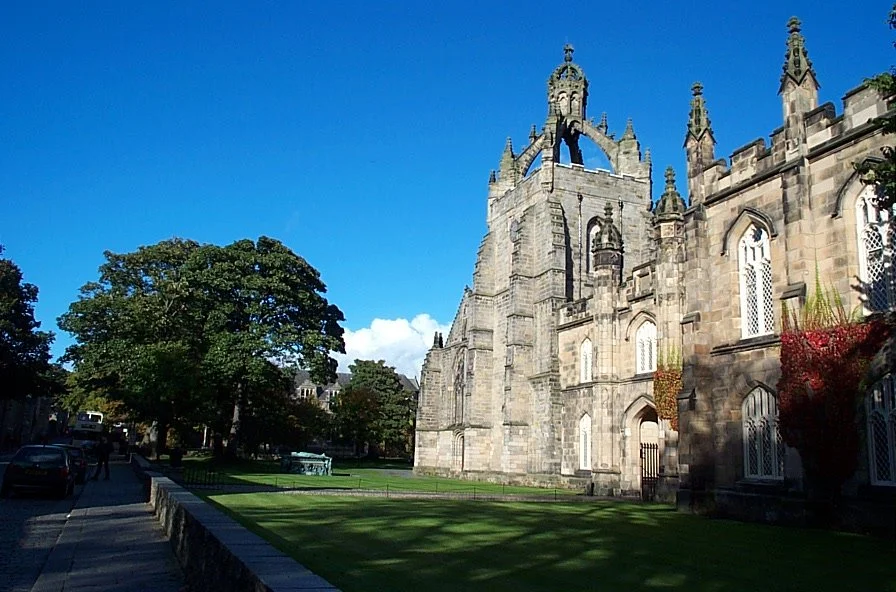
Before the university came, Old Aberdeen was a cathedral town. St Machar's Cathedral - the high kirk of Aberdeen, named for a sixth-century Pictish saint - is the oldest building on the site and the reason the settlement existed at all. Around the cathedral grew an ecclesiastical community of clergy, scholars, and the tradesmen who served them. The river Don ran north of the town, then as now, and the small hamlet of Brig o' Balgownie marked the only crossing - the medieval gothic bridge built around 1320 that survives, pedestrianised, today. Then in 1495 Bishop William Elphinstone won a papal bull from Alexander VI and founded King's College. The university transformed Old Aberdeen from cathedral close to university town within a generation, and the High Street running south from St Machar's became the central thoroughfare of a small but ambitious academic settlement. Many of the vernacular buildings now lining the conservation area date from the seventeenth and early nineteenth centuries, built in the same locally ubiquitous grey granite that gave Aberdeen its nickname.
The Old Town House
The Old Town House, completed in 1789, was the original home of the burgh's local government - small things needing harmony, and somewhere to manage themselves from. It sits at the centre of the High Street in restrained early Georgian design, granite-built, with a fine cupola above the façade. The street widens around it in a way that still betrays its original function as a trading space: the burgh's market booths once filled the broadened section, with the mercat cross (the head is late medieval, the shaft more recent) standing outside the Town House as it always has. The university acquired the building in recent years and renovated it in 2005, and it now houses King's Museum - one of two university museums in Old Aberdeen, the other being the Zoology Museum with its natural history collection. The continuity has its own kind of poetry: civic chamber became market, became museum, all in the same granite walls.
The Powis Gates
Just south of King's College, across the High Street, stand the Powis Gates. They were erected in 1834 by Hugh Fraser Leslie of Powis, owner of an estate that formerly lay behind them, and they are not what you would expect to find in Old Aberdeen. Two pointed towers in a Near Eastern minaret style flank an arched gateway - a piece of Georgian orientalist fantasy that would not look out of place in Brighton. The shield on the reverse of the arch shows the busts of three black men. The provenance is contested: some scholars trace it to the Fraser Leslie family's involvement in a grant of freedom to enslaved people on their plantation in Jamaica, while others suggest it represents impaled arms from a marriage between the Leslies and the Moir of Scotstoun family. The Leslies of Powis, like many landed Scottish families of the eighteenth and early nineteenth centuries, had made part of their fortune through Caribbean slavery. Whether the shield commemorates emancipation or unrelated heraldry, the connection to the wider trade is real, and Aberdeen as a city has only recently begun to reckon with its own threads in that history.
Bishops' Wars and After
Old Aberdeen was a flashpoint in the religious wars of the seventeenth century. In the 1630s the Covenanters - Presbyterian Scots opposed to Charles I's attempts to impose Anglican-style worship on the Church of Scotland - challenged the moderate Doctors of Aberdeen, the cluster of conservative theologians around King's College. The challenge sparked the first battle of the Bishops' Wars, when William Keith, 7th Earl Marischal, and the Marquess of Montrose led a Covenanter army of 9,000 men over the Causey Mounth from the south and attacked royalist forces at the Bridge of Dee. Old Aberdeen fell to the Covenanters as part of that campaign. The town would suffer through Cromwell's occupation in the 1650s, recover under the Restoration, and survive into the eighteenth century as an academic enclave attached to a growing commercial neighbour. By 1891, when the merger came, New Aberdeen had grown so dramatically that Old Aberdeen's separate burgh status looked like an anachronism. Today the area, set back from the harbour by Seaton Park's 27 hectares of riverside green space, retains its character as one of the most coherent medieval-and-Georgian streetscapes in Scotland - small things, harmonious, increased.
From the Air
Old Aberdeen lies at 57.16N, 2.10W in the northern part of the city, between King Street to the east and the University grounds to the west. From altitude, look for the distinctive crown spire of King's College Chapel and St Machar's Cathedral's twin towers 400 yards apart along the High Street, with Seaton Park's open ground separating the old burgh from the River Don to the north. Aberdeen International (EGPD) lies 4nm northwest. Best viewed at 1,500-3,000 ft AGL in clear conditions; the contrast between Old Aberdeen's compact medieval-Georgian core and the surrounding 20th-century housing developments is unmistakable from the air. The Brig o' Balgownie crosses the Don half a mile northeast of the cathedral.
Nearby Stories
- Monymusk Priory 3.9 km away
- Deer Abbey 8.6 km away
- Glendronach Distillery 9.8 km away
- Fettercairn Distillery 13 km away
- Dunnottar Castle 16 km away
- Piper Alpha 146 km away
- German submarine U-1274 151 km away
- HMS Nottingham (1913) 192 km away