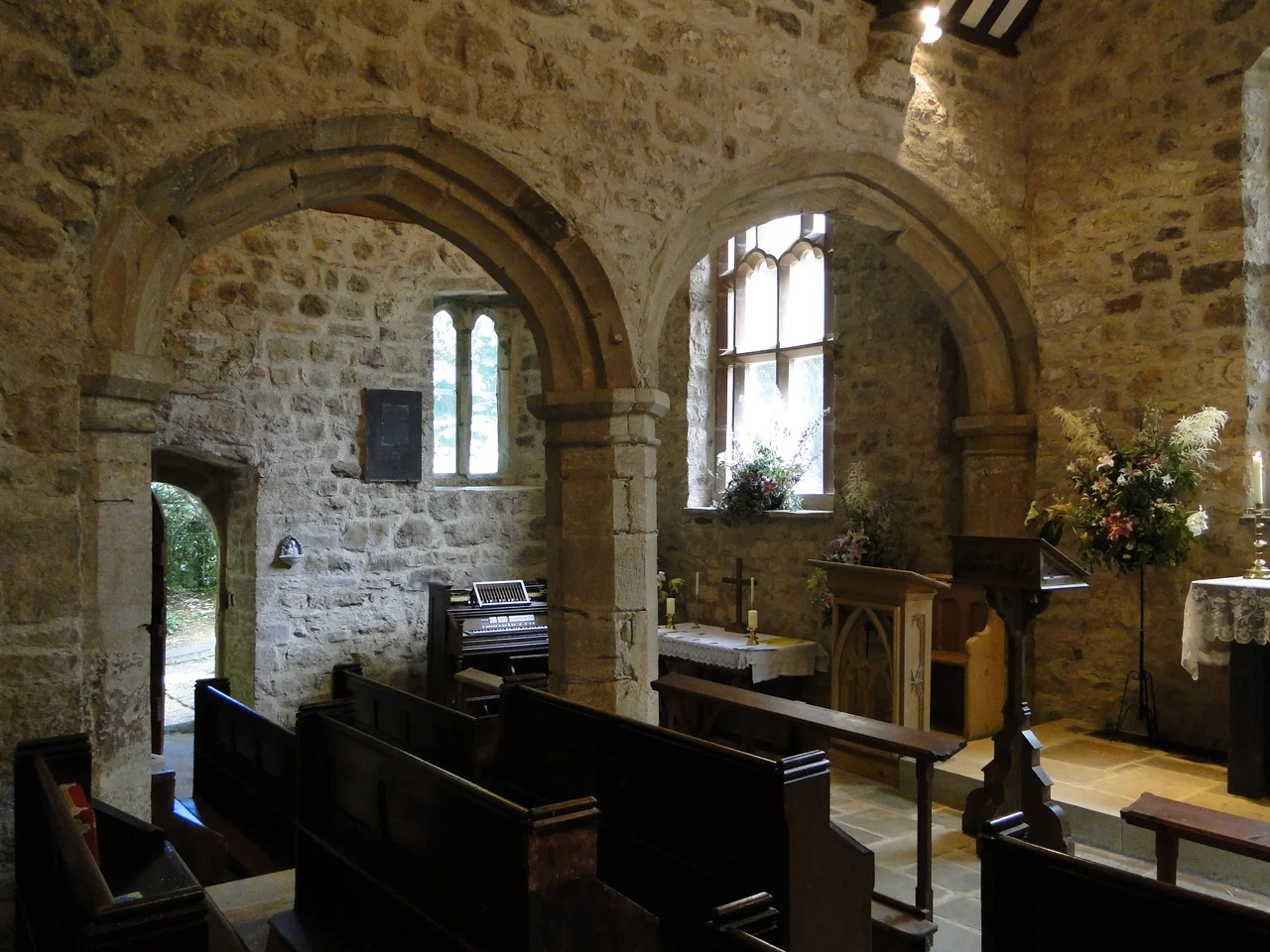

Old Church of St Nidan, Llanidan
Gerald of Wales, the great 12th-century traveller and chronicler, recorded a peculiar story about the church at Llanidan. There was a stone carving here, he said, in the shape of a human thigh, that would always return to the church by the next morning no matter how far away it was taken. A Norman earl, sceptical, had chained it to a large rock and thrown it into the sea. By dawn the stone was back. Whether you believe the story or not, the church Gerald wrote about is now itself almost a ruin - dismantled in the 1840s in a decision one Victorian antiquarian denounced as a melancholy fate. What survives is strange and beautiful: a roofless arcade of six arches standing in a graveyard, framing a vanished interior.
St Nidan's First Church
The tradition recorded by a 2009 survey of north-west Wales's buildings holds that the first church on this site was founded in 616, by Saint Nidan himself. Nidan was the confessor of the monastery at Penmon, on the eastern tip of Anglesey - a community founded by Saint Seiriol that became one of the most important religious centres in early medieval Wales. The Welsh place-name element llan, originally meaning enclosure, came to mean church, and Llanidan is the church of Nidan. The 7th-century timber building would have been replaced and rebuilt many times. The oldest surviving stonework dates to the 14th century - the north doorway, the tracery patterns in the windows. By 1360 a charter records that the church and rectory belonged to the priory at Beddgelert in Snowdonia, though earlier records are lost and the date of the priory's acquisition is unknown.
The Twin Naves
Around the year 1500 the church was substantially enlarged. A south porch was added, and a second nave was built on the north side of the original one. Between the two naves an arcade of six arches was constructed, dividing yet uniting the two spaces. Whether this enlargement was driven by a growing congregation or by the patronage of a wealthy benefactor is unknown. What is known is that the result was a building Cadw, the Welsh historic environment agency, would later describe as "a good example of a simple medieval rural church, enriched by 15th-century additions." When Henry VIII dissolved the monasteries in 1535, ownership passed to the Crown. Elizabeth I subsequently granted the advowson - the right to choose the parish priest - along with the surrounding grounds and the estate house called Plas Llanidan, to Edward Downam and Peter Ashton; over the following centuries the property passed by sale, marriage, and bequest into the hands of the Boston family.
A Melancholy Fate
By the early 19th century the old church was in poor repair, and Brynsiencyn village was a longer walk from worship than felt right. Between 1839 and 1843 a new church was built nearby to serve the parish. Then most of the old building was deliberately taken down, leaving only part of the western end and the central arcade standing. The clergyman and antiquarian Harry Longueville Jones was outraged. He called the demolition a "melancholy fate" for what he described as "one of the largest and most important [churches] in the island of Anglesey," and dismissed the official reasons - cost of repair, distance from the village - as mere "pretexts." The 13th-century font, which Jones called "a singularly beautiful specimen," was moved to the new church around 1860, along with a sandstone chest containing bone fragments believed to be saintly relics. The chest had been found buried beneath the altar; Henry Rowlands, who had been vicar of St Nidan's in the early 18th century, thought it had been hidden there for safekeeping during the religious upheavals under Edward VI.
What Stands Now
The result is one of the most haunting ecclesiastical sites in Anglesey. The arcade of six pointed arches rises from the graveyard with nothing left to support but air. The roof is gone. Most of the walls are gone. The font and the relic chest have been moved to the working church a short walk away. But the arcade survives, framing the sky between its piers. A late visitor described it as a "dark, dusty and empty place" but praised the "elegant" arcade that "rises from the graveyard like an abstract sculpture." The Old Church is a Grade II* listed building and a scheduled monument. The sculptor John Gibson (1790-1866) was born to a William Gibson who was the fourth member of his family to serve as parish clerk at St Nidan's; the Gibson family's association with this church reaches back to at least 1708, when the baptism of Grace Gibson is recorded in the registers. Two verses from Psalm 84, in Welsh, are written on the wall above the doorway: "For one day in thy Courts is better than a thousand. I had rather be a door-keeper in the house of my God than to dwell in the tents of ungodliness." The author of one modern guide added, of this stillness, that "some stillness still remains in secret places like Llanidan."
From the Air
Coordinates 53.178°N, 4.253°W on the south coast of Anglesey, about 400 metres inland from the Menai Strait, in the community of Llanidan near Brynsiencyn village. RAF Valley (EGOV) lies 25 km west, and Caernarfon Airport (EGCK) sits 7 km south across the strait. The site is a small, partly ruined church in a circular walled churchyard surrounded by mature trees - the circular enclosure itself a clue to the site's ancient sanctity. The strait and the dramatic backdrop of Snowdonia are visible immediately to the south. Best viewed at 1,500 to 3,000 feet.
Nearby Stories
- Wakestock 1.7 km away
- Trefriw 3.8 km away
- Irish Sea 8.7 km away
- Irish Sea Bridge 20 km away
- East–West Interconnector 30 km away
- Machynlleth 36 km away
- HMS Tyler 41 km away
- New Brighton Lifeboat Station 54 km away