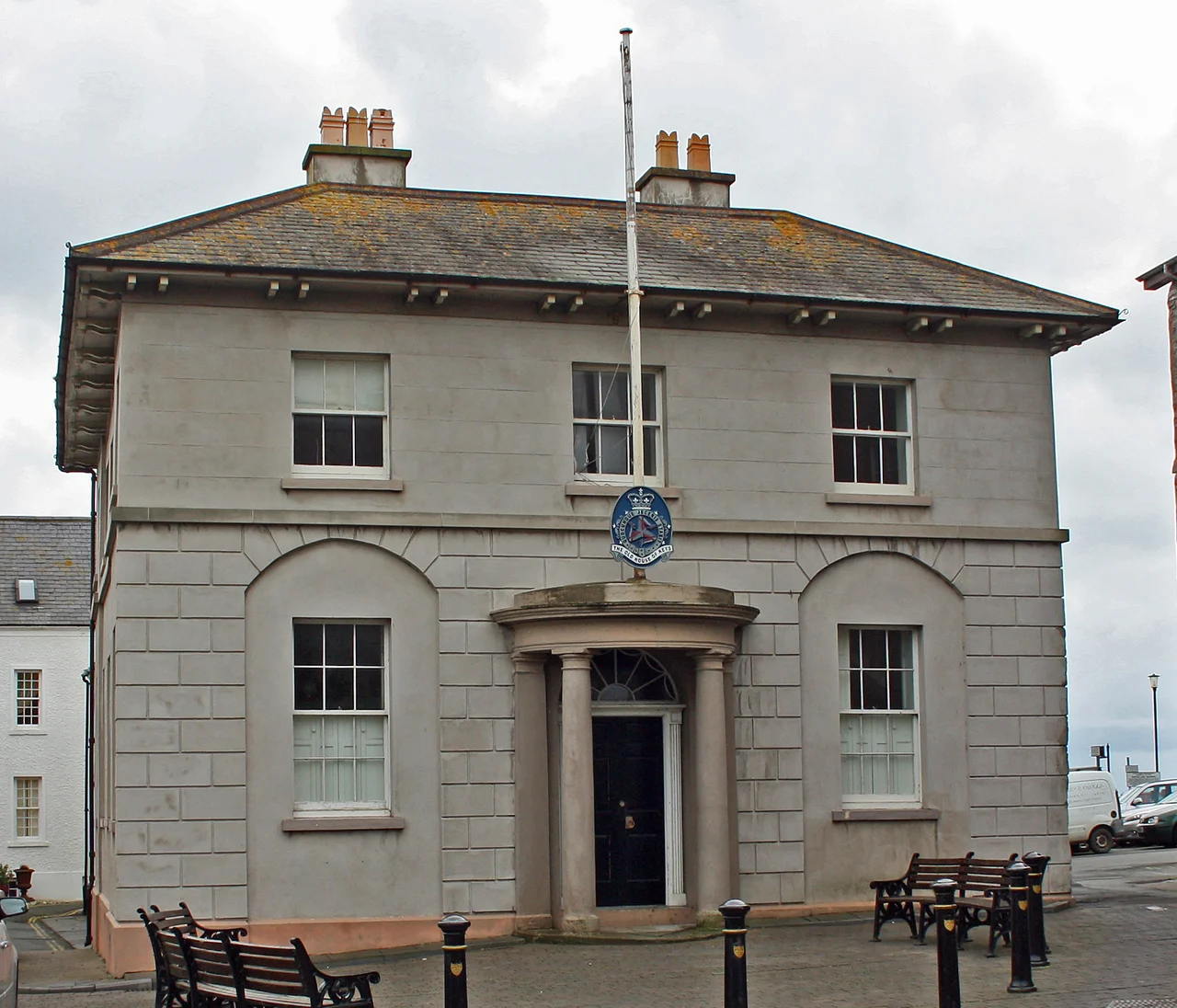

Old House of Keys
Walk in the door and the doorkeeper hands you a card with a name on it. You are now William Callister of Ramsey, or Mark Hildesley Quayle of Bridge House, and in a few minutes you will be expected to vote on whether to widen the franchise of the Manx parliament. The Old House of Keys in Castletown is a museum that demands you do more than look. It is a small Georgian chamber, twenty-four green leather benches arranged in a semicircle around the Speaker's chair, and Manx National Heritage have restored it to look exactly as it did on a particular afternoon in 1866 when Tynwald was about to change forever. The building is across the street from Castle Rushen, in the old capital. Both the castle and the chamber speak to the same long story: how a small island in the Irish Sea built one of the most enduring forms of self-government on earth.
A Chamber Demanded by a Royal Commission
Tynwald, the parliament of the Isle of Man, is generally reckoned to be the oldest continuously running parliament in the world, with origins in the tenth century and possibly the eighth. By the sixteenth century it had divided into an upper house and a lower house known as the Keys, a body of twenty-four. The Keys had no proper meeting place. They met first in Castle Rushen, then from 1710 in the Bishop of Sodor and Man's library, a building that a Royal Commission of the eighteenth century described as 'a mean decayed building little more than sufficient to contain the number which they consist.' The Commission's verdict took thirty years and a great deal of arguing about money to produce action. The 4th Duke of Atholl, then Governor, instructed his Clerk of Works, Thomas Brine, to draw up plans. The British Treasury called them too expensive. The Keys called the Treasury's counter-proposal too cheap. Eventually each side coughed up a share of the 1,039 pounds, ten shillings, and the chamber was built. The Keys moved in in January 1821.
Where the Vote Came From
For most of its history the House of Keys was self-elected: when a member died or resigned, the remaining twenty-four chose his replacement from a list. The chamber in Castletown is where that ended. In 1866 the Keys themselves voted to be elected by popular vote, a decision that turned an oligarchy into a parliament. The argument for and against had run for years, and the museum's central exhibit re-enacts it in audio, with actors reading from the actual Hansard of the chamber. You sit in a member's seat and listen to him argue. Then you vote. The vote of 1866 was close. The principle it established, that the people of the Isle of Man should choose their lawmakers directly, then quickly outgrew Castletown. By 1869, Douglas had replaced this town as the capital. In 1874 the Keys themselves followed, leaving the chamber behind.
What Banks Do to Buildings
After the Keys departed, the building became a bank. Dumbell's Bank stripped out the chamber's ceiling, punched a great skylight through the roof to flood the hall with light, and painted the new banking hall an expensive blue. When Dumbell's collapsed in 1900, taking many Manx savings with it, Parr's Bank took over. The render came off the outside in the 1910s or 1920s, revealing the rough Manx limestone underneath. The Westminster Bank absorbed Parr's in 1918. The upper floor of the chamber was replaced in the 1960s. By the time the National Westminster Bank gave the building to Castletown in 1973, the chamber that the Keys had sat in for fifty-three years was effectively gone, sliced up by a century of commercial use.
Restoration by Inference
Manx National Heritage took on the building in 2000 with the strange task of reconstructing an interior nobody had ever photographed. No images of the chamber survived. They had to rely on written descriptions, inventories of furniture, and the proportions of the rooms themselves. The result, opened in November 2001, is the chamber as it appeared in 1866: green benches polished, the Speaker's chair carved with the Three Legs of Man, the gas-lamps fitted but unlit, the chamber smelling slightly of beeswax. It is small. You expect the cradle of a parliament to be vast and intimidating, and what you find is a room not much bigger than a comfortable village hall. That smallness is the point. The Keys were twenty-four men from a population of fifty thousand, arguing about taxes and herring laws and the franchise, and the room is sized to that argument.
The Vote Today
Tynwald still sits. The Keys are now elected by universal suffrage and meet in the Legislative Buildings in Douglas, in a chamber that descends in unbroken line from the one you sit in at Castletown. Every July, on Tynwald Day, the Manx parliament processes out to Tynwald Hill at St John's and proclaims its laws in the open air, in Manx and English, exactly as it has done for at least a thousand years. Sit on a green bench in the Old House of Keys and you can hear the same argument that produced Tynwald Hill, that produced the franchise of 1866, and that produces the current government's questions and answers a few hours' walk to the north. The chamber is empty now. The argument is not.
From the Air
The Old House of Keys is located at 54.07 degrees north, 4.65 degrees west, in the centre of Castletown directly across Parliament Square from Castle Rushen. Best viewed at 1,500 to 2,500 feet on a coastal pass, with the grey limestone walls of Castle Rushen as the clearer landmark from the air; the chamber is the smaller two-storey Georgian building immediately opposite. Nearest airport is Ronaldsway (ICAO: EGNS), about two miles to the north-east. The harbour mouth of Castletown sits a few hundred metres south of the building.
Nearby Stories
- RAF Jurby Head 14 km away
- German submarine U-246 16 km away
- German submarine U-1051 17 km away
- Kilclief Castle 18 km away
- Ardglass 31 km away
- St Bees Lighthouse 44 km away
- Trwyn Du Lighthouse 54 km away
- Seascale Lifeboat Station 61 km away