
Old Navarino Castle
Fifty men took it back. In December 1500, after the castle's 3,000-strong Venetian garrison had just surrendered to the Ottomans, a force of only fifty soldiers slipped in almost by accident and recaptured it — holding it for barely five months before a combined Ottoman land and naval assault under Kemal Reis retook it for good. That kind of improbable, grinding back-and-forth is the story of Old Navarino Castle in miniature: a place so strategically important, sitting above the northern entrance to Navarino Bay on an imposing 200-metre rock, that nobody could afford to let anyone else have it for long.
A Headland With Many Names
The Franks called it Port-de-Jonc — Cane Harbour, in French — a name that survives in Italian variants like Zunchio and Zonchio. When the Navarrese Company held it in the late fourteenth century, it became Château Navarres; local Greeks called it Spanochori, the "village of the Spaniards." Today it is most often called Palaiokastro or Paliokastro — simply the "old castle" — to distinguish it from the Ottoman-built New Navarino fortress to the south. The site itself is far older than any of those names. The castle occupies the headland of cape Koryphasion, where an Athenian fort stood during the 425 BC Battle of Pylos. The naturally defensible rock, flanked by sheer cliffs, has probably been occupied in some form since classical antiquity. Every culture that arrived looked at those cliffs and understood immediately what the place was worth.
Built by the Franks, Fought Over by Everyone
After the Fourth Crusade in 1204, the Peloponnese came under the rule of the Frankish Principality of Achaea. The Chronicle of the Morea credits the construction of the castle to Nicholas II of Saint-Omer, lord of Thebes, most likely in the period 1287–89 when he served as viceroy. Scholars believe he intended it as a fief for his nephew, Nicholas III, though the inheritance was disputed and the castle reverted to the princely domain after Nicholas III died without children in 1317. It passed through Genoese hands in the 1350s, who used it as a base for raids on Venetian possessions. In 1354, a naval battle between Venice and Genoa took place just off the headland. A decade later, Mary of Bourbon held the castle in a succession dispute, briefly imprisoning a rival prince's bailiff. In 1417, the Venetians seized it outright, eventually legitimizing their hold in 1423. The list of owners reads like a roll call of medieval Mediterranean ambition.
The Long Ottoman Chapter
Ottoman raids struck Navarino in 1423 and again in 1452. It was here that Byzantine Emperor John VIII Palaiologos embarked in 1437 for the Council of Ferrara, and here that the last Despot of the Morea, Thomas Palaiologos, fled with his family in 1460 as the Ottomans completed their conquest of the peninsula. The Venetian garrison finally surrendered during the Second Ottoman–Venetian War in 1500, and the castle never fully recovered its importance after that. In 1572/3, following the Battle of Lepanto, the Ottoman admiral Uluç Ali Reis built the New Navarino fortress to the south, covering the bay's main southern entrance. The old Frankish castle, now obsolete as a defensive structure, was left to decline. By the late sixteenth century it had only a token garrison. By 1706, Venetian inspectors counted just five guns of any consequence, and plans were drawn up to demolish the place. Those plans were interrupted by the Ottoman reconquest of 1715.
Greek Independence and Ruin
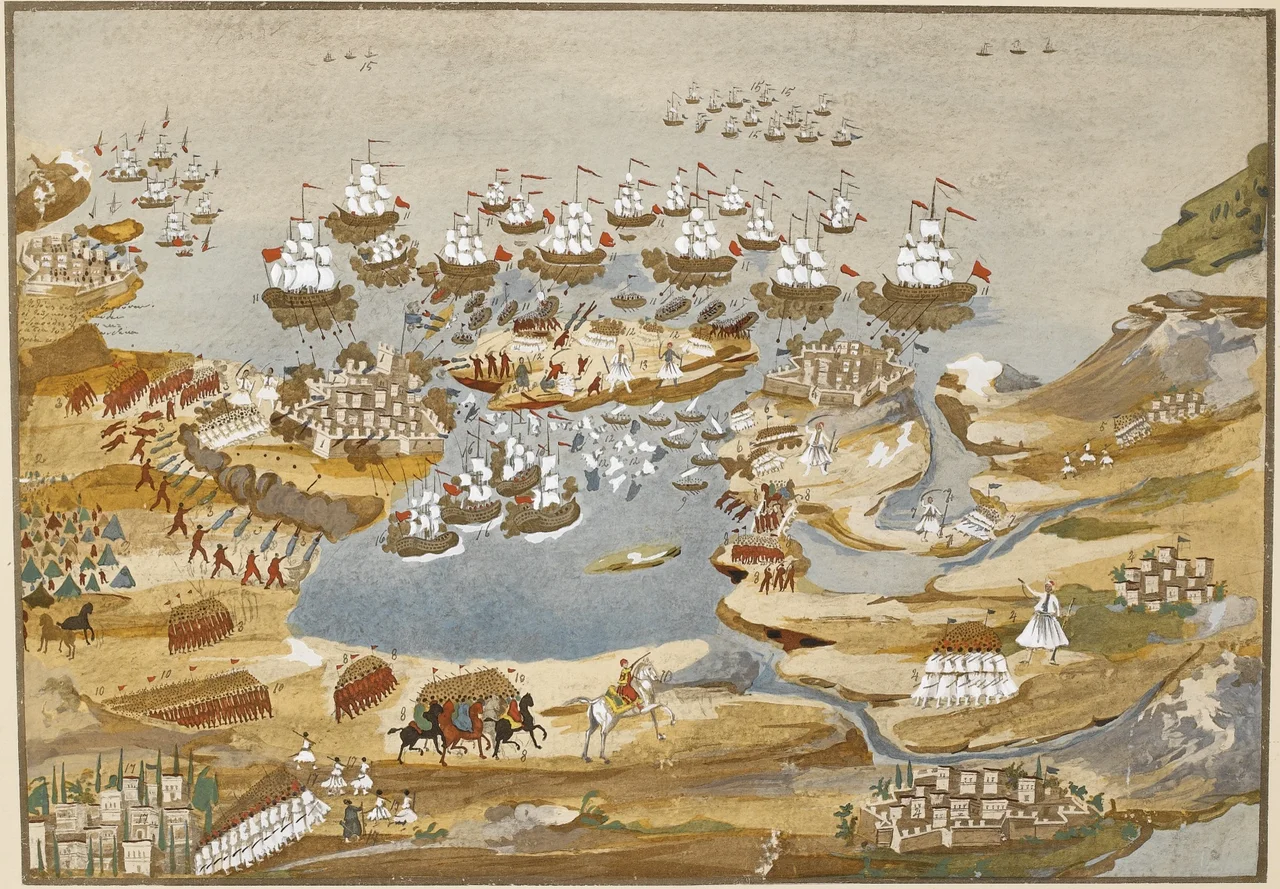
The castle saw one last burst of consequence during the Greek War of Independence. After Greeks captured the New Navarino fortress and killed its Ottoman garrison in August 1821, the area held for several years before Ibrahim Pasha of Egypt swept through in spring 1825, taking the old castle on 29 April and New Navarino a fortnight later. The Ottoman-Egyptian garrison remained until French troops under General Nicolas Joseph Maison arrived in 1828. The French found the old castle in a state of essential ruin. Today it still stands — barely — on its headland above Voidokilia Beach, declared off-limits because the structure is considered dangerous, though the sign-posting does not deter everyone. From below, from the perfect omega-shaped arc of the beach, you can look up and see the walls against the sky, and understand why every power in the Mediterranean once decided this rock was worth fighting over.
From the Air
Old Navarino Castle sits at approximately 36.958°N, 21.657°E on the cape Koryphasion headland, at the northern tip of Navarino Bay. The nearest airport is LGKL (Kalamata International), about 45 km northeast. From the air, the castle is immediately recognizable: a ruined structure crowning a dramatic 200-metre cliff above the omega-shaped arc of Voidokilia Beach. Approach from the northwest at 1,500–2,000 feet for the best view, with the bay opening to the south and Sphacteria island visible across the water. The white sand of Voidokilia directly below the headland makes orientation effortless.
Nearby Stories
- 1986 Kalamata Earthquake 2.8 km away
- Peloponnese 20 km away
- Kalamakia Cave Site 21 km away
- Lepreum 22 km away
- Strofades 29 km away
- 2018 Ionian Sea Earthquake 55 km away
- Apidima Cave 67 km away
- Valletta 597 km away