
Old Protestant Cemetery (Macau)
Before 1821, Protestants who died in Macau had no legal place to be buried. The Portuguese colonial authorities regarded the territory as sacred Catholic ground and barred non-Catholic interment within the city walls. On the other side of the barrier gate, the Chinese were equally unwilling to receive foreign dead in their soil. So the Protestant community of British, American, and Northern European traders did what they could: they buried their dead in secret, at night, in the strip of unclaimed land between the city walls and the gate, and hoped the graves would not be disturbed by morning.
A Death That Changed Everything
The hidden burials continued for years before a death finally forced the matter into the open. When Mary Morrison, wife of the missionary Robert Morrison, died in 1820, her husband's grief collided with the same bureaucratic indignity that the trading community had long endured in silence. The local committee of the British East India Company, moved partly by sympathy and partly by the practical need for a permanent solution, voted to purchase a plot of land next to the Company's headquarters. They negotiated with the Portuguese authorities until they secured legal permission to bury British Protestants there. The cemetery opened in 1821. Later the Company extended that right to Protestants of all nationalities, and graves that had been scattered in the borderland were brought in and reinterred, which is why some headstones carry dates earlier than the cemetery's founding year.
The People Beneath the Trees
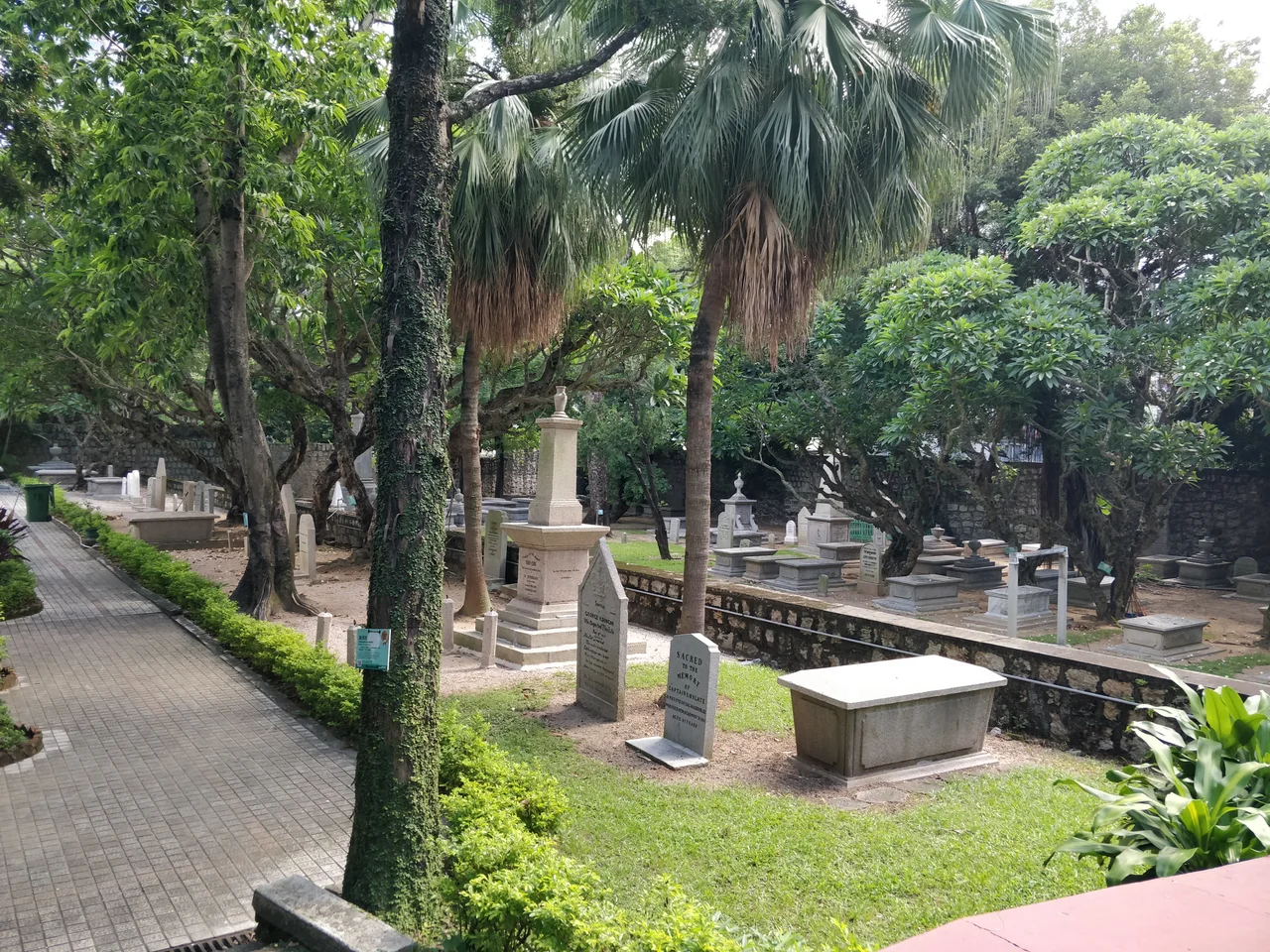
The Old Protestant Cemetery is divided into two terraced levels, shaded by mature trees, with 162 memorials in total. The lower terrace holds the earlier burials; the upper terrace, with 40 monuments, contains those from the cemetery's final active decade, roughly 1850 to 1858. The roll of the dead reads like a cross-section of the nineteenth-century world that converged on Macau. George Chinnery, the Irish portrait painter who spent nearly thirty years here capturing local life in his meticulous drawings, is buried here. So is Robert Morrison himself — the first Protestant missionary to translate the Bible into Chinese. Samuel Dyer, another missionary whose work on Chinese typography shaped how the language would be set in metal type for generations, lies nearby. Royal Navy captain Henry John Spencer-Churchill, son of the 5th Duke of Marlborough and great-great-granduncle of Winston Churchill, rests in this ground. So does US Naval Lieutenant Joseph Harod Adams, grandson of President John Adams and nephew of President John Quincy Adams. Humphrey Fleming Senhouse, a Royal Navy captain who served in the First Opium War, is here. And John Robert Morrison — son of Robert, appointed Acting Colonial Secretary of Hong Kong — died of fever in Macau just eight days after taking up his post, and is buried in the same ground as his father.
Men of Commerce and Consequence
Not all who rest here were soldiers or saints. Anders Ljungstedt, a Swedish businessman who became one of the foremost historians of early Macau, compiled records of the territory that are still consulted by scholars today. William Napier, 9th Lord Napier, was buried here after dying in the city following a failed diplomatic mission to open trade with China — though his body was later exhumed and returned to Scotland, leaving only a memory in the register. The cemetery closed in 1858 when the Portuguese authorities required all burials to take place outside the city walls and a new plot was purchased. In 1971, twenty-two memorials that had been stored in the newer cemetery were set into a wall here, consolidating the community's scattered dead one final time. The Morrison Chapel, which stands beside the cemetery, was rebuilt in its present form in 1922; it was restored again after World War II and remains an active Anglican congregation.
What Endures
In 2005, the Old Protestant Cemetery was formally incorporated into the UNESCO World Heritage Site Historic Centre of Macau. The designation acknowledged what anyone who walks through its gate already senses: this is not merely a historical curiosity but a document of the extraordinary collision of cultures that made Macau what it was. People from Britain, the United States, the Netherlands, Denmark, Sweden, Armenia, and Germany were brought to this ground, their nationalities listed in the register as if the cemetery were a small, permanent embassy for the Protestant dead. In 1977, the ashes of Lindsay Ride — a scholar who spent decades researching the cemetery's occupants and their biographies — were scattered here, and a memorial was raised to him. Ride understood that the value of the place lay not in its stones but in the lives the stones indexed. Walking among those memorials today, in the dappled shade of trees that were saplings when the first burials arrived, that understanding is easy to share.
From the Air
The Old Protestant Cemetery sits at 22.1999°N, 113.5402°E in the Santo António district of the Macau Peninsula, a few blocks north of the Ruins of St. Paul's. Recommended viewing altitude is 1,500–2,500 feet; the dense historic core of the peninsula is visible from this range, with the casino towers of the Cotai Strip rising to the south on reclaimed land between Taipa and Coloane. The nearest airport is Macau International Airport (VMMC), approximately 3 nautical miles southeast on Taipa Island. The Pearl River Delta spreads to the north and west, with the city of Zhuhai immediately visible across the border.
Nearby Stories
- 2024 Shenzhen Stabbing 0.8 km away
- Lantau Peak 1.5 km away
- Kweilin Incident 2.4 km away
- Taishan City 7 km away
- Wanshan Archipelago Campaign 38 km away
- Hong Kong 12 68 km away
- Battle of Nanpeng Island 82 km away
- Erhai Lake 1335 km away