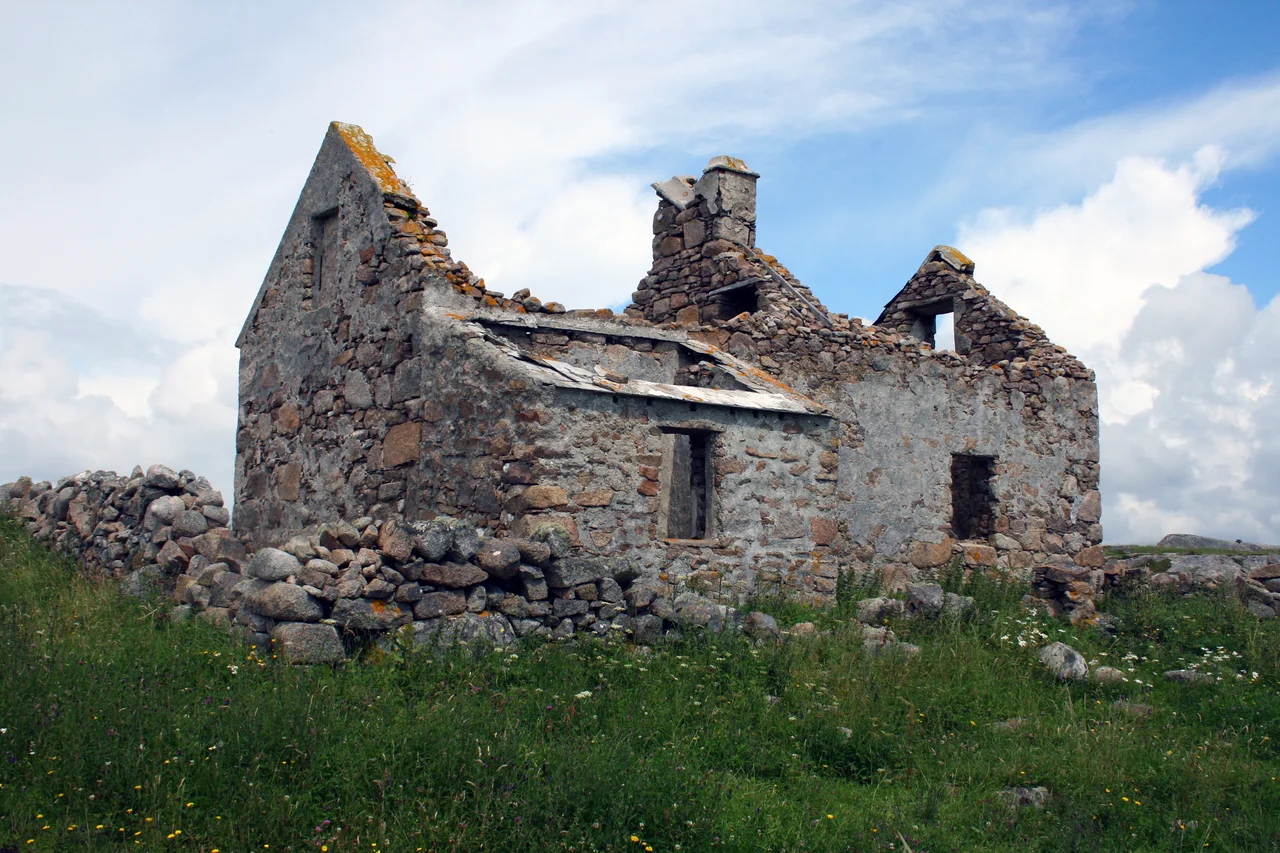

Omey Island
Twice a day the tide goes out at Claddaghduff and the Atlantic surrenders a temporary road. Painted arrows on stakes mark the route across the strand to Omey Island. At low water you can drive across in an ordinary car, or walk it in twenty minutes; at high water the channel is deep enough to submerge a vehicle entirely. The crossing is a country lane that runs through the sea. Locals time their day around it. Tourists who do not time their day around it learn fast - either by waiting for the next low tide or by listening to the laughter from the shore as they watch their hire car begin to swim.
St Feichín's Pagans
Omey's Irish name is Iomaidh Feichín - Feichín's bed, or Feichín's seat. The saint himself was the seventh-century abbot of Fore in Westmeath, and according to the old Latin hagiologists he found the inhabitants of Omey still entirely pagan when he arrived. The article published in Duffy's Hibernian Magazine called Omey 'the very last spot in which paganism lingered in Ireland.' Feichín met violent resistance when he tried to build a monastery there. He prevailed, founded the community, and the island became Imagia insula in the medieval Latin records. In the early-to-mid 1990s archaeologists from University College Dublin began excavating the monastic remains. They found, among other things, one of the few known burials of a woman within a monastic burial ground. The site is believed to date from the early sixth century - older than Feichín's own arrival - suggesting Christian and pagan worlds overlapped here longer than the medieval texts admit.
The Church the Sand Buried
At the western edge of the island sits St Feichín's Holy Well. Near it stood a medieval parish church that the wind buried over centuries under drifting sand. Most of its stones had stayed in place, but the building was completely invisible. In 1981 the parish priest decided enough was enough. With the help of local people he organized a dig and unburied the church. Most of the original stonework was still there, weathered by salt air but largely standing. The graveyard around it - Ula Bhreandain - is still in use today. The shell middens scattered around the island have been carbon-dated to AD 1000-1500, evidence of continuous occupation across centuries when the island was home to hundreds of people.
The Last Resident
The population of Omey peaked in the early 19th century when hundreds of people lived there. The National School opened in 1883 and closed in 1973. By 1988 there were three households left. For more than thirty years the only full-time inhabitant was Pascal Whelan, a former Hollywood stuntman who returned home to Connemara in retirement. Whelan lived alone on the island, looked after the cottage and the strand, and died in February 2017 - the last permanent resident of a place that had supported communities for at least fifteen hundred years. The Connemara poet Richard Murphy also lived on Omey for a period and built an octagonal retreat there that still stands. Bernard Henry Becker, a Daily Mail correspondent in 1880-81, described locals telling him 'there are nights when the pitaties themselves 'ud be blown away' on Omey - and he believed them, having seen the Atlantic winds work the surface of the island.
Horses on the Beach
Once a year, in late summer (usually July or August), the Omey Races bring crowds back to the strand. The event was reestablished in 2001 after a long lapse. Horses gallop on the wet sand at low tide, riders silhouetted against the Atlantic, spectators lined along the high water mark with picnic baskets and binoculars. The races last only a few hours, the tide returns, and the island goes quiet again. From the small graveyard at Ula Bhreandain you can hear the Atlantic working against the western cliffs, and you can stand on stones that have not moved since pagans buried each other here fifteen hundred years ago - a stone's throw from a strand where, on the right summer afternoon, thoroughbreds will be racing on what was, an hour earlier, the bottom of the sea.
From the Air
53.5353 N, 10.1575 W. Omey Island sits in a tidal channel off Claddaghduff on the western tip of the Connemara mainland, about 8 km northwest of Clifden. From the air the island appears as a distinctive almost-circular landmass connected to the mainland by a sandy strand visible at low tide. Inishbofin sits 12 km to the west. Inishturk South lies just south. The Twelve Bens fill the eastern horizon. Connemara Regional Airport (EICA) at Inverin is about 60 km southeast. Best visibility on clear winter days. The tidal causeway and the white sandy beaches around Omey are visually striking from low altitude - a hard, bright patch of sand against the dark Atlantic and the green of the small fields. Tide schedules are essential for anyone planning to visit on foot.
Nearby Stories
- Clare Island Abbey 2.1 km away
- Lough Mask Murders 3.7 km away
- RMS Carinthia (1925) 9.4 km away
- Battle of Castlebar 15 km away
- The Burren 23 km away
- Inishmore 25 km away
- Action of 7 May 1794 73 km away
- Inishtooskert 155 km away