_-_Ch%E1%BB%A3_%C4%90%C3%B4ng_Ba_Hu%E1%BA%BF_(July_2024)_-_img_02.jpg)
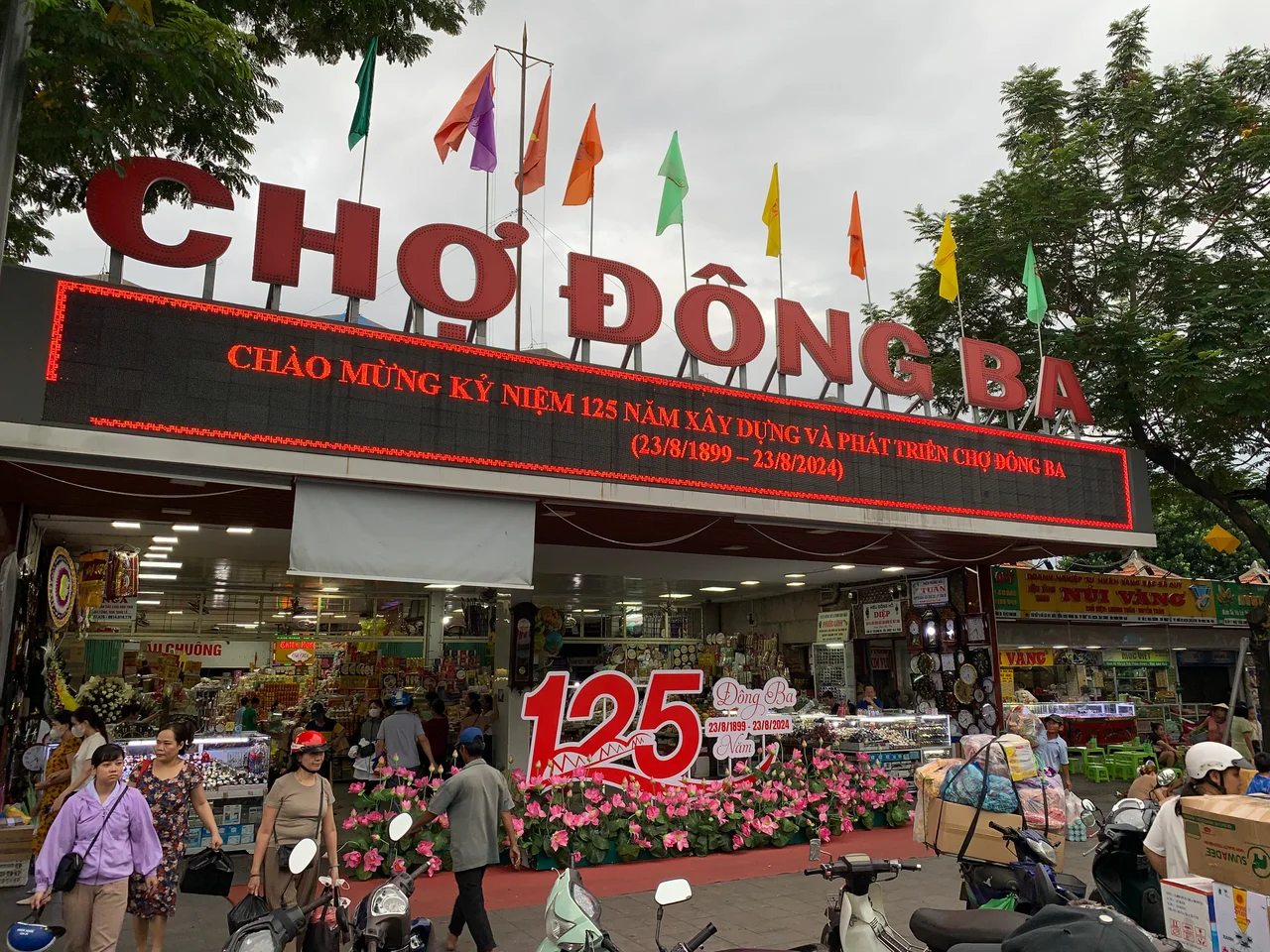
Đông Ba Market
A Franco-Vietnamese school once stood where the old market used to be, just outside the Eastern Gate of the Huế citadel. A student named Nguyễn Tất Thành — the young man the world would later know as Ho Chi Minh — studied there around the turn of the twentieth century. The market itself had already moved on, relocated by imperial order to a new stretch of road along the Perfume River. That kind of layered reinvention is Đông Ba's signature: burned down, rebuilt, moved, rebuilt again, and still trading every day more than a hundred years later.
Born at the Gates of Empire
The earliest version of Đông Ba Market took shape during the reign of Emperor Gia Long, the ruler who unified Vietnam in 1802 and made Huế his imperial capital. The market sat just outside the Eastern Gate of the citadel, sheltered beneath a roofed central hall called the đình Quy Giả — which gave it an alternate name, Quy Giả market. Traders gathered in the shadow of the imperial walls to exchange goods from across the region: fish from the Perfume River, cloth woven in the villages to the south, ceramics and lacquerware from court craftsmen.
Then, in 1885, war arrived. The Battle of the Huế Imperial City — a violent confrontation between Vietnamese loyalists and French forces — burned the market to the ground. Two years later, Emperor Đồng Khánh ordered it rebuilt. But the rebuilt version did not last in its original form either: in 1899, Emperor Thành Thái had it reconstructed entirely at its current site along Truong Tien Road. The new market opened with forty-eight roofed stalls and a well dug inside the grounds for water supply. The old site outside the Eastern Gate was handed over to educators.
The Perfume River's North Shore
Đông Ba Market occupies 47,614 square meters on the north bank of the Perfume River, pressed against the southeast corner of the citadel. That location is not incidental. The Perfume River was the lifeblood of commerce in central Vietnam for centuries, connecting the mountains to the sea and funneling goods through Huế on their way to markets further north and south. A market anchored to that riverbank could draw from the entire watershed.
Standing on the embankment today, you can see the Trường Tiền Bridge spanning the water to the south. The citadel's walls rise nearby. The market's corrugated roof stretches across the block, a practical structure crowded with traders, buyers, and the particular energy that only a working market generates. The river glints in the morning light. Sampans still move along the water, and the smell of fresh fish and rice mingles with the smoke of cooking stalls near the entrance.
Before the City Wakes Up
Đông Ba is open all day, but the people who know it best arrive before dawn. The early morning hours bring the densest crowds and the freshest goods — river fish hauled in overnight, produce carried in from the surrounding countryside, flowers bound in bundles that won't last past midday. By the time most of Huế is eating breakfast, the serious commerce is already well underway.
The goods on offer span an enormous range: fresh seafood and vegetables in the market's open-air sections, followed by stalls selling clothing, shoes, toys, silk fabric, and handicrafts deeper inside. Huế has a strong artisan tradition, and the market has always been one of the main venues where locally made lacquerware, conical hats, and embroidered cloth reach buyers. For visitors, it is also one of the best places to find the city's distinctive food — bánh khoái, bún bò Huế, and the sesame sweets the region is known for.
A Century of Reinvention
What makes Đông Ba unusual among Vietnamese markets is the density of history compressed into a single site. The market has been destroyed and rebuilt multiple times, relocated by imperial decree, renamed, and modernized — yet it has retained its identity as Huế's central trading place through all of it.
In 2009, the market celebrated its 110th anniversary at its current location, marking more than a century of continuous operation since Emperor Thành Thái's 1899 reconstruction. Proposals for further renovation and modernization have been discussed in the years since, with local traders consistently at the center of those conversations — the market's character, advocates argue, comes from the people who have worked its stalls across generations, not from its buildings. Đông Ba has outlasted the empire that created it, two world wars, reunification, and the rapid modernization of Vietnamese cities. On an ordinary morning, that history is invisible. The vendors are arranging their stalls, the buyers are deciding what to buy, and the market is doing what it has always done.
From the Air
Đông Ba Market sits at 16.4725°N, 107.5886°E on the north bank of the Perfume River in central Huế. At 2,000–3,000 feet, the Perfume River's distinctive curve through the city is clearly visible, with the dark rectangular footprint of the Imperial Citadel to the northwest and the long span of Trường Tiền Bridge just to the south of the market. The nearest airport is Phú Bài International (VVPB / DAD is the regional hub; Phú Bài ICAO is VVPB), approximately 14 km to the south. From the air, the market's dense block is one of the most active commercial footprints in the city, easily distinguished from the open grounds of the nearby citadel.
Nearby Stories
- Battle of Fire Support Base Ripcord 4 km away
- Sơn Trà Mountain 5.8 km away
- Quảng Trị Citadel 7.3 km away
- Battle of Nam Dong 10 km away
- Hội An wreck 56 km away
- Battle of Cua Viet 65 km away
- Saravan 100 km away
- Hainan Island Incident 342 km away