
Operation Starlite
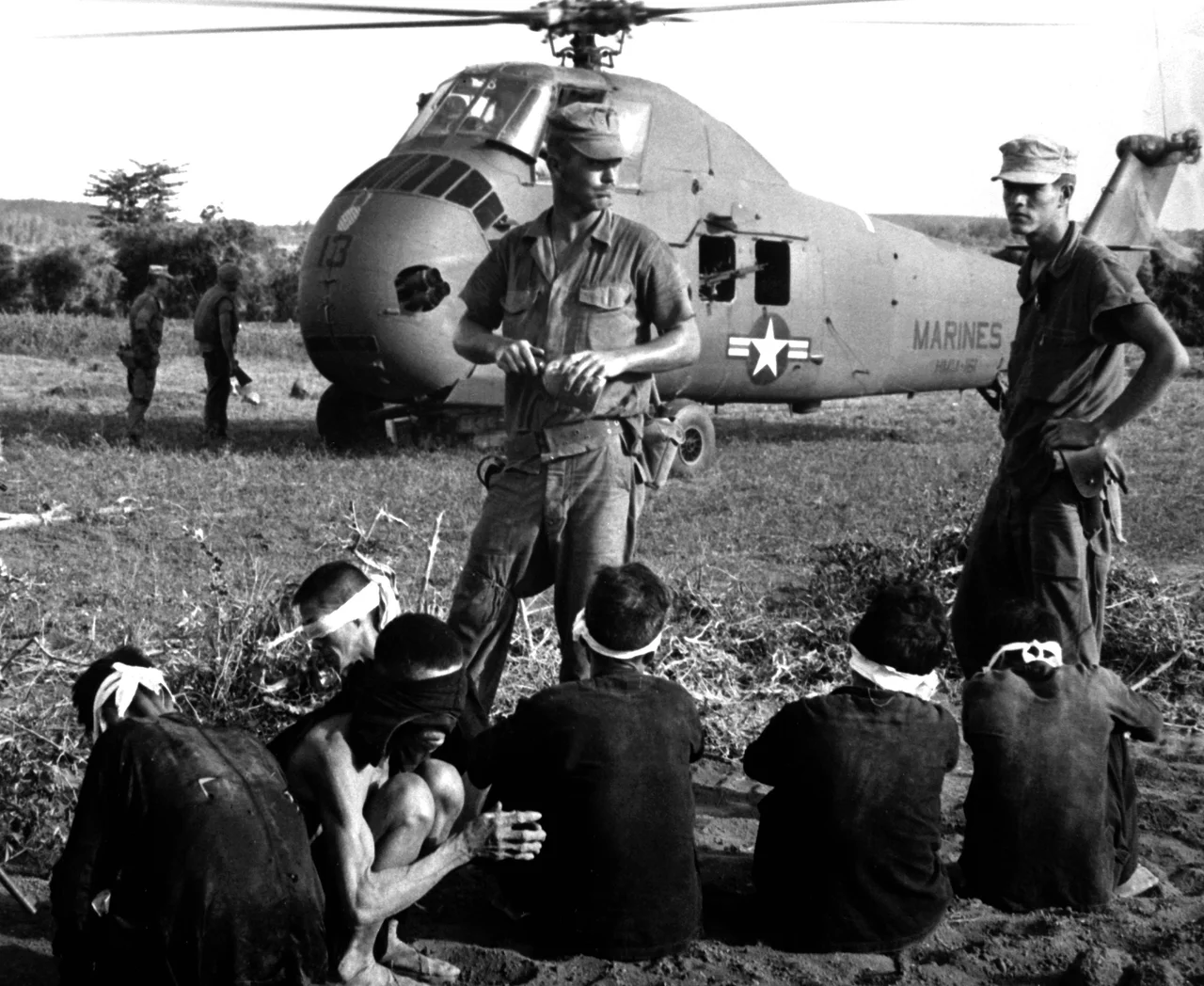
The intelligence arrived on 15 August 1965: a Viet Cong regiment was massing in the villages around Van Tuong, about 20 kilometers south of Chu Lai, preparing to attack the Marine air base. Lieutenant General Lewis Walt, commanding III Marine Amphibious Force, chose not to wait. Within three days he had launched Operation Starlite — a combined-arms assault involving helicopters, amphibious landings, naval gunfire, and close air support, all converging on a coastal rice-farming district that was about to become the opening battleground of American ground combat in Vietnam.
The Permission to Fight
For the first months after U.S. Marines landed at Da Nang in March 1965, their rules of engagement confined them largely to defending their own bases. General William Westmoreland, commanding all U.S. forces in Vietnam, had been pushing III MAF commander Walt to take larger offensive action against the Viet Cong. Walt reminded Westmoreland that a May letter of instruction still restricted the Marines to reserve and reaction missions in support of South Vietnamese units. Westmoreland's response was direct: those restraints were no longer realistic, and Walt should rewrite the instructions himself. On 6 August, Walt received formal permission to go on the offensive. When the 7th Marine Regiment arrived a week later, he had the force he needed. The intelligence about the gathering VC 1st Regiment near Van Tuong gave him his opportunity.
Three Prongs, One Objective
Walt's plan used the terrain against the Viet Cong. Three Marine battalions would strike simultaneously: one by amphibious landing from the sea to the east, one inserted by helicopter to the west and south to cut off escape routes, and one overland from Chu Lai to the north. Naval gunfire and air strikes would suppress VC positions as the Marines closed in. The operation began on 18 August 1965. The amphibious force came ashore from LSTs and landing craft; the helicopter assault deposited Marines in landing zones cut from rice paddies and sugar cane fields. The VC 1st Regiment had prepared defensive positions in the villages — bunkers, tunnels, and firing pits — and used them effectively in the early fighting, before the weight of Marine firepower and the pincer of the three-pronged assault began to tell.
What Each Side Claimed
By 24 August, when operations ended, both sides declared victory. The U.S. Marine Corps reported 45 Americans killed and 203 wounded; the VC 1st Regiment had been driven from the area with substantial losses. American commanders called it a success: a local-force VC unit had been engaged and defeated in a stand-up fight, demonstrating that U.S. troops could take the offensive and win. The Viet Cong told a different story. They claimed to have inflicted 900 American casualties — killed and wounded — destroyed 22 tanks and armored personnel carriers, and downed 13 helicopters, while losing only around 200 fighters. Lê Duẩn, the North Vietnamese Party Secretary, later placed VC dead at 50. The gap between these accounts reflects something true about the war itself: operational outcomes were contested ground, as much a matter of narrative as of bodies counted.
The Ambush the Pentagon Denied
Not everything went to plan. A Marine supply column, moving overland to support the operation, was ambushed and badly mauled by VC forces. Journalist Peter Arnett reported the ambush — one of the early instances of a correspondent documenting a military setback the command was trying to keep quiet. The Johnson administration wanted the operation kept secret; the story of the ambushed column was denied by the Marine Corps. The tension between what soldiers experienced and what official accounts reported would only deepen in the years ahead. Operation Starlite also produced a practical lesson that sounds almost mundane against the scale of the battle: the daily water ration of two gallons per man was dangerously inadequate in the Vietnamese heat. Future operations planned accordingly.
From the Air
The battlefield of Operation Starlite centers on the Van Tuong peninsula at approximately 15.299°N, 108.840°E, in Quảng Ngãi Province about 20 km south of Chu Lai Airport (VVCA). The terrain is low coastal plain — rice paddies, fishing villages, and sugar cane fields between the Trường Sơn foothills to the west and the South China Sea to the east. From the air, the triple threat of sea, coast road, and inland landing zones that defined the operation's geometry is immediately apparent. The village of Van Tuong lies just inland from the coast. Recommended viewing altitude: 3,000–5,000 feet. Nearby ICAO: VVCA (Chu Lai, 15 km north), VVDN (Da Nang, 145 km north).
Nearby Stories
- Battle of FSB Mary Ann 20 km away
- Trà Kiệu 20 km away
- Ngọc Linh 33 km away
- Chàm Islands 37 km away
- Operation Masher / White Wing 69 km away
- Vũng Rô Bay 251 km away
- Battle of the Paracel Islands 263 km away
- Vũng Rô Bay Incident 280 km away