
Orango National Park
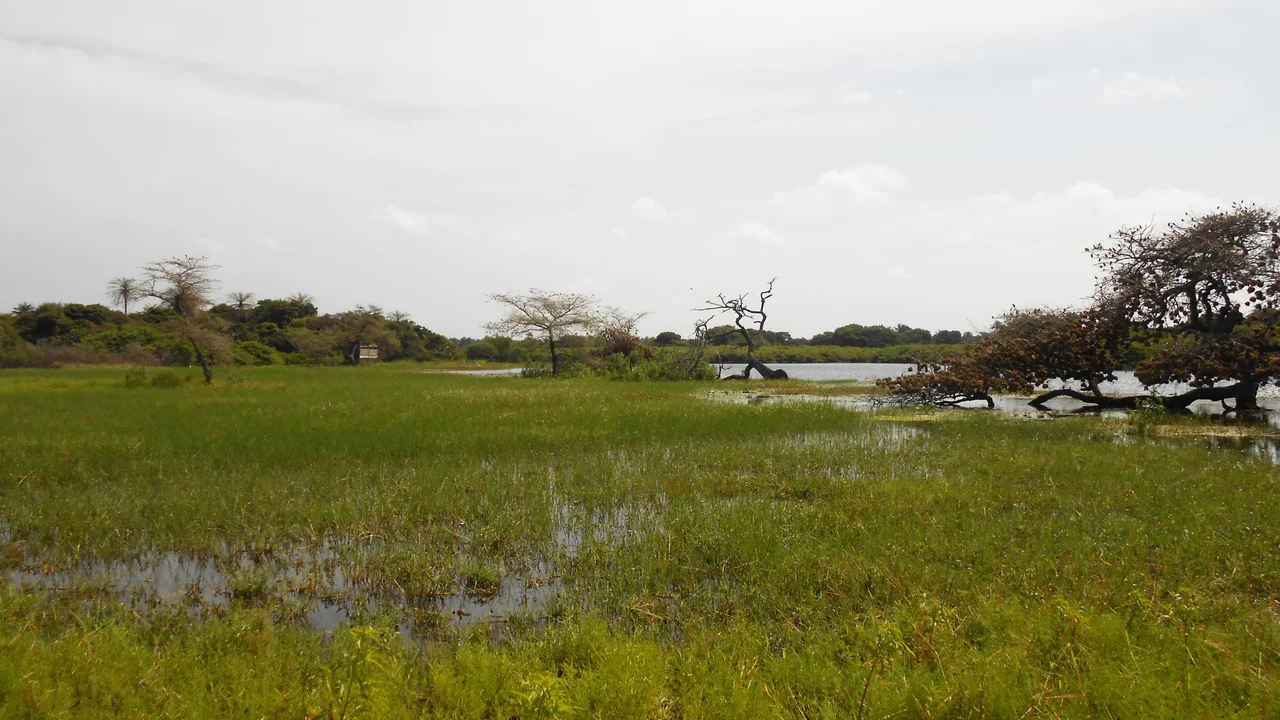
Hippopotamuses are not supposed to live in the sea. Yet on the islands of Orango National Park, in the southern reaches of Guinea-Bissau's Bijagós Archipelago, a small population of them moves through brackish channels and salt water, fording tidal flats between freshwater pools. There are perhaps two hundred of these animals here, smaller than their inland cousins, and they are the reason much of the world has heard of this remote scatter of mangrove islands at all. The park was established in December 2000 to protect them, and the maze of water, palm savanna, and tidal forest they depend on.
The Hippos That Took to the Sea
Orango's hippos are among the few populations on Earth known to swim in salt water and graze along ocean shores. They are not a separate species, but they have adapted to a place where fresh water is scarce and the tide rules everything. By day they shelter in inland pools and creeks; at dusk they cross the flats, sometimes wading into the surf. To the Bijagó people who share these islands, the hippopotamus is not a curiosity but a sacred presence, woven into their understanding of the land and its spirits. The park's 1,582 square kilometres, roughly a tenth of it open sea no deeper than thirty metres, exist largely to keep this strange coexistence intact.
Where Women Hold the Land
The Bijagó who live across the archipelago organise their society along matrilineal lines, and on Orango the pattern runs deep. Women choose their husbands, own the houses and the land, and govern much of village life. Spiritual authority rests with priestesses who tend the sacred spaces and conduct the animist ceremonies that mark birth, initiation, and death. This is not a tourist's fantasy of a lost matriarchy but a living social order, practised in tabancas of palm-thatch houses, that has held its shape through Portuguese rule, independence, and the slow arrival of the outside world.
Queen Okinka Pampa
In the village of Eticoga stands the mausoleum of Okinka Pampa, remembered as the last great queen of the Bijagó. Ruling Orango in the early decades of the twentieth century, she is credited with abolishing slavery on the islands, widening the rights of women, and shielding her people from the worst of Portuguese colonisation. Her tomb is no museum piece. Her descendants and the villagers still gather there for rituals, keeping a covenant with a leader whose memory shapes how Orango sees itself. To stand at Eticoga is to feel that the past here is not finished business.
A Country of Mangrove and Tide
About 160 square kilometres of the park are mangrove, and those flooded forests are its hidden engine. Their roots cradle the young of molluscs, fish, and sea turtles, feeding a food web that reaches far beyond the islands. On higher ground, oil palms rise above savanna shrub and sandy shore. The endangered African grey parrot, vanishing across much of West Africa, still finds refuge in these woods. Twice a day the Atlantic empties and refills the channels, and the whole archipelago breathes with it, a deltaic world stitched together by salt water and silt.
From the Air
Orango National Park covers the southern Bijagós Archipelago at roughly 11.12°N, 16.05°W, southwest of Bissau (GGOV) over open Atlantic shallows. From altitude the islands read as low green shapes laced with silver tidal channels and pale mangrove fringes, set in water rarely deeper than 30 metres. Best viewed in the dry-season haze of December to April; coastal cloud and Harmattan dust can flatten visibility. Nearest international gateway is Osvaldo Vieira International at Bissau (GGOV); access to the islands themselves is by boat.
Nearby Stories
- Poilão 31 km away
- Boké Museum 131 km away
- Nadir Crater 178 km away
- Pongo River (Guinea) 180 km away
- Dakar 377 km away
- Gouina Falls 554 km away
- Bafoulabé 620 km away
- SS Noemijulia 810 km away