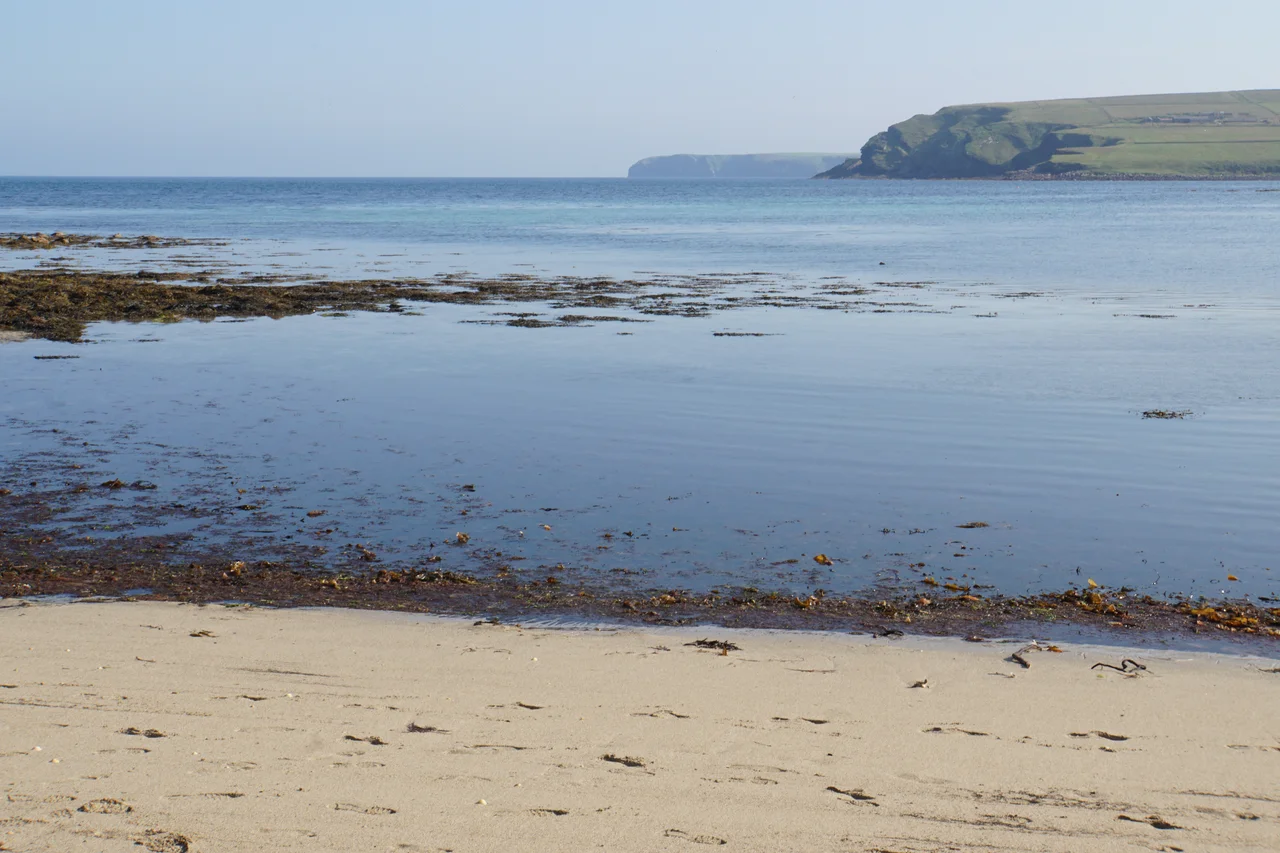

Orkney Islands
The stones at Brodgar were already two thousand years old when the first pyramid was built at Giza. The Orkney Islands have been continuously inhabited since around 7000 BC, and the people who lived here in the Neolithic left behind a denser concentration of well-preserved tombs, villages, and standing stone circles than anywhere else in northern Europe. Then the Vikings arrived in the eighth century and rewrote everything in Old Norse. Then the Royal Navy turned the great inland sea of Scapa Flow into its main wartime anchorage. The layers do not blur into each other. They sit visibly on top of one another, and you can walk between them in an afternoon.
Older Than the Pyramids
The Heart of Neolithic Orkney, a UNESCO World Heritage Site since 1999, gathers four of the archipelago's prehistoric showpieces around the narrow neck of land between the Lochs of Stenness and Harray: Maeshowe chambered cairn, the Stones of Stenness, the Ring of Brodgar, and the village of Skara Brae. Maeshowe was built around 2800 BC and aligned so that the setting sun at midwinter shines straight down its entrance passage into the central chamber. The Stones of Stenness, slimmer and sharper than Brodgar's broad slabs, are among the oldest henge monuments in Britain. The Ring of Brodgar is enormous, originally sixty stones in a perfect circle 104 metres across. Skara Brae, exposed by a storm in 1850, is a Neolithic village preserved beneath sand dunes with stone furniture still in place: beds, dressers, hearths, drains. None of these places exists in isolation; they were a working ritual landscape, and the people who used them lived close by.
The Norse Five Centuries
Vikings arrived in the eighth century and stayed. Orkney became part of the Kingdom of Norway and remained Norse for over five hundred years, long after the Norsemen had been displaced from mainland Britain. The Orkneyinga saga, written in Iceland around 1230, records the islands' earls and their feuds with a soap opera's enthusiasm for betrayal and a remarkable amount of geographic precision. In 1486 Orkney was pledged as security against the dowry of Margaret of Denmark, married at thirteen to James III of Scotland. The dowry was never paid. Orkney passed to Scotland by default. The Norse legacy remained intact in the dialect, the place names, the udal land tenure traditions, the festivals, and in the simple fact that this is not Highland Scotland. There are no Gaelic place names, no clan tartans, no midges. Just bright red sandstone, green fields, and the sea.
The Fleet at the Bottom
In November 1918 the German High Seas Fleet was disarmed and brought to Scapa Flow under the terms of the Armistice. Peace negotiations dragged on into the following spring. The captured crews grew mutinous, food was rationed, and Admiral Ludwig von Reuter became convinced the British were about to seize the ships outright when the Armistice expired. On 21 June 1919 he ordered the entire fleet scuttled. Seacocks were opened across seventy-four warships. The British managed to beach a handful and most of the others were salvaged for scrap in the 1920s and 1930s by the entrepreneur Ernest Cox. Seven major vessels remain on the seabed: the battleships König, Kronprinz Wilhelm, and Markgraf, and the cruisers Brummer, Coln, Dresden, and Karlsruhe. They lie upside down, fragile after a century underwater, beyond the depth limit for sport divers but the centrepiece of the world's most extraordinary wreck-diving destination. Twenty years later HMS Royal Oak joined them, sunk in 1939 by a U-boat that slipped through the eastern entrance.
The Working Islands
Today around twenty-two thousand people live across Orkney. Mainland, the largest island, holds eighty percent of the population. Kirkwall is the administrative capital, port, and main town. Stromness, smaller and more beautiful, is the ferry terminal for Scrabster. The Churchill Barriers, built by Italian prisoners of war after 1939 to seal the eastern entrances of Scapa Flow, now carry the road from Mainland down through Lamb Holm, Glimps Holm, Burray, and South Ronaldsay. Inter-island flights connect Westray, Papa Westray, Sanday, Stronsay, Eday, and North Ronaldsay; the hop from Westray to Papa Westray, two miles and roughly two minutes, is the world's shortest scheduled commercial flight. Loganair's pilots complete their landing checks before opening throttle on takeoff.
The Half-Joking Discussion of Leaving
Orkney's economy and identity have always faced multiple directions. The 2024 population was twenty-two thousand five hundred. The agriculture is rich. The fishing fleet still works. Highland Park and Scapa distilleries are world-renowned. North Sea oil and gas terminals at Flotta brought infrastructure money in the 1970s. And in 2023, with services squeezed and ferry funding uncertain, some Orcadians publicly entertained the idea of leaving the United Kingdom to rejoin Norway, or becoming a crown dependency on the model of the Isle of Man. The discussion was partly serious, partly Orcadian dry humour. The islands remain part of Scotland, but the conversation about who they belong to has been going on since the Vikings landed, and there is no sign it is finished.
From the Air
Centered roughly at 59.04 degrees north, 3.00 degrees west, the Orkney archipelago lies ten miles off the northern tip of mainland Scotland across the Pentland Firth. Best viewed at 3,000 to 8,000 feet AGL, where the scattered green islands separate from one another and the deep blue inland sea of Scapa Flow is unmistakable in the south. The Heart of Neolithic Orkney sites cluster around the Stenness-Harray isthmus on central Mainland. Kirkwall Airport (EGPA) is the main gateway with Loganair service from Aberdeen, Edinburgh, Glasgow, Inverness, and Sumburgh. Wick (EGPC) and Sumburgh (EGPB) provide alternates. North Atlantic weather is the dominant operational factor: strong westerlies, rapidly changing visibility, and crosswind components year-round.
Nearby Stories
- Pentland Skerries 5.4 km away
- Thurso 13 km away
- HMS Daring (H16) 42 km away
- Wolfburn Distillery 42 km away
- Orcadian Basin 55 km away
- Fair Isle 57 km away
- Jarlshof 119 km away
- The Laki Eruption: The Volcano That Changed World History 941 km away