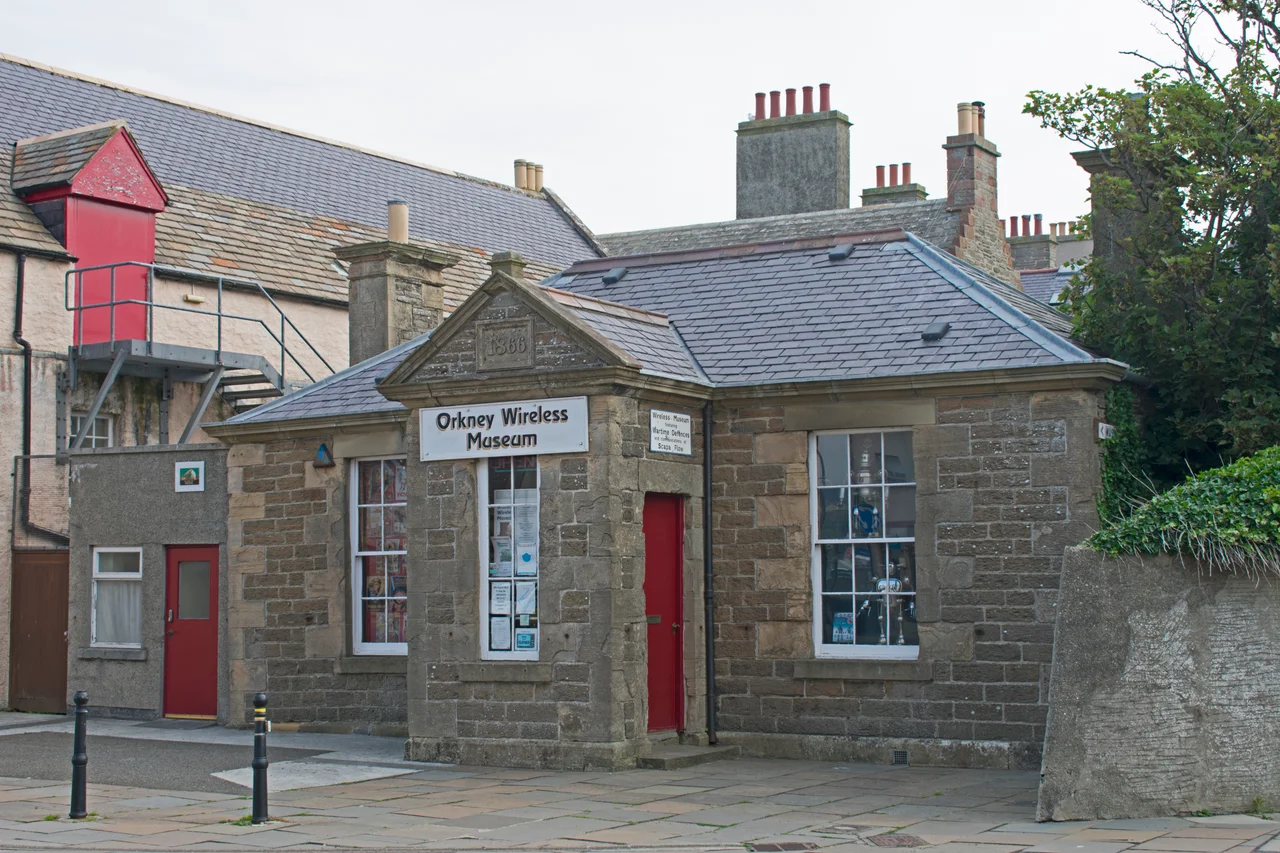

Orkney Wireless Museum
Jim MacDonald was thirteen when the Second World War began. He was already collecting old radios; valve sets, crystal sets, anything with a tube or a coil he could lay his hands on. When the war came he was put to work as a civilian electrician at the Royal Navy base at Lyness on Hoy, and at the radar station at Netherbutton on Mainland that helped defend Scapa Flow from German air attack. He never stopped collecting. The museum at Kiln Corner in Kirkwall, run by volunteers and open only April through September, is the visible end of a life's quiet obsession.
A Boy and His Crystal Sets
James MacDonald was born in 1927 on South Ronaldsay, the southernmost of the Orkney islands accessible by road, and grew up there during the years when wireless was rapidly transitioning from amateur novelty to mass medium. His apprenticeship as an electrician and radio repairman put him on the right side of every household conversion to the new technology, and gave him access to the older sets that were being replaced. The nucleus of his collection was already substantial when war broke out. It included expensive early sets by Marconi, Cossor, MacMichael, K.B., Lowe, and Amplion, names that mean little now but were the Apples and Sonys of the interwar British home. The set most fascinating to visitors today is a working crystal set built around 1912, with its cat's whisker detector visible on top. Put on the headphones and you can still pick up BBC Radio Scotland.
Fortress Orkney
During the Second World War Orkney was effectively a military base with civilians attached. Scapa Flow was the main anchorage of the Royal Navy's Home Fleet, and the islands bristled with anti-aircraft batteries, naval signals stations, and one of the world's first operational radar installations at Netherbutton. The radar prototype that defended Orkney was originally built for Dover but redirected north because the Orkney installation was not ready in time; when the Orkney station was finally finished, the original prototype was sent south to play its decisive role in the Battle of Britain. Jim MacDonald worked at Netherbutton and at Lyness, listed as in a reserved occupation, his electrician's skills more useful to the war effort than another rifleman in the trenches. The photographic archive at the museum documents what islanders called Fortress Orkney: barrage balloons over the cathedral, ammunition stores in the hills, and tens of thousands of servicemen quartered across an archipelago of twenty thousand people.
What the Museum Holds
The collection at Kiln Corner is small in floor space and huge in density. A No. 19 Tank Set, the standard British armoured-vehicle radio of the war, sits beside a Recordon dictating machine that recorded onto a flat magnetic paper disk. There is a 1930s Ardent hearing aid. A U-boat radio sits a few feet from a spy suitcase set of the kind issued to Special Operations Executive agents dropped into occupied Europe. The original Scapa Flow boom defence chart hangs on the wall, marked with the positions of the anti-submarine nets that famously failed to stop U-47 in October 1939. Radios used by Y-stations, the network of secret listening posts that intercepted enemy signals and fed Bletchley Park, are on display alongside American domestic sets by Emerson, Weston, and Philco, and British sets by EKCO. Most of the equipment saw active service; little of it has been restored to museum gloss. It looks like what it is, scarred and used.
From Family Home to Charity
MacDonald opened his collection to the public in 1983 in his family home at St Margaret's Hope on South Ronaldsay, calling it An Orkney Wireless Museum, a deliberately modest title. He died of cancer in 1988 at sixty-one, leaving instructions for his family to continue. A registered Trust was set up in 1990. The Museums and Galleries Commission admitted the collection as a member in 1994, conferring official recognition of its quality. In 1997 the museum moved to its current location at Kiln Corner in Kirkwall, where the larger premises allowed more of the collection to be displayed at once. The Royal Naval Amateur Radio Society awarded the museum a certificate for collecting, preserving, and displaying the radio and electronic heritage of Scapa Flow and the Orkney Isles. None of this would exist without the original collector and the family who carried out his wishes.
On the Air, GB2OWM
The amateur radio call sign GB2OWM is regularly activated from the museum, and during the Orkney International Science Festival each September volunteers make contacts with operators around the world, exchanging QSL cards with the stations they reach. It is a fitting continuation; Jim MacDonald started collecting because he wanted to know how radio worked, and the museum keeps the equipment doing the thing it was built to do. Drop in during opening season (April to September) and you will likely find a volunteer happy to demonstrate a set, explain a circuit, or hand you the headphones on the 1912 crystal set. Kiln Corner is a small building beside a busy road. The history compressed inside it is enormous.
From the Air
Located at 58.9853 degrees north, 2.9561 degrees west, at Kiln Corner in central Kirkwall a few minutes' walk from St Magnus Cathedral. Best viewed at low altitude on approach to Kirkwall; the museum is a small building and not a distinctive landmark from the air. Nearest airport is Kirkwall (EGPA), three miles southeast, served by Loganair. The wartime radar sites at Netherbutton and the naval base ruins at Lyness on Hoy, both heavily represented in the museum's collection, are also visible from the air in clear weather.
Nearby Stories
- Pentland Skerries 5.4 km away
- Thurso 13 km away
- HMS Daring (H16) 42 km away
- Wolfburn Distillery 42 km away
- Orcadian Basin 55 km away
- Fair Isle 57 km away
- Jarlshof 119 km away
- The Laki Eruption: The Volcano That Changed World History 941 km away