
Ormskirk
The town's name is a confession of conquest. Ormskirk comes from Ormres kirkja, Old Norse for Ormr's church, and Ormr meant serpent or dragon. Some Viking settler called Ormr put up a church here in the years after the Norse arrived on the Lancashire coast, and the place has been called by his name ever since. He left no other trace beyond the syllables. By 1189 the lord of Lathom was granting the church to nearby Burscough Priory, and by the thirteenth century Ormskirk had been laid out as a planned market borough on a sandstone ridge eighty-one metres above the West Lancashire Plain. The serpent's church became a town for selling cheese, gingerbread, and machinery, and it has kept its market day for eight hundred years.
The Tower and the Spire
The Parish Church of St Peter and St Paul stands where Ormr's kirk once stood, and it has done something no other parish church in England does at the same end of the building: a tower and a separate spire side by side. Only two other English parishes have both at all, both near Swindon, and neither puts them together. The local story goes that Orme had two sisters, one wanted a tower, the other a spire, and rather than choose he built both. The truer history is more interesting: the spire dates from the early fifteenth century, blew down in 1731 and was rebuilt across the next four decades, and the great west tower was added around 1548 to house the bells of Burscough Priory after Henry VIII's dissolution emptied that monastery. One of the priory bells still rings in the tower.
Where the Stanleys Are Buried
Inside the church is the Derby Chapel, where the Stanley earls of Derby lie. Thomas Stanley, first Earl, decided the Battle of Bosworth in 1485 by changing sides at the critical moment, costing Richard III his crown and his life. James Stanley, seventh Earl, did not survive the choices he made in the next century's wars: a Royalist commander whose wife Charlotte had held Lathom House against a Parliamentary siege, he was beheaded at Bolton in 1651, and his head and body were placed in separate coffins for the journey home to Ormskirk. They lie in two boxes in the chapel still, a domestic detail of regicide that lingers a long time after you have walked back out into the churchyard.
The King and the Gingerbread
Ormskirk gingerbread is not the same recipe as anywhere else, and its makers have always insisted on that. Local women baked it at home and walked it down to the staging inns to sell to passengers waiting for coaches. When the railway opened in 1849 the gingerbread sellers were given permission to work the platform, hawking warm slabs to travellers passing through. One regular customer was Edward, Prince of Wales, who liked it enough to send orders north to Ormskirk after he became Edward VII. Sally Woods was the great gingerbread name of the Victorian market, a figure everyone in town recognised. Several bakers still claim the original recipe, and the disputes are ongoing in the way only matters of dark molasses and warm spice can be.
The People Who Came From Here
Notable Ormskirk lives spill across the centuries. Sir James Jeans, born here in 1877, became one of the great physicists and astronomers of his era, presiding over the Royal Astronomical Society from 1925 to 1927. Marianne Faithfull, born in 1946, recorded one of the haunting songs of the British sixties, As Tears Go By, written for her by Mick Jagger, Keith Richards, and Andrew Loog Oldham; her career ranged across drug arrests, comebacks, and a voice that aged into something more interesting than her early prettiness ever was. Sir Jonathan Pryce studied at Edge Hill College and went on to High Sparrow, Pope Francis, and a long career on stage. John Rimmer, born here in 1878, won two gold medals at the 1900 Paris Olympics in the 4000-metre steeplechase and team race. Edge Hill University remains the town's largest single institution and its biggest employer.
A Market Town That Stayed One
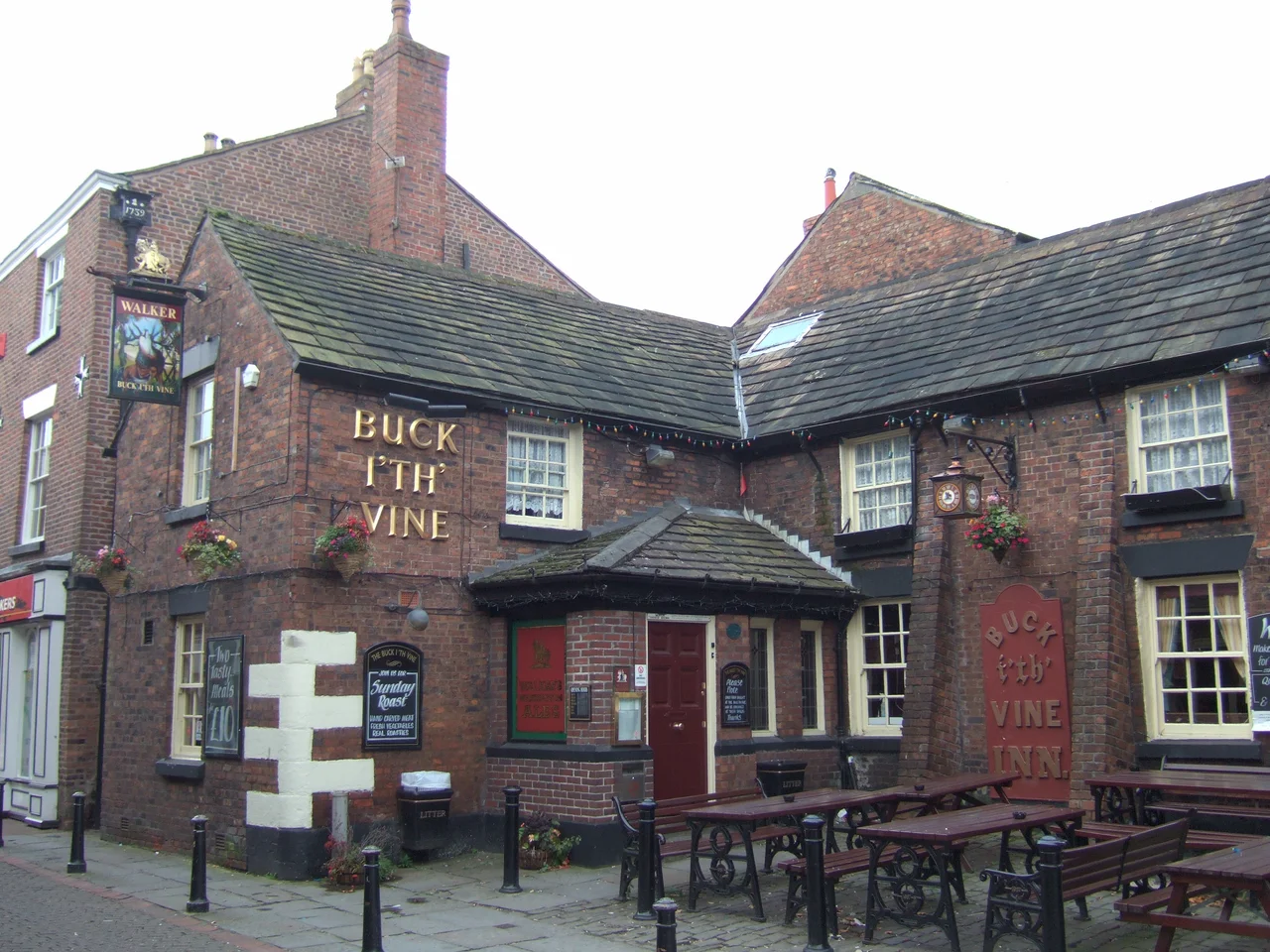
Walk Ormskirk on market day, Thursday or Saturday, and the centre still carries on as a planned medieval borough should. The Old Town Hall went up in 1779. The Beaconsfield monument stands on Moor Street. The Buck i'th' Vine Inn still serves on Burscough Street. Victoria Park, the oldest of the town's three main parks, holds memorials to the Boer and Crimean wars, and Coronation Park was laid out in 1905 to mark Edward VII's coronation, with the war memorial moved there in 2012 from its earlier home outside the Comrades' Club. The town never grew into a city. It stayed what it was made to be, a place to buy and sell on the West Lancashire Plain, and that is the version of itself the railway and the A59 still find.
From the Air
Coordinates 53.5665 N, 2.8869 W on the West Lancashire Plain. Recommended viewing altitude 3,000 to 5,000 feet to pick out the unusual tower-and-spire silhouette of the parish church. Nearest airports: Liverpool John Lennon (EGGP) 12 nautical miles south, Blackpool (EGNH) 18 nautical miles north, Manchester (EGCC) 27 nautical miles east. Ormskirk sits on a low sandstone ridge between the Mersey estuary and the Ribble; the A59 runs through, with the M58 motorway clipping the southern edge.
Nearby Stories
- Blackpool Pleasure Beach 4.4 km away
- Whalley Abbey 4.8 km away
- Worsley 5.4 km away
- Second Battle of Middlewich 7.7 km away
- Chester Zoo 7.9 km away
- Llanrwst 23 km away
- Abergele Rail Disaster 27 km away
- Sea Lion Rocks railway station 73 km away