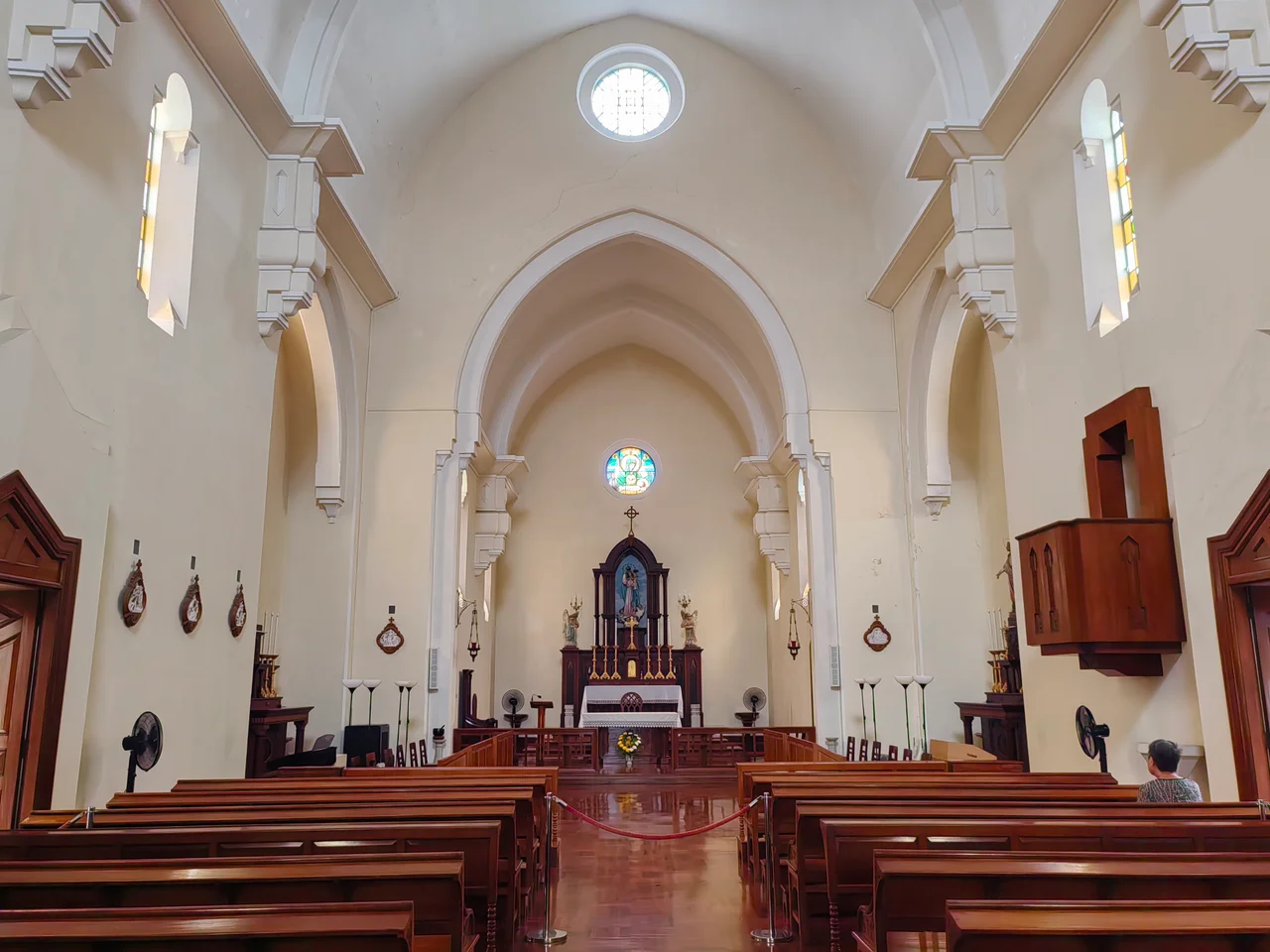

Our Lady of Penha Chapel, Macau
In the winter of 1622, a Portuguese ship called the São Bartholomeu was running for its life. En route from Macau to Nagasaki, the vessel found itself pursued by Dutch warships in the Taiwan Strait. The crew made a vow: if they survived and made it home, they would build a church. They did survive. They did come home. And on the crest of Penha Hill, the highest point of the Macau Peninsula, they kept their word.
A Vow Made at Sea
The Portuguese and Dutch were fierce rivals in the early seventeenth century, contesting trade routes, colonies, and allies across Asia with a ferocity that made every voyage a gamble. For the crew of the São Bartholomeu, the pursuit in the Taiwan Strait was not an abstraction — it was the specific terror of being outgunned at sea, far from port, with no certainty of return. The vow they made was the kind of vow that sailors have always made in extremis: a bargain with heaven, payable on survival. The Augustinians received the land from the Senate of Macau for the construction. The church was dedicated to Our Lady of Penha of France, and it became the property of the Augustinian order, which maintained it until 1834, when the Augustinians were expelled from Macau following the suppression of religious orders in Portugal.
Three Centuries, Three Rebuildings
Few buildings in Macau carry as many layers of reconstruction as the chapel on Penha Hill. After the Augustinians departed in 1834, the church fell into disrepair. In 1837, it was reconstructed, and the Bishop's residence was built alongside it — the chapel becoming, in effect, the private church of Macau's Catholic leadership. Then, nearly a century later, in 1935, it was torn down again and completely rebuilt in the Neo-Manueline style, an ornate Portuguese architectural revival that borrowed its decorative vocabulary from the age of exploration: carved stonework, maritime motifs, elaborate facades. The Neo-Manueline style was a deliberate act of cultural memory, linking the colonial present to the fifteenth and sixteenth centuries when Portugal's ships first reached Asia. That the chapel on Penha Hill was rebuilt in this style — a chapel that literally originated with a ship's crew — gave the reconstruction a certain poetic coherence.
The Hill Above the City
Penha Hill gives the chapel something that most Macau landmarks cannot claim: elevation and distance. The peninsula is flat for most of its length, and the hill rises enough to separate the chapel from the noise and density below. From the forecourt, where a statue of Our Lady of Lourdes stands at the entrance, the view takes in the inner and outer harbours, the older districts of São Lourenço, and on a clear day the islands of Taipa and Coloane to the south. At the base of the hillside staircase, a grotto of Our Lady of Lourdes — smaller and more intimate than the forecourt statue — offers a stopping place for those who climb on foot. Pilgrims and tourists tend to pause there. The chapel itself, at the summit, is enclosed within the grounds of the Bishop's residence and is not always open to the public, but the approach up the hill is itself the experience — a slow emergence from the city into something quieter.
Faith Held in Stone
What makes the chapel on Penha Hill distinctive is not its architecture, which has been rebuilt too many times to carry the authenticity of great age, but its continuity of purpose. From 1622 to the present, this site has been a place of Catholic devotion on a peninsula where Portuguese, Chinese, and other communities have negotiated the terms of coexistence for four centuries. The chapel predates most of Macau's other surviving monuments. It predates the Ruins of St. Paul's by a decade and outlasted them by centuries. The vow made by frightened sailors in a distant strait was honored, and the honor has been renewed — in stone, in dedication, in rebuilding — ever since. Macau's identity is built from exactly these layered acts of memory, and Penha Hill is one of the places where that layering is most visible.
From the Air
The Our Lady of Penha Chapel stands at 22.1869°N, 113.5351°E on Penha Hill in the southern part of the Macau Peninsula, near the São Lourenço district. At the highest point of the peninsula, the hill is a useful navigation reference from the air. Recommended viewing altitude is 1,500–2,500 feet. The nearby airport is Macau International Airport (VMMC) on Taipa Island, approximately 2.5 nautical miles southeast. From the air, the older Portuguese-era districts of the peninsula are visible to the north, with the Cotai reclamation visible across the channel to the south.
Nearby Stories
- 2024 Shenzhen Stabbing 0.8 km away
- Lantau Peak 1.5 km away
- Kweilin Incident 2.4 km away
- Taishan City 7 km away
- Wanshan Archipelago Campaign 38 km away
- Hong Kong 12 68 km away
- Battle of Nanpeng Island 82 km away
- Erhai Lake 1335 km away