
Palace of Nestor
On the first day of excavation — 4 April 1939 — the archaeologists hit stone walls, fresco fragments, Mycenaean pottery, and inscribed clay tablets. The site on the hill of Epano Englianos had been chosen as a likely candidate for Homer's "sandy Pylos," but nobody expected to find the archive on day one. Around a thousand Linear B tablets came out of that 1939 season alone. Then World War II intervened, the tablets were locked in the vaults of the Bank of Greece for safekeeping, and the site waited another thirteen years before excavation could resume. What eventually emerged from the hillside was the best-preserved Mycenaean palace in Greece.
Homer's Sandy Pylos
In the Odyssey, Telemachus travels to Pylos searching for news of his father, Odysseus, missing since the Trojan War. King Nestor receives him at his "lofty house" and treats him as a father would a long-absent son. Homer was probably drawing on genuine memory of a place that had been real and powerful. The Palace of Nestor sits on the hill of Epano Englianos, 17 km north of modern Pylos, at 150 metres above sea level. Its footprint covers an area of 170 by 90 metres. The palace was two storeys tall, with storerooms, workshops, baths, light wells, and reception rooms — the full apparatus of Bronze Age palatial life. It served as the administrative, political, and financial centre of Mycenaean Messenia. Most artifacts date from around 1300 BC. Fire destroyed the complex around 1200 BC, baking the clay tablets hard and preserving them for three thousand years.
The Archive and the Man Who Read It
The Linear B tablets found at Nestor's palace sat unread through the war years, locked away in Athens. When excavations resumed in 1952 and the tablets were finally examined, they were part of the royal archive — lists of personnel, livestock, land allocations, contributions to the palace, offerings to the gods. That same year, an English architect named Michael Ventris cracked the code. Working from the patterns of the script, Ventris determined that Linear B was an archaic form of Greek — not a lost language but an ancestor of the one scholars already knew. The translation of the Nestor tablets was a landmark moment in understanding ancient literacy. Among the records was a land dispute involving a priestess named Eritha; her case survives as one of the most detailed accounts of an individual from Mycenaean Greece. The tablets also mention a figure whom modern scholars regard as a possible king of Pylos: Enkheljawon.
The Painted Bathtub and the Frescoes
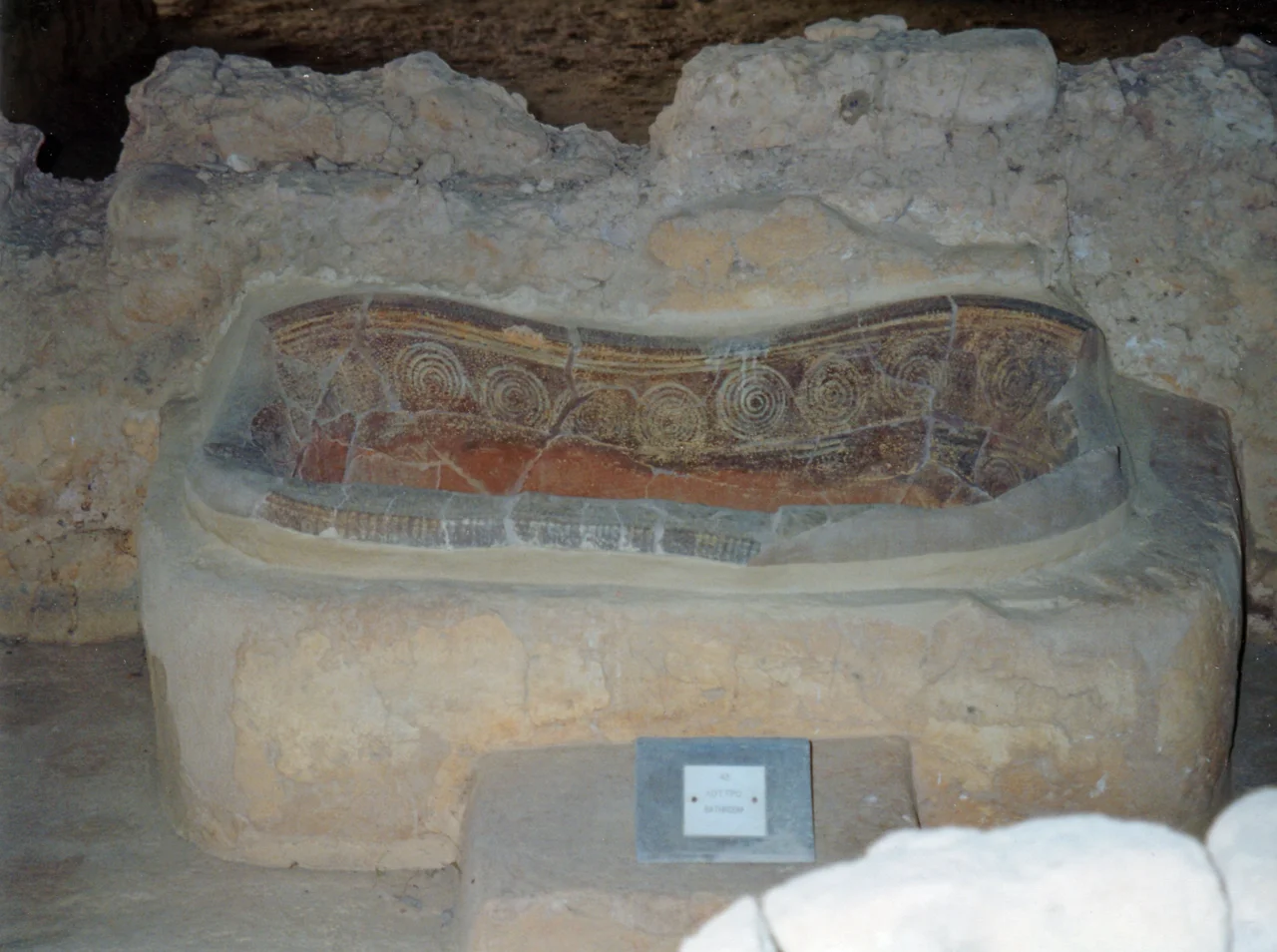
The palace's most famous single object is a painted terracotta bathtub, now displayed in the nearby museum in Chora. It sits in what was clearly a bathing room — Telemachus, in the Odyssey, is given a bath at Nestor's palace, and scholars have long noted the correspondence with this actual tub. The walls of the palace were covered in elaborate frescoes painted in egg tempera, making them among the oldest known examples of this technique anywhere in the world. Surviving fragments show a hunter and a stag, warriors in combat, and processional figures. During the 2009 refurbishment of the site's protective roof — reopened to the public in June 2016 with raised walkways — conservation work continued on the painted surfaces. The frescoes are fragile survivals of a visual culture that was largely extinguished when the palace burned.
The Griffin Warrior
In 2015, University of Cincinnati archaeologists working near the palace made one of the most remarkable finds of recent decades. Not far from the palace itself, they uncovered an undisturbed Bronze Age warrior's burial — a grave that had never been looted. The man, known as the "Griffin Warrior" after the imagery on some of his grave goods, was buried with gold rings, bronze weapons, and a collection of carved gems displaying a striking mixture of Minoan and Mycenaean iconography. The richness and condition of the find were extraordinary. Scholars debated whether the warrior represented an early Mycenaean adopting Minoan cultural symbols, or evidence of direct Minoan cultural transfer to the mainland at a critical early moment. The Griffin Warrior does not appear in any Linear B tablet. He is known only from what he was buried with — which, it turned out, was more than enough.
From the Air
The Palace of Nestor sits at approximately 37.027°N, 21.695°E, on the hill of Epano Englianos near Chora in Messenia. The nearest airport is LGKL (Kalamata International), about 40 km to the northeast. From the air, look for the modern protective roof structure covering the excavated palace complex — it stands out on the hilltop southwest of Chora. Approaching from the south at 2,000–3,000 feet, Navarino Bay and Voidokilia Beach are visible to the southwest, providing excellent orientation. The hill rises clearly from the surrounding olive groves. Clear visibility is typical in summer; morning light from the east illuminates the hilltop well for aerial observation.
Nearby Stories
- 1986 Kalamata Earthquake 2.8 km away
- Peloponnese 20 km away
- Kalamakia Cave Site 21 km away
- Lepreum 22 km away
- Strofades 29 km away
- 2018 Ionian Sea Earthquake 55 km away
- Apidima Cave 67 km away
- Valletta 597 km away