
Palácio do Planalto
When Brazilians say "Planalto," they do not usually mean the plateau. They mean the building, and through the building they mean the presidency itself - the whole executive branch wrapped up in the name of one structure. The Palácio do Planalto in Brasília is the official workplace of the president of Brazil, distinct from the Palácio da Alvorada where the president actually lives. It sits at the Praça dos Três Poderes, the Three Powers Plaza, directly east of the National Congress and across from the Supreme Federal Court. Oscar Niemeyer designed it in 1958 and it was inaugurated on 21 April 1960 - one of the first buildings in a capital city that did not yet exist when construction began.
The Columns
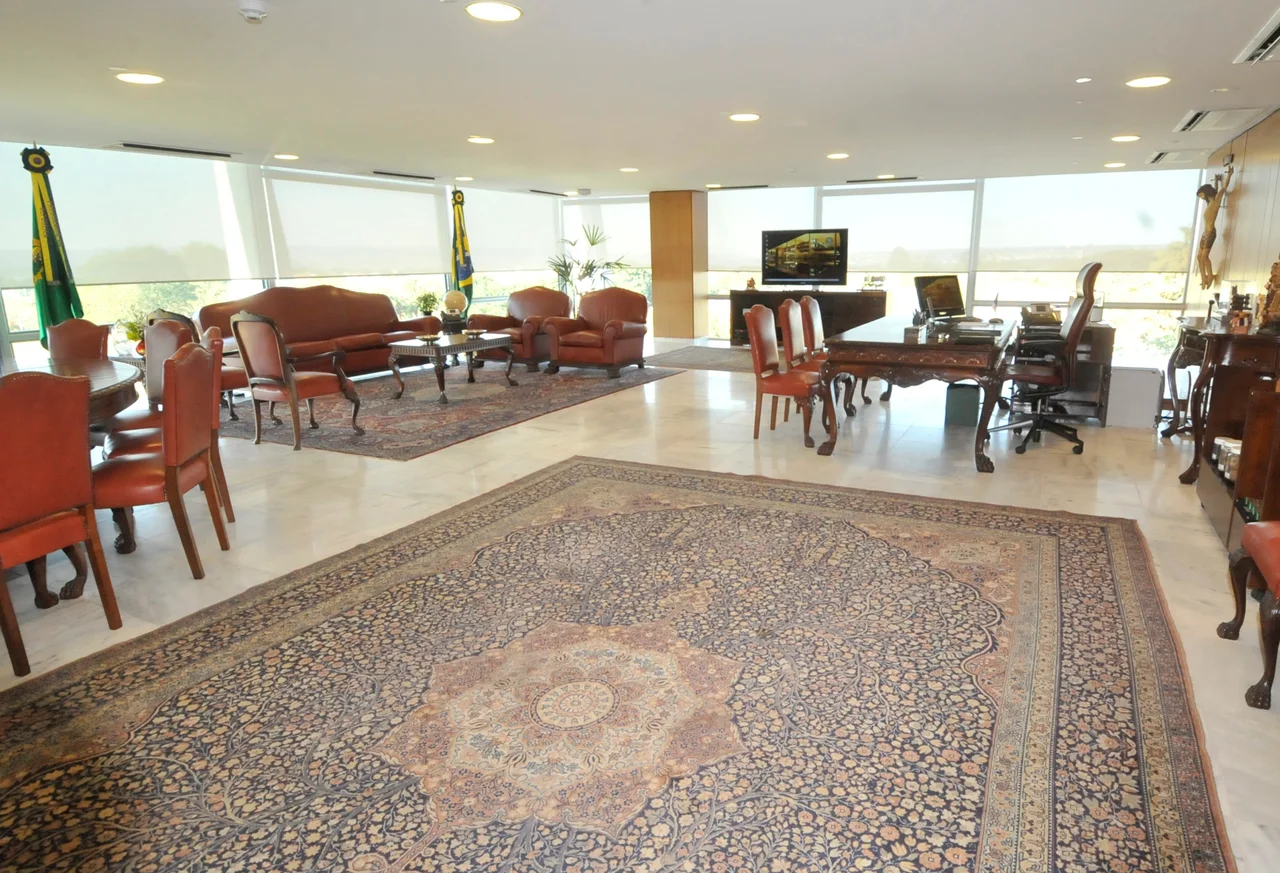
What everyone remembers about the Planalto is the columns. They flare outward at the top and bottom in shapes that look structural but are really sculptural - the actual load-bearing work is done by internal supports. The flaring columns are decorative, rhythmic, a repeating motif that gives the whole building its recognizable silhouette. Niemeyer wanted the building to project simplicity and modernity through fine lines and curved forms. The rest of the architecture is deliberately spare. Glass walls, marble and granite façade, a ramp ascending to the ceremonial entrance for presidential inaugurations and state visits. The ramp is only used on those rare ceremonial occasions. Most of the time the president enters through the north door or arrives by helicopter on the palace roof.
Ten Years Of Work
Construction began on 10 July 1958, led by the firm Construtora Rabello S.A. While the palace was being built, the Executive Office ran out of a small government residence called Catetinho, perched on the outskirts of what was not yet Brasília. When the Planalto was inaugurated on 21 April 1960 by President Juscelino Kubitschek, it was one of a handful of buildings that actually existed in the new capital - alongside the National Congress and the Supreme Federal Court. The ceremony attracted foreign leaders and thousands of spectators who had come to see what Brazil had decided to build in its own center. Decades of use and poor maintenance took a toll on the original structure. A major restoration was completed on 24 August 2010 at a cost of R$111 million, replacing electrical and water systems, dismantling and rebuilding interior spaces, cleaning the exterior marble and granite, and adding an underground parking garage for 500 vehicles.
The Reflecting Pool
In 1991 a reflecting pool was installed in front of the building. It covers 1,635 square meters and holds 1,900 cubic meters of water, 110 centimeters deep. The pool serves two purposes. It doubles the humidity near the palace during the long Brasília dry season - the capital sits on a high plateau where rainfall between May and September is minimal and the air goes punishingly dry. It also adds a security buffer. The water creates distance. It forces anyone approaching the palace to find a specific path, making casual access harder. At night the pool lights the building from below, doubling its image against the sky. The combination of the pool and the flared columns has become one of the most photographed architectural compositions in Latin America.
8 January 2023
On 8 January 2023 the Planalto was attacked. Supporters of former president Jair Bolsonaro, protesting the inauguration of Luiz Inácio Lula da Silva the week before, broke through police barriers alongside thousands marching from the Army Headquarters toward the Three Powers Plaza. They reached the Planalto, the National Congress, and the Supreme Federal Court. Inside the Planalto, historic artworks were damaged - some beyond repair. BBC News reported the scale of the cultural destruction. The assault on the three buildings drew immediate comparisons to the United States Capitol riot two years earlier. More than two thousand people would eventually be arrested for participation in the attacks. The Supreme Federal Court classified the events as acts of terrorism, and a federal intervention was imposed on the Federal District through the end of January.
Guarded By Dragoons
The Planalto is protected by two military units that rotate responsibility every six months. The Presidential Guard Battalion shares duty with the 1st Guard Cavalry Regiment, known as the Independence Dragoons - a unit whose lineage traces back to the founding of independent Brazil in the 1820s. When rotation day comes, a change of guard ceremony marks the transfer, and the Dragoons in their nineteenth-century uniforms and shining helmets become a visible reminder of the connection between the modernist palace and the imperial history that preceded it. The building is part of the Brasília UNESCO World Heritage Site designated in 1987. Guided public tours last twenty minutes. From the Monumental Axis, the Planalto reads as a single horizontal slab lifted above the plateau - a deliberately approachable building for the center of a continental democracy.
From the Air
Coordinates: 15.80 S, 47.86 W. Best viewing altitude: 2,000-3,500 feet AGL for the Three Powers Plaza composition. Nearest airport: Brasília International (SBBR), 8 nautical miles west-northwest. The Planalto, National Congress Palace, and Supreme Federal Court frame the Three Powers Plaza in a triangular arrangement. The Monumental Axis runs westward. Clear dry-season air (May-September) provides exceptional visibility.
Nearby Stories
- Valparaíso de Goiás 7.8 km away
- Formosa, Goias 26 km away
- Pireneus State Park 36 km away
- Planaltina, Goiás 40 km away
- Anápolis 59 km away
- Unaí 73 km away
- Ceres, Goiás 117 km away
- Mambaí 181 km away