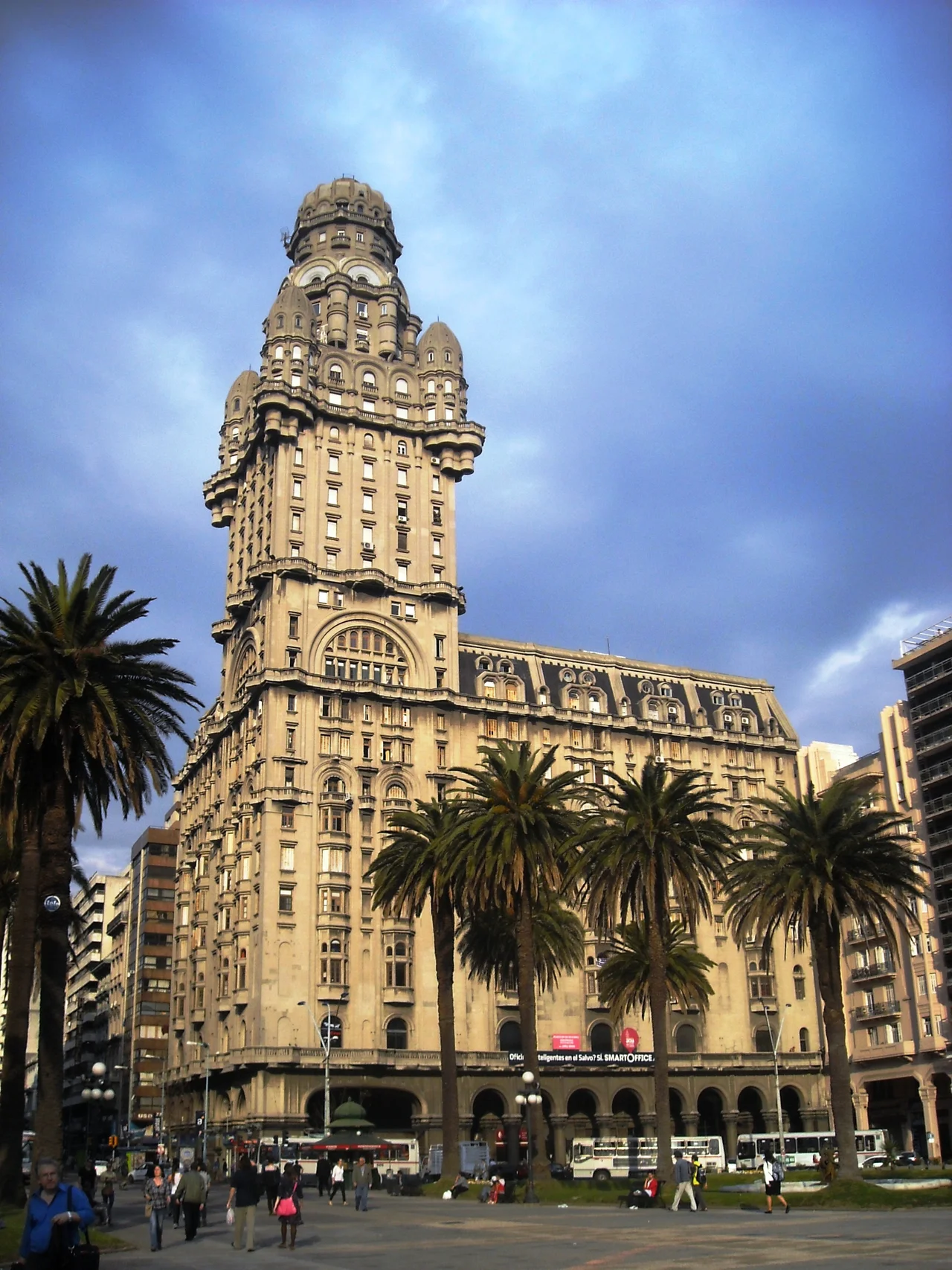

Palacio Salvo
Two brothers wanted to build the tallest tower on the continent, and on a corner of Montevideo's Plaza Independencia, they did. When the Palacio Salvo was finished in 1928 it stood as the tallest building in South America, a title it held until 1935, and at its completion it was the tallest reinforced-concrete structure anywhere on Earth. It is not a beautiful building in any tidy sense. Its silhouette is a collision of Renaissance, Gothic, and Neoclassical impulses, crowned by a tapering tower that looks less designed than dreamed. Montevideo has never quite agreed on what to make of it, and that may be exactly why the city cannot imagine itself without it.
The Corner Where the Tango Began
Before the Salvo brothers bought the plot, a popular pastry shop stood here called La Giralda. It was at this café, in 1917, that a young Uruguayan named Gerardo Matos Rodríguez first heard his composition played as a tango. The piece was La Cumparsita, and Roberto Firpo's orchestra reshaped it on the night of 19 April 1917 into the form the world would come to know. It went on to become perhaps the most famous tango ever written and, by law, a cultural anthem of Uruguay. The café is gone, but the building that replaced it remembers: the Palacio Salvo now houses a Tango Museum devoted to La Cumparsita and the music it helped define. The most danced melody in the world began on this corner.
A Tower Built on Dante
The Salvo was designed by Mario Palanti, an Italian immigrant working out of Buenos Aires, and he built it as a literary monument as much as an office block. Both the Salvo and its near-twin across the river, the Palacio Barolo in Buenos Aires, were inspired by Dante Alighieri's Divine Comedy, their proportions and ascending structure echoing the poem's journey from hell to paradise. Palanti dreamed bigger still. He imagined a beam of light atop each tower, the two beacons meeting in the air over the Río de la Plata to form a bridge of light linking the sister cities. The beams were never able to reach each other. The vision missed by miscalculation, but the romance of it survives in the buildings themselves.
Lives Inside the Landmark
The tower was meant to be a grand hotel. That plan collapsed, and the Salvo became instead a vertical neighborhood of offices and apartments, today some 370 residential units stacked through ten full floors and fourteen tower floors. Its basement once held a theater where Josephine Baker performed, where the Lecuona Cuban Boys played and the Mexican singer Jorge Negrete took the stage; that space is now a parking garage. A passageway through the ground floor connects Plaza Independencia to the street behind, where citizens still pass beneath one of the strangest ceilings in the country. People have lived their whole lives here, raising families inside a landmark that tourists photograph from the plaza below.
The Salvo's Light
The original blueprints called for a lighthouse at the summit, an Italian-made lamp with a parabolic mirror meant to throw its beam roughly 100 kilometers across the estuary. Somewhere along the way it vanished, replaced by a television antenna that was finally taken down in November 2012. For five years the tower stood dark on top. Then, on 28 April 2017, a new LED beacon called the Gran Salvo was lit atop the dome, deliberately reaching back toward the splendor of inauguration day. Restoration has continued: the original passage gates were reinstalled in 2017, and since 2021 crews have worked on the facade and the building's grand stained-glass window. The tower that announced Montevideo to the world is slowly being polished back to its old shine.
From the Air
The Palacio Salvo stands at the eastern end of Avenida 18 de Julio where it meets Plaza Independencia, at 34.91°S, 56.20°W, in central Montevideo just inland from the harbor. Its tapering tower and distinctive crowning dome make it one of the most recognizable structures on the city skyline, visible against the flat estuary plain and the broad brown expanse of the Río de la Plata to the south. Carrasco/General Cesáreo L. Berisso International Airport (ICAO: SUMU) lies roughly 18 km to the east along the coast, with Ángel S. Adami Airport (ICAO: SUAA) handling general aviation to the northwest. Best viewed at lower altitudes in clear weather, when the tower casts a long shadow across the plaza.
Nearby Stories
- Piriápolis 24 km away
- Minas 40 km away
- Tronador (rocket) 67 km away
- Nueva Helvecia 69 km away
- La Plata Museum 122 km away
- Battle of Sarandí 126 km away
- Mundo Marino 145 km away
- South Georgia Island 2584 km away