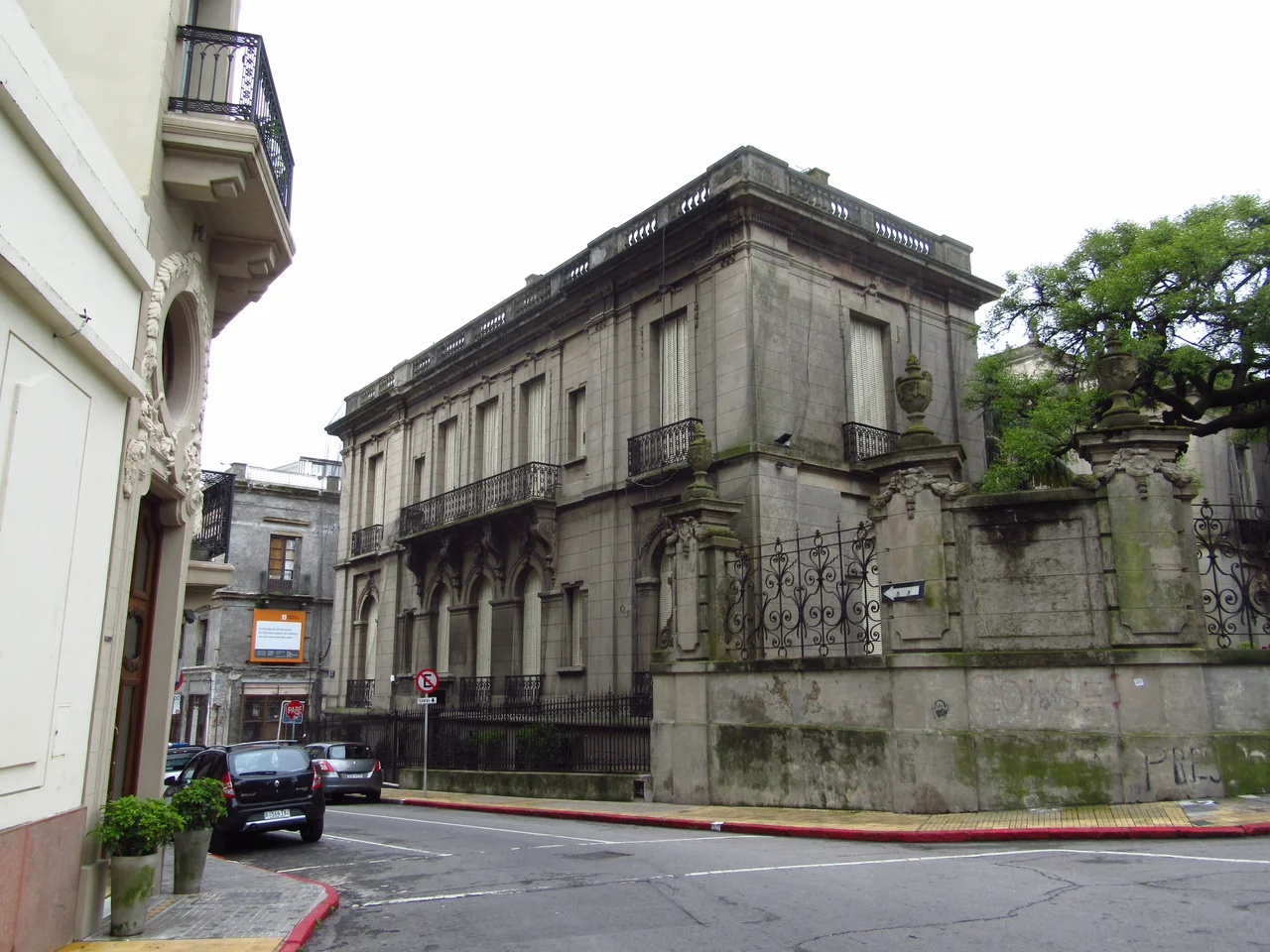

Palacio Taranco
The men who drew the Petit Palais and shaped the colonnades of Paris also designed this corner of Montevideo. Stand on the Plaza Zabala, in the oldest part of the city, and the Palacio Taranco looks as though a slice of the Right Bank drifted across the Atlantic and settled here, all carved stone, mansard roofline, and tall French windows. It is no accident. When the Taranco Ortiz family wanted a home worthy of their fortune, they hired Charles Louis Girault and Jules Chifflot Leon, two French architects with the credentials to match the ambition.
A Theatre Beneath the Palace
Before the palace, there was a stage. The ground where the Taranco now stands held Montevideo's first theatre, built in 1793, when the city was still a walled colonial outpost on the edge of the Spanish empire. By the early twentieth century that old playhouse was gone, and on its footprint rose something entirely different in spirit. The family commissioned the building in 1907, and workers finished it in 1910. The timing mattered: this was Montevideo's confident age, when a small, prosperous nation looked to Paris for its sense of beauty and built accordingly. The result is one of the purest expressions of French academic architecture anywhere in South America.
From Family Home to National Treasure
For decades the palace was a private residence, its rooms filled with European furniture, paintings, and tapestries gathered with a collector's care. That changed in 1943, when the Uruguayan state purchased the house along with much of its furniture and its works of art. The transition from home to institution took time. Not until 1972 did the building open as the Museum of Decorative Arts, and in 1975 it was declared a National Historic Landmark. The slow pace suited the place. A house like this could not simply be emptied and repurposed; it had to be understood, catalogued, and preserved as the layered thing it was.
Rooms Full of Centuries
Walk the ground floor and you move through the eighteenth century. Inlaid furniture in the styles of Louis XV and Louis XVI sits beneath canvases by Spanish masters, among them Jusepe de Ribera, whose dark, dramatic figures hang alongside work by the Flemish painter David Teniers the Younger and the Spanish portraitist Joaquin Sorolla. Sculptures by Mariano Benlliure and others punctuate the rooms. Descend to the basement and the timeline stretches far deeper. There the museum keeps a collection of classical art and archaeology, ceramics, glass, and bronzes drawn from the Greco-Roman world and the ancient Near East. Persian curtains and Flemish tapestries share the building, and even old perfumes and oils survive, the small remnants of a vanished domestic life.
Architects of an Empire's Capital
It is worth pausing on the men who designed this place, because their resumes explain its grandeur. Charles Louis Girault was no provincial draftsman. He won France's prestigious Prix de Rome and went on to design the Petit Palais for the 1900 Paris Exposition, the great world's fair that announced the new century. He also had a hand in monumental works tied to the Arc de Triomphe area of Paris. To bring such a figure, with his collaborator Jules Chifflot Leon, across the ocean to build a private house in Montevideo was a statement in itself. Uruguay at the turn of the century was small but rich, exporting beef and wool to the world, and its elite wanted architecture that announced their place among nations. The Taranco delivered exactly that.
Where the Government Still Gathers
The Taranco is no museum frozen behind velvet rope. The Uruguayan government still uses it as a place to meet, hosting officials and visiting dignitaries beneath its painted ceilings. A photograph from 2010 captures Uruguayan officials in conversation in its salons, the past and the present occupying the same gilded room. That dual life gives the palace a quiet vitality. It is at once a record of a family's taste, a repository of European and ancient art, and a working ceremonial space at the center of national affairs, all within walls that began as a stage for actors more than two centuries ago.
From the Air
Palacio Taranco sits in Montevideo's Ciudad Vieja at roughly 34.907 degrees south, 56.208 degrees west, facing the green rectangle of Plaza Zabala near the waterfront on the Rio de la Plata. From the air, look for the dense colonial grid of the Old City reaching out on its narrow peninsula, with the wide brown estuary to the south and west. The nearest major field is Carrasco International Airport (ICAO: SUMU), about 11 nautical miles east-southeast along the coast; the smaller Angel S. Adami Airport (ICAO: SUAA) lies northwest of the city. Best viewed at lower altitudes in clear conditions, when the palace's pale stone stands out against the surrounding rooftops.
Nearby Stories
- Piriápolis 24 km away
- Minas 40 km away
- Tronador (rocket) 67 km away
- Nueva Helvecia 69 km away
- La Plata Museum 122 km away
- Battle of Sarandí 126 km away
- Mundo Marino 145 km away
- South Georgia Island 2584 km away