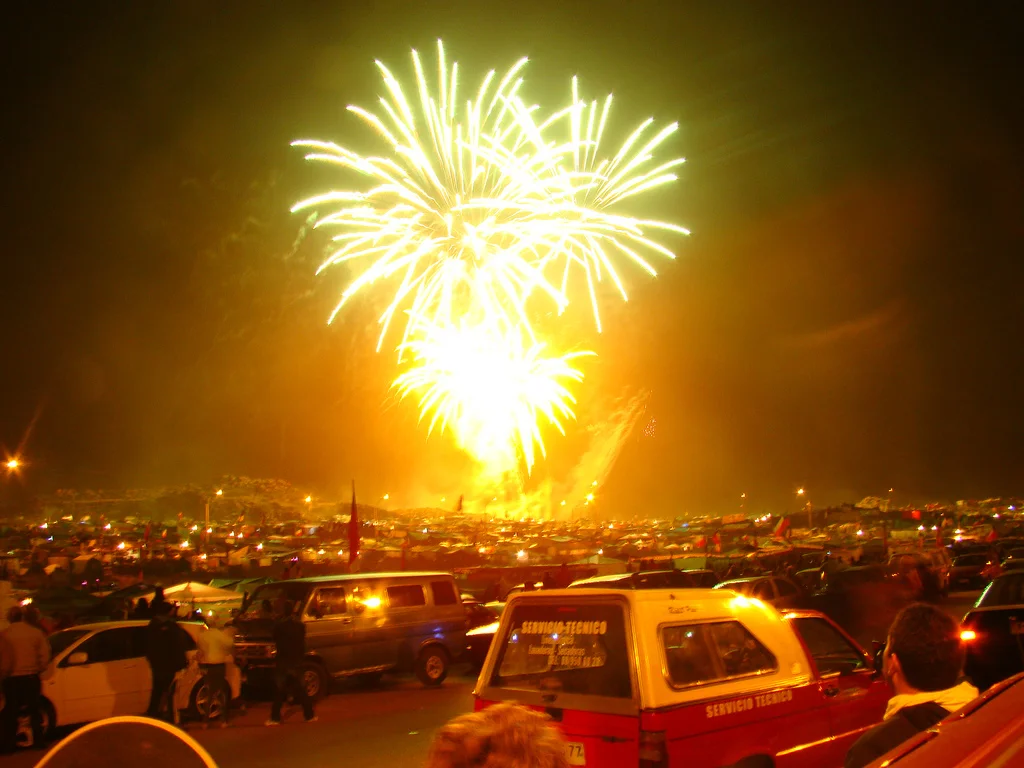

Pampilla Festival
Weeks before the music starts, the hills above Coquimbo begin to fill with tents. Families stake out the same patches of dirt their parents and grandparents claimed, and by mid-September the esplanade called La Pampilla has become a temporary city of canvas, woodsmoke, and anticipation. This is Chile's Fiestas Patrias at its most enormous — the largest gathering of the country's Independence holiday, and a tradition Coquimbo has guarded for two centuries.
Why the Twentieth, Not the Eighteenth
Most of Chile marks Independence on 18 September, the day the First Government Junta formed in 1810. Coquimbo celebrates two days later, and the reason is pure distance. News of the junta's establishment in Santiago had to travel hundreds of kilometers north, and it did not reach this coast until the twentieth. The city never let go of the lag. To this day, 20 September is an official holiday across the Coquimbo Region and the formal closing date of La Pampilla. A piece of slow nineteenth-century communication has been preserved as civic pride.
From Horse Races to a City of Tents
The festival's roots run back to 1823, when the annual celebrations began. By the late nineteenth century, horse races were being run on these grounds each September. The land itself passed through private hands — acquired in 1870 by José del Carmen Vicuña Lavigne, who opened it for public entertainment — until 1968, when the city's Lions Club took it over after their president, Meli Elizondo Diaz, organized a music festival to raise funds. In 1978 the property was handed to the Municipality of Coquimbo, which runs it still. What began as a country fairground had become the people's stage.
Fondas, Fireworks, and a Hundred Thousand Neighbors
During the celebration, fondas and ramadas — open-sided stalls of branches and cloth — sell empanadas, grilled meat, and terremotos, the potent wine cocktail whose name means earthquake. A monumental stage rises in a moat at the western end; for years its predecessor was shaped like a pirate galleon and known simply as El Galeón. National and international acts perform nightly, from folk groups like Los Jaivas and Illapu to reggaeton headliners. At its peak the crowd has exceeded a hundred thousand, and in recent years far more. The fireworks that close the twentieth send everyone home.
When the Music Stopped
Twice the festival has fallen silent. In 1973 it was simply not held; the country was under a state of siege following the 11 September coup that overthrew President Salvador Allende, and celebration was impossible. In 2015 a powerful earthquake struck near Illapel the day before the opening, and the shows and fireworks were called off out of grief and caution. The grounds stayed open anyway, and the city turned the weekend into Pampilla Solidaria — a relief drive for those the quake had left homeless. Even when it could not celebrate, Coquimbo found a way to gather.
From the Air
La Pampilla esplanade lies at 29.959°S, 71.353°W, on the hills above the port of Coquimbo. The nearest airport is La Florida (ICAO: SCSE, IATA: LSC) at La Serena, roughly 10 km north, field elevation near 481 feet. From the air during the September festival the site is unmistakable — a dense field of tents and stage lighting on otherwise bare coastal hills. The rest of the year the grounds host amateur football and a road racing circuit built in 2006. Coastal low cloud can settle over the shoreline in the mornings; afternoons are typically clear and bright.
Nearby Stories
- Carmen de Andacollo 9.5 km away
- Pisco Elqui 24 km away
- Dominga 38 km away
- Pascua Lama 76 km away
- El Leoncito National Park 214 km away
- 1985 Algarrobo Earthquake 336 km away
- Pichilemu 492 km away
- Colca Canyon 1569 km away