
Panduranga (Champa)
On March 22, 1471, a Cham general named Bố Trì Trì fled the burning capital of Vijaya and rode south to Phan Rang. Behind him, the Vietnamese emperor Lê Thánh Tông had just destroyed the heart of the Champa kingdom — tens of thousands killed, the king taken prisoner, artists and intellectuals deported to Hanoi to silence their voices. Seven days after arriving in Panduranga, the general submitted to the emperor. Champa, as a unified kingdom, was over. But Panduranga was not.
The Last Redoubt
Panduranga — called Paṅrauṅ in Old Cham and centered on present-day Phan Rang in south-central Vietnam — had been a semi-autonomous principality within Champa for centuries before 1471. It was the southernmost piece of what had once been a civilization that stretched across much of coastal Vietnam, building Hindu temples, sailing the South China Sea, and trading across Southeast Asia for over a millennium. After the fall of Vijaya, the emperor divided the Cham remnants into smaller polities. Panduranga was one. The Cham people who remained — rather than joining the waves of refugees who fled to Cambodia, Malaya, and the Malay Archipelago — did so in a landscape they had inhabited for generations, under kings who still claimed their own dynastic legitimacy.
A Kingdom That Refused to Disappear
The Cham in Panduranga did not accept subjugation quietly. They stopped paying tribute to the Vietnamese court in 1526 when internal Vietnamese politics gave them an opening. In 1578, they raided the Nguyen lords' territories. In 1594, their king dispatched a fleet of 400 warships to aid the Johor Sultanate against the Portuguese in Melaka — a signal that Panduranga still thought of itself as a maritime power with regional connections and responsibilities. Spanish colonial officials in Manila wrote alarming letters to Philip II describing the Cham king as a dangerous tyrant who needed to be conquered with only a few hundred soldiers. The governor was never given his soldiers. The Cham were still there.
Po Rome and the Blending of Faiths
The most remarkable figure of Panduranga's final century was King Po Rome, who reigned from 1627 to 1651. Educated in Islam during studies on the Malay Peninsula, he returned to lead a people navigating a profound religious transition. Champa had been a Hindu kingdom for centuries, but Islam had been spreading through maritime trading networks since at least the 15th century. Po Rome found a way through the tension: he ordered the Cham Bani — the Muslim community — to integrate their practice more fully with Cham customs, while asking the Hindu Ahier community to accept Allah as supreme while retaining their traditional rituals. It was a deliberate, practical syncretism. Today Po Rome is venerated as a deity by Cham people, and the lunisolar calendar he helped create — blending the ancient Hindu Śaka calendar with the Islamic lunar calendar — is still used in Cham religious life.
Vassalization and the Long Ending
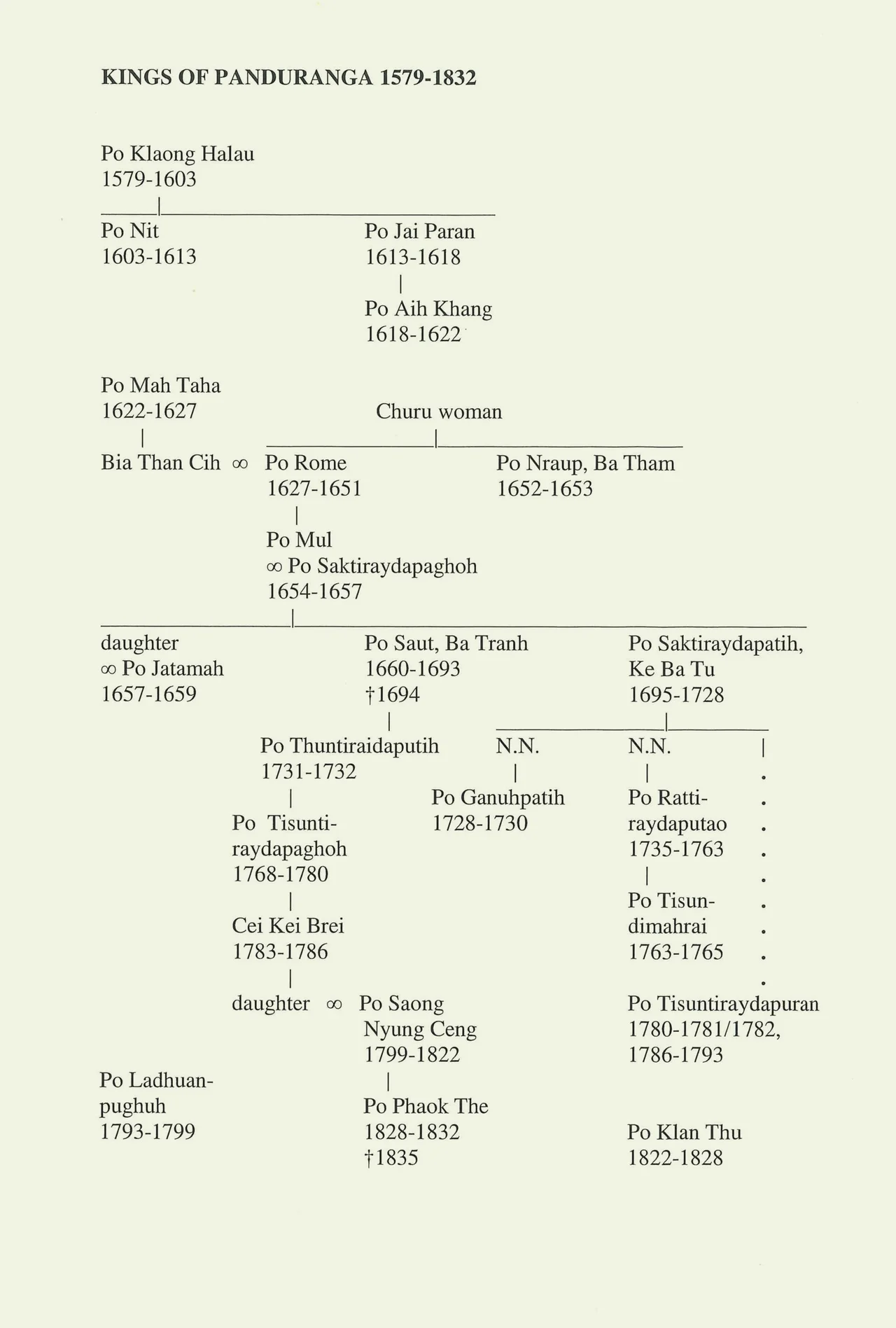
The Nguyen lords invaded Panduranga repeatedly: in 1611, 1629, 1653, and finally, decisively, in 1692. That year, lord Nguyễn Phúc Chu arrested King Po Saut and renamed Panduranga "Trấn Thuận Thành" — the Principality of the Submissive Citadel. The name said everything. Cham revolts in 1693 to 1696 were strong enough to force a negotiated settlement, restoring the Cham monarchy's formal rights, but as a vassal state. From 1695 onward, the Cham kings bore Vietnamese-granted titles and ruled at the pleasure of the Nguyen. The Cham people who had built the towers at Po Klong Garai, who had once commanded fleets that ranged from Manila to Makassar, were now subjects in their own ancestral lands. The principality would endure in diminished form until the early 19th century.
What Remains
Today the Cham people of south-central Vietnam — descendants of those who stayed in Panduranga rather than fleeing — number in the hundreds of thousands. They maintain two distinct religious traditions: the Cham Bani, who practice a syncretic form of Islam shaped by centuries of coexistence with Hindu customs, and the Cham Balamon, who continue forms of Hindu worship unique in Southeast Asia. The towers of Po Klong Garai, built in the 13th century, still stand near Phan Rang, their brick rising from a rocky hill that the Cham called Paṅrauṅ — the same name that became Panduranga, that became Phan Rang. The name survived. The people survived. The question of what they lost, and what they preserved, is still being answered.
From the Air
Panduranga was centered on modern Phan Rang–Tháp Chàm at approximately 11.567°N, 108.983°E in Ninh Thuan Province, south-central Vietnam. The Po Klong Garai Cham towers are visible on a rocky hill northwest of the city — three brick towers standing roughly 20 meters tall, an unmistakable landmark when approaching from the north or west. Recommended viewing altitude is 2,000–4,000 feet. The nearest airport is Cam Ranh International (CXR), approximately 60 km to the north along the coast. The coastal plain here is broad and flat, giving way to mountains to the west, the terrain that defined Panduranga's geographical limits for centuries.
Nearby Stories
- Operation Byrd 1.3 km away
- Principality of Thuận Thành 28 km away
- Phước Bình National Park 33 km away
- Tà Đùng National Park 42 km away
- Battle of Long Khanh 121 km away
- Vũng Rô Bay 122 km away
- Vũng Rô Bay Incident 151 km away
- South-East Asian Theatre of World War II 157 km away